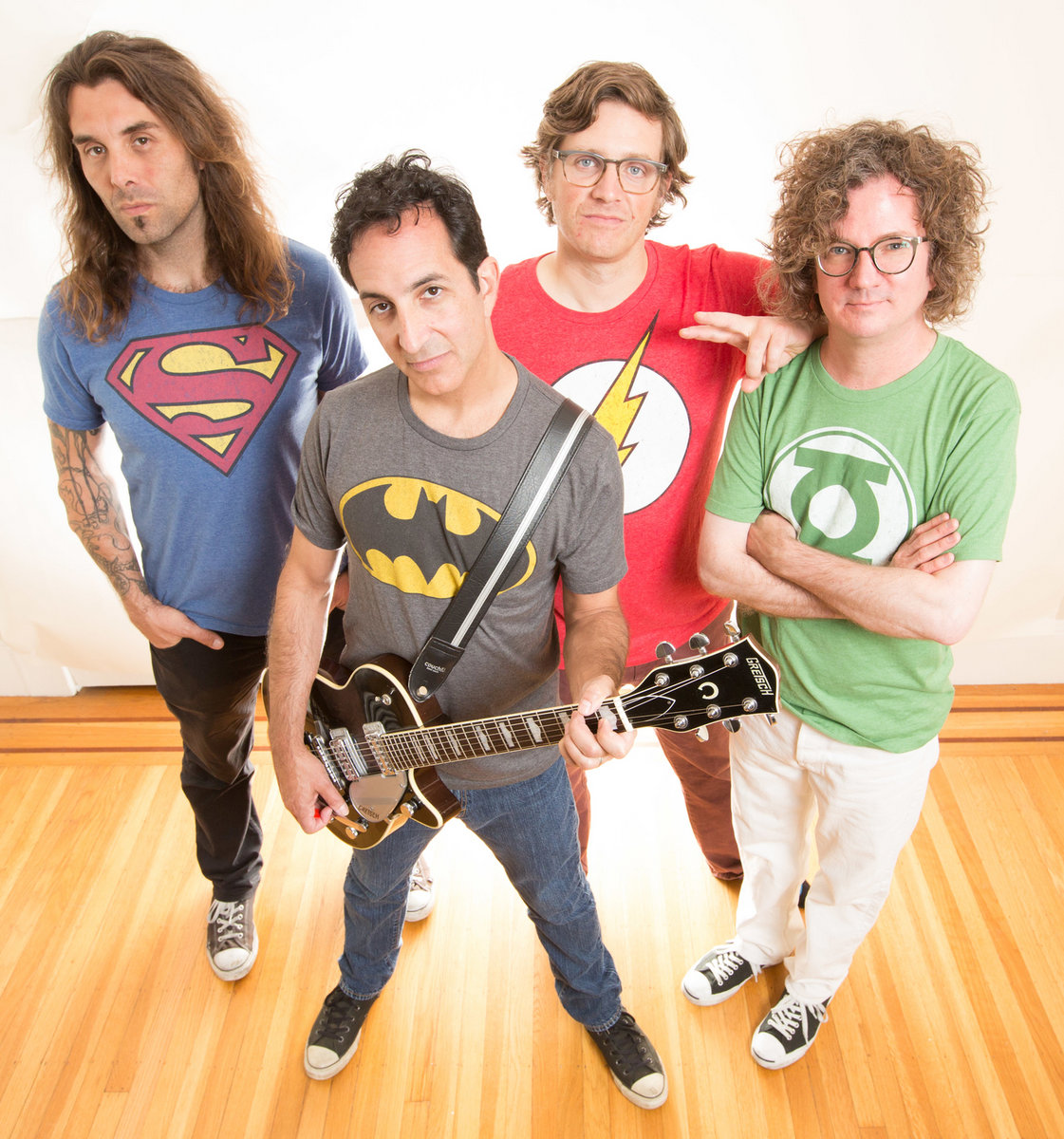
Baseball Bat, a power pop band from Nashville, has recently released two strong, catchy songs, building anticipation for their upcoming EP set to drop in mid-June.
In an interview with Sweet Sweet Music blog, Brian Fuzzell explains that these songs have a long history.
Could you share the journey of bringing this record to life?How did all the pieces come together to create the final product?
The four of us worked together and became friends at a Nashville technology company. One day, Jerry came in with the idea that he wanted to form a band called Baseball Bat. He had the name before he had a band. So, the four of us got together to try to play some Weezer songs, but we never did. Instead, we wrote some of our own songs—the first was our own type of theme song, called “Baseball Bat.” Years later, we finally played one or two of those old Weezer songs.
But it took a lot to make these songs come to life as recordings. Over the last 12 years, we’ve recorded most of them twice in separate sessions, and both times, we ended up trashing the recordings. We also kind of, sort of, passively broke up for about six years. But like Voltron, we re-formed two years ago with the goal to give this another shot and truly make some recordings we’re proud of. Fortunately, Jeremy Ferguson agreed to produce, mix, and engineer the sessions. He really captured the sound and energy we’d always hoped for. Another amazing thing that happened is our old friend and former coworker, Brian Murphree, got involved and mastered the recordings. He’s become an incredible mastering engineer with his business, Soundporter Audio Mastering, so it felt great to keep things in the family to finish the project.
With the resurgence of cassettes, imagine curating your inaugural mixtape. Which five songs would be must-adds and why?
Harry Nilsson “Gotta Get Up,” The Posies “Daily Mutilation,” The Replacements “Bastards of Young,” Weezer “El Scorcho,” Tom Petty “Honey Bee.” We love these songs, and they get to the heart of what the four of us collectively love about rock music.
If tasked with introducing your music through three songs, which ones would you choose and what story do they collectively convey to new listeners?
“Let Down,” “Brain Dead,” and “Baseball Bat” (the song) are probably the best introduction to what this Baseball Bat thing is all about. Those three represent our blend of slacker garage-y quirkiness very well.
Where do you see yourself situated within the broader landscape of the music industry? How do you perceive your unique role and contribution?
We have absolutely no role in the music industry at all. Ha! Baseball Bat is more like an art project, existing only for the purpose of friends having some laughs and creating together. Our unique contribution to listeners is to provide the soundtrack to make memories, make babies, have some laughs, and repeat.
In the digital age, visual elements are intertwined with music. How did you approach the album’s visual aesthetics, such as album art and accompanying visuals? How do they complement the sonic experience you’ve crafted?
We keep it pretty simple. Baseball Bat is a garage band at the end of the day, and we like taking a straight-ahead approach to our music and visuals. We try not to overthink, much like the punk and garage rock we grew up on, but that doesn’t mean we want to be boring. Our “logo” came from duct tape letters, and most of our imagery is playful, simple, and fun.
We are inspired by the ones that blew our minds with simple, relatable, not-trying-too-hard releases from bands like Superchunk, Pavement, Tom Petty, The Toadies, and Green Day. Our EP cover for “It’s A Let Down” is an actual photograph from our bass player’s house in East Nashville when his basement flooded and all his vintage toys went everywhere. The natural chaos of that image felt just right for the cover and namesake.
These songs are 10-12 years old, and no matter how good we record them, it’s still just us behind them—a bunch of middle-aged dudes from Nashville, TN playing with heart. It kind of is a letdown, so we lean into it and hope that not taking ourselves too seriously is the key ingredient to make an unassuming set of songs that just wanted to get out into the world sound just right, despite the world not asking for them.
What’s coming up?
THURSDAY, JUNE 6: Cassette release show at The 5 Spot, Nashville, TN
6-8 pm early happy hour rock show with The Robe (Soccer Mommy & Features drummer Rollum Haas side project). We’ll sell the limited edition cassette exclusively at this release show – only 50 copies pressed on assorted colors!
FRIDAY, JUNE 7: Worldwide digital release
Digital and streaming release to all major outlets, including Bandcamp.
Dave Ambrose and Lawrence Grodeska joined forces to create The Real Numbers, a musical fusion blending power pop and geek rock. Drawing inspiration from bands like Weezer, Fountains of Wayne, and possibly even the Barenaked Ladies of Steve Page, their new album, titled “THANK YOU!“, has been in the works for approximately 8 years. Dave Ambrose recently shared the story behind the album’s creation with the Sweet Sweet Music blog.
You can discover ‘Lucy’s in Love’ featured on the Best Power Pop of 2024 Spotify Playlist.
Could you share the journey of bringing this record to life? How did all the pieces come together to create the final product?
This record has been a very, very long time in the making. We released our previous record called “Wonderful” in 2015 and then early the next year we went back into the studio to begin work on some of the songs which would eventually make their way onto “THANK YOU!”. At that time, our good friend and longtime stalwart engineer Andy Freeman was working out of a studio called Coast Recorders in San Francisco. Since we didn’t have a lot of money to record the entire record all at once, we started tracking one song at a time, taking advantage of late nights and off-hours there whenever we could (as well as some sessions at Hyde Studios, not far away), so the recordings came together gradually over the course of many months.
Then, almost a year after we had started, disaster struck: the hard drives (a Drobo device with a multi-drive RAID array) on which all our tracks were stored, died. We did everything we could to try to retrieve the data, to no avail. There were a few incomplete older backups but almost all of the work was lost. To say this was a massive disappointment would be an understatement. We cried a bit, threw ourselves into playing some more shows and writing some more songs, but it felt like a huge blow.
2017 brought a lot of changes. Our lead singer Lawrence Grodeska got married, our bass player Chuck Lindo told us his wife had received an offer for a job back in their home town of St. Louis (many hundreds of miles away) and that were planning on moving. Our drummer Rob Tucker landed a gig playing with Jason Newsted (formerly of the band Metallica). My wife and I adopted our daughter. The band played a few final shows together and although we all remained friends, it really seemed like the chapter of The Real Numbers might be over for good… but we just couldn’t let the songs go. Before Chuck left for Saint Louis, we booked some last-minute sessions at Hyde Street. Then, in early 2018, Rob and I flew out to Andy’s new place, Studio Punch-Up, in Nashville to record more drums. I took those tracks home and worked with them in my basement when I could, usually late at night after my wife and daughter were asleep. Bit by bit, track by track, we slowly started to rebuild what had been lost. More time passed, Lawrence became a father. My wife and I decided to move to Colorado so we could be closer to family.
Then another (this time much, much larger) disaster struck: there was a global pandemic. As many parents of young kids at the time will tell you, COVID made it pretty difficult to find any time to do anything besides keeping your family safe and alive. Since everyone was pretty much stuck at home, we began to reach out to friends and even some of our musical heroes to ask them to play on the record. Having been a huge and longtime fan of the band Jellyfish, I was elated when the opportunity to have keyboardist Roger Joseph Manning Jr. and bassist Tim Smith contribute to the record (Roger can be heard playing some fantastic Chamberlin, piano, and pump organ parts on the song “Lydia Pinkham”, and Tim laid down some absolutely stellar bass lines on the song “Lucy’s In Love”). Our friend Chris Hatfield of the fantastic band Love Axe arranged some beautiful strings. Kelly Atkins of 20 Minute Loop sang some great background vocals. Michael Klooster of SmashMouth laid down some amazing Hammond organ on a couple tunes, and Stewart Killen of the band Orgone played some killer percussion on Smile.
Gradually, the record came into focus. Lawrence and I flew out to Nashville a few more times for some more tracking and mixing. Finally, in late 2023 the record was complete. Drummer Rob Tucker created the beautiful San Francisco backdrop image for the record and we coordinated to release the record in January, almost eight years after the first recording sessions had been started.
We considered naming the album “Finally!” to acknowledge the seemingly Sisyphean task of completing the record, but in the end we decided that the most important thing we wanted to express was our gratitude – to all the other musicians who contributed tracks, to our friends who stood by us, to our fans who encouraged us, to our families who supported us, and to each other for staying the distance. And so the album was christened “THANK YOU!”
Was there a particular moment or experience that struck you, signaling that you were onto something special with this project?
During one of the last sessions we were at Hyde Street Studios before the hard drive crash was a moment I knew that there was something magic happening. Our bass player Chuck had brought in an old Fender amp – I believe it may have been a Concert model – and we were using it to track the song Lydia Pinkham. We had the amp turned up really LOUD, to the point where it was making this incredible sound like it was just on the edge of exploding. We got through about three quarters of the song and then the amp just shut off. A blown fuse. We found a spare, let the amp cool down and then did another take. Just as we got to the very end, it died again, but this time smoke came out of the back. One of the power tubes had completely fried, but we had the take and the sound was glorious. Andy (our engineer) turned to me and said “people are going to ask you ‘how the hell did you get that sound?’”.
Of course, all those tracks disappeared when the hard drives failed. 🤦🏻♂️
The decision to seek opinions on your new songs is intriguing. When did you realize that external perspectives could contribute to your creative process?
When we decided to bring in some additional musicians to contribute to the record I definitely felt some trepidation – especially when sending the incomplete songs to Tim and Roger from Jellyfish. At that point, the songs had been percolating in my basement studio for a couple years and hadn’t been heard by anyone outside the band. Also, as much as I believed in our vision for the songs, I admit there were times when I’d listen to the songs and be convinced they all sounded terrible – like I’d wasted years of my life on a pile of musical spaghetti. So letting anyone (much less two of my musical heroes) hear these half-baked creations was daunting. Fortunately, both Tim and Roger contributed some incredible parts and they were both very kind and complimentary about the songs. It really gave us all a boost of confidence and definitely encouraged me to stick with it.
Success can take on different meanings as time goes on. When envisioning success for this new record, what does that picture look like now?
While The Real Numbers has always been a passion project, we also always try to push ourselves to not settle for just “good enough”. We have no record company executives to please. Our millions of imaginary fans don’t argue about their favorite tracks on Reddit. I’m OK with all that. I’ve been as proud of the music this band has made as I’ve been of anything I’ve ever done and that is success to me.
Within this collection, do you feel that the best song you’ve ever written finds its home? If not, what distinguishes this record’s essence from your prior work?
Our records are a mix of my songs and Lawrence’s (along with a few we’ve written together and the odd cover song). On “THANK YOU!” it felt like there was a bit more contrast between our two writing styles – mine were a bit more loud and frenetic, Lawrence’s were more poignant and straightforward. That said, I think the album holds together well as a connected piece.
My songs to me are like my children and I love them all. However, I do feel like some of the best songs that I’ve ever written are on this record.
Back in 2001, I was living in Los Angeles and heard a story on the radio (NPR) about the real-life Lydia Pinkham, an early female American entrepreneur who sold regenerative “tonics” for women in the mid-1800’s. Something about her colorful name and her story really struck me. The hook of the chorus “and she owes it all to Lydia Pinkham” came to me quickly but the rest of the song was just fragments which then sat around in the back of my mental song closet for a decade and a half before the song was ready to be completed. The collision of all the elements at the end (which sort of mirrors the song’s subject’s descent into dementia) might sound like disastrous cacophony to most listeners, but for me it’s EXACTLY what I set out to achieve. We must have mixed that part twenty times before I felt it was done.
Lucy In Love is the autobiographical story of my experience moving to San Francisco and meeting my now wife. We moved into a top-floor apartment which we nicknamed the Ecstatic Attic – it was a magical time in my life. The way the chorus kicks in still makes me feel super happy when I listen to it.
I’m not sure if he feels the same, but to me Lawrence’s song “Hello World” is one of his best, as well. It’s very genuine. For those who know Lawrence, the almost wide-eyed wonder he expresses is very much who he is.
Defining a song’s completion can be elusive. How do you determine when a composition has reached its final, ready-to-record form?
A friend’s father who was, himself, a painter and a collegiate professor, once shared this aphorism: He said “It takes two artists to complete a painting. One to put the paint onto the canvas, and the other to tell the first when to STOP”.
I personally love big, lush song arrangements and in the age of digital recording and endless tracks, it’s very easy to get carried away layering instruments and vocal parts on ad-infinitum (especially when one takes EIGHT YEARS to track a record). So when it came time to mix the songs, I knew we would have to do some paring-down and stripping away. We were also incredibly fortunate to be working with Andy Freeman as our engineer and mixer – he was able to wrestle some of my worst tendencies into submission and help us get at only what was really necessary for the song.
The Real Numbers: – Lawrence Grodeska – lead vocals, guitar – Dave Ambrose – guitar, keyboards, backing vocals, arrangements – Chuck Lindo – bass, backing vocals – Robert Tucker – drums
with help from our friends: – Roger Joseph Manning Jr. – keyboards on Lydia Pinkham – Tim Smith – bass on Lucy’s In Love – Kelly Atkins – backing vocals on I Love to Sing – Michael Klooster – keyboards on Spin and Souvenirs – Stewart Killen – conga and tambourine on Smile – Chris Hatfield – string arrangement on Souvenirs


 Sweet Sweet Music Blog