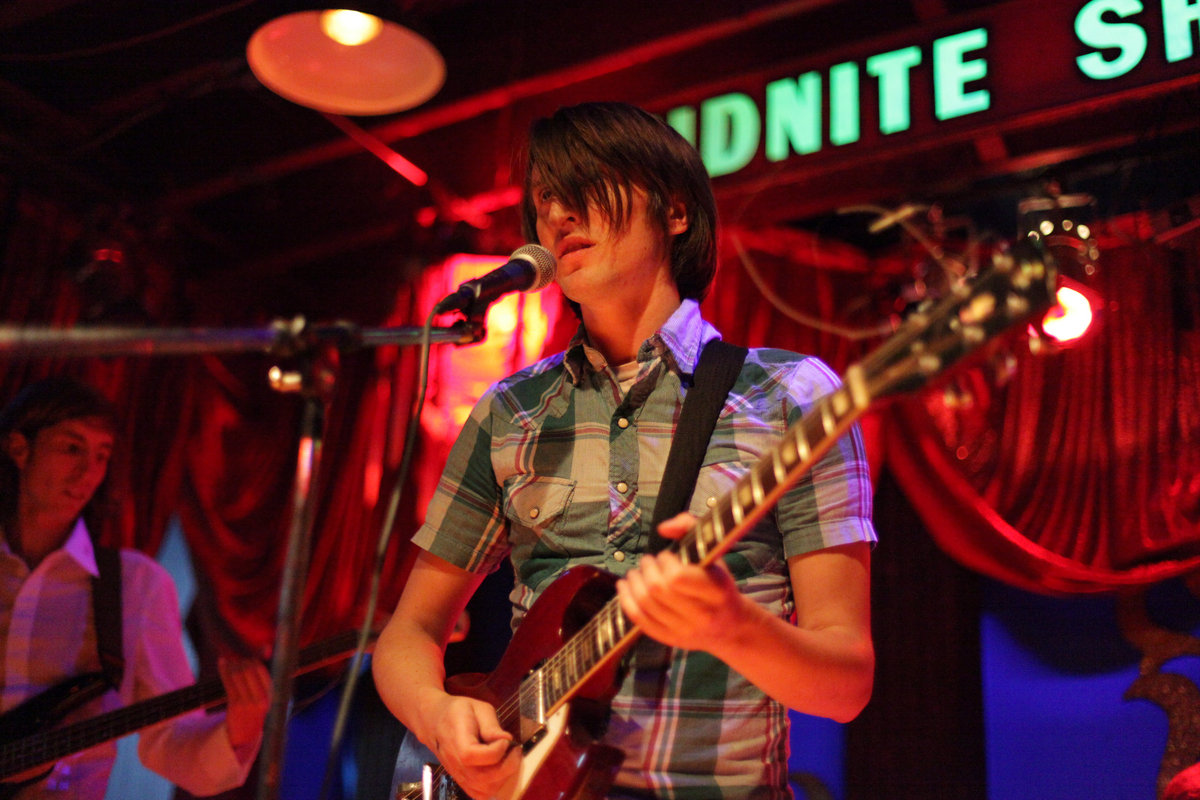
In recent times, a fresh wave of Power Pop artists has surfaced, crafting their unique sonic palette. Their music embodies catchy melodies and gentle choruses that offer familiarity, yet it’s the subtly unsettling and oddly discomforting delivery that infuses a sense of urgency. Mo Troper and Tony Molina paved the way, and, among others, Diners and Goat Yoga follow suit in this vein.
The Creepy Crawlies also align with this movement. Their latest album, ‘Weeds,’ epitomizes disturbing beauty. Chris Donlon’s storytelling style reminds me of both Ray Davies and Scott Miller, inviting listeners to delve into the narratives with intense engagement.
Be sure to catch, ‘Frozen Lake,’ featured on the ‘The Best Power Pop of 2023‘ Spotify playlist.
Could you share the journey of bringing this record to life? How did all the pieces come together to create the final product?
I sheepishly say that it took over ten years to finally bring this record to life. In some ways, I’m just a slow-moving animal. I was always the last person to turn in a timed essay in class. And working on my own at home in the nooks and crannies of my life with no label and no deadline, I had the luxury and curse of unlimited time to take with it.
It’s funny cause I wouldn’t say it’s a particularly complicated album production-wise. I purposely tried to limit my palate to mostly two guitars, bass, drums, and one or two sampled instruments and synthesizers. My original concept was to have one totally unique instrument/sample for each song, like the kids sledding at the start of “Frozen Lake” or the train whistle in “Evil Twin”. I didn’t totally stick to this, but I think the spirit of this idea is embedded in the album. I wanted an almost timeless “rock” sound with a touch of the uncanny.
While working on the album, I got married, and my friend Kate who sang on our last album, “Get Buried!” bought a Wurlitzer to play Daniel Johnston’s “True Love Will Find You in the End” during the ceremony. It turned out it was too much of a burden to transport the Wurlitzer back to their apartment in SF, so I ended up storing it at my place, and I quickly realized its warmth was the missing piece to the album.
Once I added the Wurlitzer to most of the songs, I was able to get serious about finishing. Over the pandemic, I had more time to finesse the mixes, and for the last step, I found my mastering engineer Ryan Schwabe through his work on Mo Troper’s MTV, an album I really love. In fact, it’s been kinda amazing to witness this mini power-pop resurgence happen over the last few years, and hopefully, my power-pop adjacent album can be a small part of that.
Within this collection, do you feel that the best song you’ve ever written finds its home? If not, what distinguishes this record’s essence from your prior work?
I’m not sure if it’s my best, but a song I’m really proud of is “Further from the Fairytale”. I really pushed myself musically to try to make something that felt epic, immersive, and hypnotic that grew from a more straightforward power-pop song. I was listening to a lot of My Bloody Valentine while working on the song, and one night I had a fit of inspiration and wrote and recorded the whole long outro guitar solo in a couple hours. Then over a long time, I kept adding layers and layers, and it was so hard to mix, but I’m happy with how it turned out.
As an artist, the act of baring your emotions to the world is profound. Does this vulnerability come naturally to you, or is it a constant journey of finding comfort?
Like a lot of musicians and songwriters, I find it’s often easier to convey emotions through songs. I love the emotional catharsis of songwriting, and I find living in my own creations is comforting. It’s a strange compulsion to want to share this with the world, and yet here I am, both proud and profoundly embarrassed.
While you can’t dictate how people interpret your music, are there specific elements you wish to highlight that set your songs apart?
While my songwriting is pulled from my life, I feel I often take on the perspective of a character who embodies a more extreme version of something I may be feeling or someone who doesn’t even necessarily see themselves that clearly. I’ve been interested in the idea of the unreliable narrator in song form for the past few albums.
If tasked with introducing your music through three songs, which ones would you choose, and what story do they collectively convey to new listeners?
I think I’d say listen to “Get Buried!” from the album with the same name, as well as “Frozen Lake” and “Weeds” from the album Weeds. “Get Buried!” is the celebration of denial, “Frozen Lake” is the bubble starting to burst, and “Weeds” is the acceptance of all the skeletons and confusions of life.
Among the compliments you’ve received, is there one that remains etched in your memory? If so, what made it particularly unforgettable?
I received a comment on my “Yolk of Love” YouTube page from someone who said that they were listening to the song and thinking about their long-term relationship and trying to decide if they were going to keep living together and that the song was bringing them some melancholic comfort and I was blown away by their vulnerability in sharing that and that the song had struck them enough to make that comment. It strikes me as a perfect example of the alchemy of music to take a situation that can be agonizing and not something I’d wish anyone would have to go through and make a point of connection around it.
In the digital age, visual elements are intertwined with music. How did you approach the album’s visual aesthetics, such as album art and accompanying visuals? How do they complement the sonic experience you’ve crafted?
The cover art was made by my wife, Lou Donlon, who is an incredible artist. When I saw this particular drawing she had made of a figure sitting with a head and torso completely covered in a thicket, I knew almost immediately that I wanted to use it as the art for this collection of songs that I was already planning on calling “Weeds”.
There’s a tension of vulnerability and mystery in the art that I could really relate to, and it seemed just perfect, like this feeling of “oh, this was always meant to be the cover”. It made me really excited to finish and release the album.
Another visual aspect I knew I wanted to try for this album was creating more lyric animations for the songs. Visuals are so important for things like Instagram, TikTok, and YouTube, and I wanted to extend my interest in animation into visuals for my music. There’s a full animated lyric video for “Yolk of Love” that’s a combination of my wife’s artwork and my hand-drawn animations that was satisfying to make.
 Sweet Sweet Music Blog