The Jimmy C: Letting the Song Happen
Fifteen songs, and Jamie Coghill goes just about everywhere with them. On Pretending To Be A Person, The Jimmy C moves from country-tinged pop to seventies rock swagger, quirky sixties psych, garage rock and even flashes of proto-metal, with little concern for stylistic consistency. Somehow, it all hangs together. The constant is Coghill’s instinct for the song itself: whatever clothes it happens to be wearing, the hook comes first.
That restless musical curiosity has been part of The Jimmy C from the beginning. Coghill talks about discovering Nuggets after growing up on grunge, his love of bands that happily jump between genres, and an approach to songwriting that relies more on instinct than intention.
We spoke with Jamie about where those songs come from, the art of sequencing an album in the streaming age, the strange story behind the cover of Pretending To Be A Person, and what happens when you finally let a record go and allow listeners to make it their own.
This album seems to go everywhere musically, and I love that about it. Was that freedom to move between styles something you consciously wanted when you started making the record, or did the songs simply take you in different directions?
It might be the same for all songwriters but I don’t actually understand where my musical ideas come from and I very rarely set out to write in a specific style. I like to say that I try to let a song happen without getting in the way too much! It’s a case of letting the idea just happen organically or by instinct … that sounds pretty artsy-fartsy wanky-douchebaggy but I think part of me doesn’t want to analyse it too closely in case I lose it.
My taste in music probably plays a large part in the varying styles of music I make. I grew up in a country town in the 80s and early 90s and was a full-on grunge kid. Classic cliche 70s rock and grunge were my life and I was incredibly judgemental of all other musical styles. The blinkers came off when I was about 18 and I discovered movie soundtrack music (Goblin, Morricone, John Barry) and most significantly, Rhino’s Nuggets CD box set. Film music was a passion but was far too progressive, jazzy or orchestral for a young drummer to ever imagine playing by himself, but the Nuggets music was incredibly inspiring – 4 CDs of late 60s garage punk and pop! The best song from bands that mostly only ever got to record one single or one album. It was an amazing mix of wild fuzzy garage pop and psych from a hundred different bands but all somehow fit together perfectly in a unified collection. It was an awakening, and a gateway into the amazing music those bands made.
Some of the music was primitive enough that it felt like even I could learn a few guitar chords and write dumb noisy songs like that, but it was also sprinkled with sophisticated proto-power-pop that broadened my thinking of what a song could be. I had been drumming since I was 12 years old and by 2005 I had learned enough guitar from being around guitarists that I was able to start recording primitive garage songs all by myself on my Tascam 4-track recorder. That’s right, the drummer was no longer reliant on the “talent”!
My songwriting has become a little more sophisticated over the 21 years of making music as The Jimmy C but that broad range of styles remains one of my defining characteristics. My favourite bands are ones that jump around the genres too – Ween, Super Furry Animals, Sloan, Jellyfish … it’s great music for people with a short attention span!
There are some pretty extreme contrasts in the tracklist. You can have a hard-rocking song followed by something tiny and introverted, or a full song followed by a 40-second instrumental. Was the sequencing part of the creative process for you? Did you enjoy putting those contrasts next to each other?
Absolutely, yes! I look at albums as an entire piece of art. Concept albums as a genre are usually incredibly pretentious but the idea of unifying a collection of songs as a whole piece is wonderful.
Pretending To Be A Person isn’t a concept album but I always like to approach my albums with a focus on the journey that the songs take the listener on. I like to experiment with how one song flows into the next, sometimes letting it take an emotional breath or exploiting this power to knock the wind out of the listener with a jarring and sudden transition. It’s all part of the fun of making music and I refuse to let it go, even in the age of streaming consumerism where many artists release songs individually with the expectation that they’ll end up in a playlist rather than the running order of an album.
Perhaps it’s naive of me to expect listeners to take in albums as a whole in one sitting or maybe it’s stubbornly retro of me to still care about the track sequence of an album but I’m a total record dork and love albums. All art is storytelling so why shouldn’t the entire album also tell a story?

When you start a new song, how do you decide what kind of song it is going to be? Does the melody tell you, does the lyric suggest a particular sound, or do you sometimes deliberately think, “I want to make a song that sounds like this”?
As I mentioned above, I like to let a song happen without thinking too much about it. My ideas for songs aren’t conscious or deliberate and usually happen when I’m not in a musical headspace at all. It seems to happen while I’m doing something mundane like showering or walking to work. An idea just pops into my head – a little snippet of melody and a few lyrics – on repeat in my head so then I’ll go and hum, sing or strum (if there’s a guitar nearby) the idea into my phone as a voice memo so I don’t forget it and can get on with my day.
These voice memos can sometimes sit around for years without turning into a full song but it’s a good way to catalogue these thoughts and not forget ideas that could turn into a good song one day. I’ve had some song ideas that are so complete I can finish them really fast and have them fully recorded in a few days. Other ideas will lay dormant for years and I’ll listen to it and another section of the song magically pops into my brain and now it’s a song.
I’ve read about Nick Cave and Harry Nilsson going into an office all day and just writing songs. I’d love to try that one day but I just don’t have the time because I’m a 49 year old with kids and a day job. I’ve also read about Andy Partridge from XTC playing around with a new guitar tuning and some kind of synesthesia kicks in and he’s written something completely brilliant like River Of Orchids or Love On A Farmboy’s Wages! But again, that’s only possible with having time to pissfart about in the studio. Normal people don’t have that luxury!
I can only think of one occasion when I’ve written a song after consciously wishing I could write a song like Ever Fallen In Love by The Buzzcocks. I went to bed thinking about it and woke up half an hour later with the idea for I’m No Good For You, which ended up on the first album of my other project Lava Fangs.
Writing music for soundtracks is totally different though. I’ve written and recorded music and songs for 4 movies and 2 web series so far. I’ve done a couple of podcast themes and some video art installations too! I really enjoy doing movie music, it’s challenging and forces me out of my usual routines and comfort zone and gets me writing in genres I normally wouldn’t try. It’s great because there’s a specific reference point like a script or rough cut of a scene and these references help determine the music. With the two soundtracks I’ve done for indie filmmaker Joe Bizarro (Brides Of Satan, shot in California and Curse Of The Baby Eater, shot in Austin TX) he would send me a rough cut of a scene with some placeholder music that they’d never be able to afford the license for and so I would have to write something that captures the essence of someone else’s song without ripping it off or becoming a parody. It’s called Rutling but that’s a very specific reference … look up The Rutles and hear Neil Innes of The Bonzo Dog Doo Dah Band’s incredible Beatles songs that are in many ways better than The Beatles!
The artwork is very specific and has a slightly strange, almost surreal personality of its own. What was the idea behind it, and how closely is the artwork connected to the music?
I suppose the biggest connection is that it all came out of my head! And my head might be a strange and surreal place … My day job is graphic designer for a CD & DVD company in Melbourne, Australia. I’m always thinking about cover design and in my spare time sometimes just put ideas together with no real purpose. Sometimes it might be something I can use for the freelance design I do for local musicians and the Cheersquad Records & Tapes label. I’ve done designs for Aussie legends like Kim Salmon, Dave Graney, Steve Kilbey, The Meanies, Hard-Ons, The Stems … heaps of stuff …
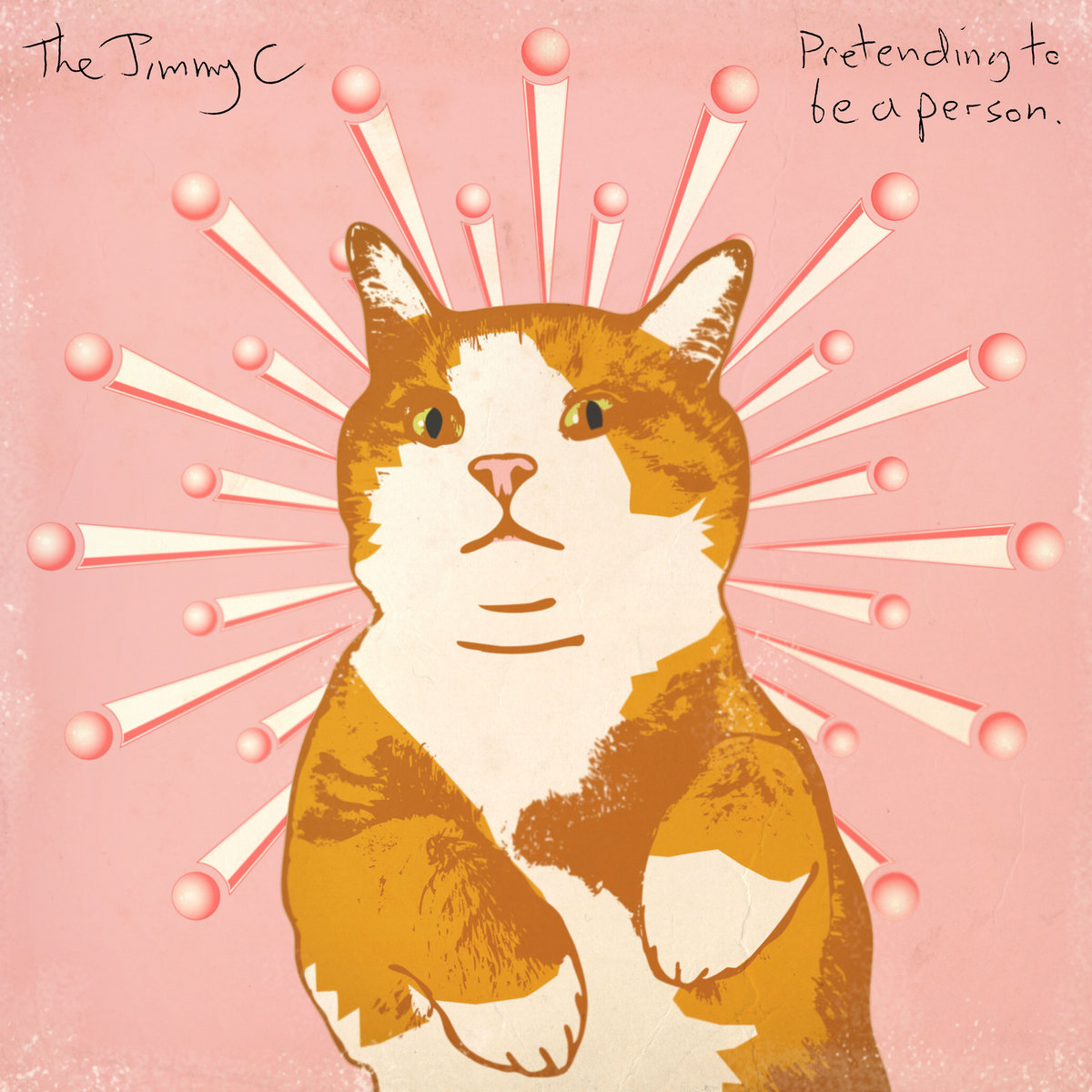
The cover for Pretending To Be A Person started as a simple geometric design inspired by some of the late 50s/early 60s jazz covers on the Command label, things like Persuasive Percussion, Provocative Percussion and Murder Inc., and at the last second I decided to add a vectorised picture of my cat Diego (aka DooDoo) to it! It softened the formal look of the design and I felt like it fit in more with the title Pretending To Be A Person – though the title isn’t about animals pretending to be people, it’s more about neurodiversity (a subject I’ve dealt with a lot recently with friends and family) and how we mask our differences and feelings. We’re all pretending to be a person on the outside while dealing with all sorts of stuff on the inside. That theme comes up a bit in the music on the album and fit nicely with an illustration of my autistic looking cat!
The songs are out now, and they are no longer entirely yours to interpret. They belong to the listeners to discover, make their own connections with and find their own meaning in. What is it like for you to reach that point with a record?
It’s a relief! Up until this point I’ve been stressing about all the tiny flaws in every aspect of the singing, performance and production. That leaves a lot of room for imposter syndrome to creep in and make me wonder why I bother to do it and weather it’s worth it or even good enough to release! I think most artists go through this to some extent but it feels amplified when it’s just one person responsible for everything. It’s so enjoyable doing the recording and mixing, there’s a real endorphin hit from creating a song out of thin air, but once it’s all finished, the business and marketing stuff takes over and you’re not being creative anymore. It feels like you’re bothering people with your music. Inflicting it on them even!
But at this point I’m free off all the anxiety and I can actually distance myself from it and listen to it as though I’m hearing it at face value like everyone else – and it’s actually pretty good and kind people are telling me so!
I really like hearing people’s interpretations of my songs – mostly I really like knowing that somebody’s even listened to my songs!! It’s so cool that music has a built in ambiguity that lets different people interpret the same music in different ways. I do it to my own music too, part of the release process is writing brief descriptions of the songs for distributers and radio, I often have to listen back to the songs to work out what I’m even singing about! Sometimes the story is clear from the start but even then there may be a deeper interpretation I find hiding in the words, either that or I’m retroactively adding a more clever concept to a song! Both are valid!
The most confronting lyrical theme on the album is Pieces Of Me. The literal idea is a song written from the perspective of a terrorist suicide bomber but on top of that these songs are also pieces of me and by releasing them into the world they’re also “raining down for all to see” through global streaming. The literal meaning is probably just a metaphor for anxiety … the older I get the more anxious I get! It could just be all the heavy things going on in the world these last few years (definitely an influence on parts of this album) or maybe just part of growing old. I never used to think twice about playing drums at festivals and big venues packed full of people but now I’m a nervous wreck for a week before a Sunday afternoon gig to 30 people!
But I’m no expert, I’m just lucky to be here and grateful for the opportunity to talk about my music! Music is so special that you can interpret so many layers even in dumb little ditties like mine!
 Sweet Sweet Music Blog