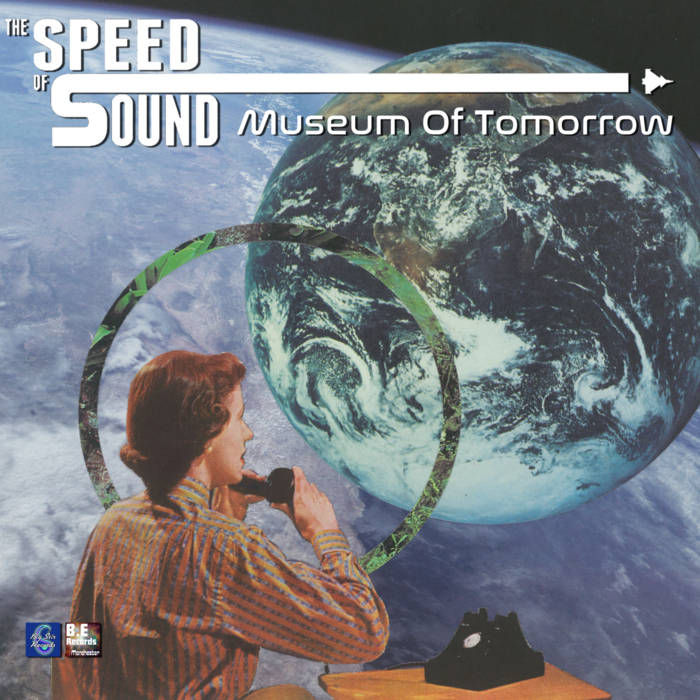
The Speed Of Sound – Museum Of Tomorrow (Q&A)

Something Else writes about The Speed of Sounds’ Museum of Tomorrow: Released by Big Stir Records, this 13-track collection centers on science-fiction concepts, where the past meets the future, the future meets the past, the present is questionable, and the line is blurred between fantasy and reality.

Sweet Sweet Music spoke to John Armstrong about a notebook for storing snatches of phrases, connected songs, an 8/10 review in Vive Le Rock, and misquoting JFK.
What was the moment you knew you were on to something?

There have been several with this album; among the biggest were:

After adding the keyboard linking parts between the tracks, the first listen through to the whole thing as a single piece and hearing the vinyl test pressing.

“Oh yes! That is EXACTLY what it is meant to sound like.” is a very good thought to have.

How did this record come together?

I write in batches; I have a notebook for storing snatches of phrases and titles while the ideas brew subconsciously and are ready to pour out when I get mental space and time. The lyrics are an essential part of The Speed Of Sound songs, so they are always the starting point. The music comes afterward to match the feel of the words. I think most people do it the other way around, but I’ve tried it, and that doesn’t work for me. 

I knew there were many connected songs brewing, and from the very beginning of the batch, I knew this would be a thematically connected album. I also knew it would be released on vinyl, so I was very conscious of the physical time constraints which forced each piece to be tight and compact, purely to get it to fit with so many songs. 

While the songs are taking shape internally, I was also thinking of the album as a whole; its dynamic feel and overall architectural shape, plus how we would link it all together – which in itself tied in the title. So rather than just a set of songs, Museum Of Tomorrow was conceived as a single piece, the only gap being to flip it over onto the other side. I like albums. 

The meaning of success has changed over the years. What would success look like for the new record?

In ‘normal’ recognized measurable terms, Museum Of Tomorrow already is a success; in that, we’ve been largely ignored or misunderstood for over thirty years and Museum Of Tomorrow went straight in with an 8/10 review in Vive Le Rock a full three weeks before release. 

In simpler, broader terms, as with the music itself, I take a longer view on it and still be making new music 32 years from the first release and enjoying doing it is success.

How great is the urge to stay creative?  To keep writing songs and lyrics?

It is big. I don’t think there is such a thing as writers’ block, but there is ‘not being in the right place.’ I find that to write new stuff, you’ve got to have no distractions and uncluttered headspace. When that lines up, they pour out. I know there’s plenty more in there, and the process of getting them out and knocking the right bits off the raw block to get at the shapes hidden in there is fascinating and a lot of pleasure, despite also being pretty damn hard work.

The process itself: experimenting with the sounds and textures of songs is very fulfilling. Most music never gets recorded at all, so the feeling of having piloted through the creative process and ‘landed’ a new album and preparing for release is addictively exciting.
As an artist, you chose to show your emotions to the world. Is it always comfortable to do so?

No. It is not comfortable, but to misquote JFK: “We don’t do these things because they are comfortable.” I find it way more interesting to write something that means something personally than go with Moon/June rhymes about nothing. It is all very serious subject matter and pretty dark thematically, but the music is uplifting and optimistic.

Gloomy, but we’re not a bunch of misery-guts about it. There is a natural playfulness there that hopefully is engaging. Not exactly a sugar coating and not exactly by way of protective body armor. Music should involve emotional experience, so that is what we do if/when other people connect; that is fabulous.

You can pick three co-writers to write new songs with. Who? … and Why?

Anna Calvi, Kate Bush, and Joni Mitchell. All three of them are explorers making their own rules and setting their standards. Each have their own Sound™, and each is very different. The idea of trying new stuff is exciting, and all three of those personal soundscapes are directions I would like to travel.

What’s the gig you will never forget? And why?

We’ve played many gigs, and they were all different and memorable, but probably the most unique was playing in the drawing-room of Victorian novelist Elizabeth Gaskell. It was a tiny intimate gig with so much history in the house and in that particular room. It felt like time travel and playing a gig in 1854. That was the first time we played Charlotte in public – which was only written about a week earlier, a song about fellow novelist Charlotte Bronte suffering an anxiety attack brought on by a doorbell ringing while she was visiting Mrs. Gaskell and hiding behind a curtain until the other guest had gone. It was Ms. Bronte’s 200th Birthday, and both hers and Mrs. Gaskell’s portraits were watching us from the wall next to the curtained window Charlotte had hidden in. It felt like she was there. Cool. But also very spooky.

Lyrics are too often taken for granted.  What is the line of text, or are the lines of text that you hope listeners will remember?  And why?

Yes, most people probably don’t listen to lyrics other than a chorus hook, or,  if they do listen, they probably mishear them anyway, which is a shame because there are an awful lot of good lyrics out there despite the general cultural dumbing-down we’ve had and the vocabulary contraction.

With Museum Of Tomorrow, the first line of ‘Tomorrow’s World’ is etched into the vinyl near the run-off groove: “We were offered Star Trek but they fed us Soylent Green.” It announces the whole album and sums up the way the 21st Century has been ‘a bit disappointing’* (*British Understatement) compared to what we were told we’d have 40-50 years ago.

There is meaning in all of the songs, plenty to dig for and carry away. We have been called a ‘thinking person’s band’ quite a few times. The vinyl issue has a printed 16-page booklet with the album lyrics in it, and that is also a PDF with the download (and the album streaming also includes the lyrics now), so there is more opportunity to hear them as they are. However, as soon as you release a song into the wild, even the people that listen to the lyrics will hear it in the context of their own experience, and it will mean something different to them.

Is recording a record easier than getting it heard nowadays?

It is possible to record an entire album and add an orchestral score all from a computer keyboard in your bedroom. Getting people to listen to it is hard. The internet is a blizzard of information blowing straight in your face, so naturally, people shut their eyes.

Countless people are shouting, “Hey, listen to my band.” It is challenging to be found amongst all that, even if people are actively looking for you. I also have a radio show (Tuning Up on Mad Wasp Radio), and the amount of submissions I get is enormous; it simply isn’t possible to listen to all of it. Time is a limited resource, and if people choose to spend it listening to you, that is an immense gift. Independent music physically IS that metaphorical/metaphysical tree falling when no one is there to hear it.

Cassettes are back. Which 5 five songs would make your first mixtape?

Only five? Whoa. That’s hard. Am I allowed to say listen to all the Tuning  Up shows on Mixcloud? There’s close to nine continuous days (and nights) worth of mixtape on there!

Recording music. What’s all the fun about?

Pushing buttons! AND sliding sliders! Recording is about exploring what you can do with the sound you’ve got and deciding when you have got enough of it. Thinking of new ways of doing things while trying to keep it as spontaneous as possible, planning things out in advance, and watching them all come together. It is sculpting shapes and structures from thin air. It is magical.

Playing music in front of a crowd. What’s all the fun about?

Live performance is where music comes alive. I’m an improviser, and in a live situation, that is pure excitement. The Speed Of Sound has never played the same set twice; there is always something different. We have a back catalog that is far too big to fit into a single gig, and although we are better at playing our own stuff than other people’s music, we do occasionally play a cover live too. Music has to evolve to stay alive. You can’t play something the same way for 30+ years; it has to stay fresh.

You can’t control the way people ‘hear’ your music. But if you could make them aware of certain aspects, you think, set your songs apart. What would they be?

We make pretty forceful crunchy music, but it floats at the same time. To get the most out of ANY music, you have to meet it halfway to start with. Our music is not background music; it is immersive. Dive in with an open mind and let it grab you. Relax into it.

They expect ‘the roaring 20s v2.0’. What kind of party are you looking for?

I like the long game, so it is a slow-burning fuse for me. I want to keep going, doing what the rest of the band and I are doing for as long as possible. Music is my drug of choice. So the so-called ‘glamorous’ matter/anti-matter type annihilation that people see as the Rock’n’Roll-Life-Style isn’t a choice I’d go for. However, for me, wherever there is a guitar, that IS a party.


STEPHEN CHOPEK – DWELLER (Q&A)

Multi-instrumentalist Stephen Chopek introduces his innovative EP, Dweller, a six-track collection of tasty power-pop music. Dweller’s genesis occurred when Chopek came home from touring with Mike Doughty, the former frontman of Soul Coughing.

Sweet Sweet Music spoke to Stephen about an unheard New Wave song from the 80s, the creative muscle and the making of Dweller.

What was the moment you knew you were on to something?

I felt good about the songs as I was recording them in Memphis during 2020, but it wasn’t until mixing earlier this year in Atlanta that the music really came alive. The first song that I started to mix was “Empty Hands”, which set the tone for the rest of the EP. I was experimenting with drum sounds, and after a few calculated guesses, I arrived at a vibe that grabbed me. Specifically, I liked how the synthesizers worked with the rhythm section. It felt like a New Wave song from the 80s that I hadn’t heard before. That groove informed the direction of the other instruments and how the vocals sit in the mix. This was my eureka moment that guided me through the other songs. 

How did this record come together?

Dweller started coming together in 2020, shortly after the pandemic forced everyone to isolate themselves from the outside world. I had just returned home to Memphis after a US tour in February, playing drums with Mike Doughty from Soul Coughing. I quickly realized that I was going to be inside for a while, so I shifted my focus from performing to recording. I had a lot of musical sketches and lyric ideas that were ready to be turned into songs. The fragments with the most promise were picked out and put through the paces. I spent a few weeks on each song, chipping away at them every day. Having the luxury of time on my side, I was able to approach the music with patience. Listening with fresh ears at the beginning of each session gave me the advantage of perspective. I allowed the songs to guide me along the writing process and see where they would take me. 

How great is the urge to stay creative?  To keep writing songs and lyrics?

The creative muscle needs to be exercised every day, so I always have a few projects going on at once. Practice routines are important, but so are designated times for uninhibited exploration. This can be applied to any number of creative endeavors. I’m always trying out new drum beats, guitar riffs, keyboard leads, chord progressions, vocal harmonies, etc., but there are other artistic avenues that I travel on. Photography is a big part of my life, as well as video art. I take lots of pictures and make my own music videos. Even though these are varied disciplines with different languages, they’re all part of the creative process, and they each inform the other’s development.

Lyrics are too often taken for granted.  What is the line of text, or are the lines of text that you hope listeners will remember?  And why?

The chorus of “Start Over” repeats the phrase “hold on, it’s not too late, we can start over”. Within the song’s context, the lyrics tell the story of a couple beginning again when things seem like they’re falling apart. On another level, those words are also about not giving up and starting new every day. Two important ingredients for a fulfilling life are persistence and patience. Balancing those two can be a challenge, but it definitely keeps things interesting. 

Is recording a record easier than getting it heard nowadays?

These days, recording songs is easier than getting them heard. You don’t need a lot of gear to record music, and technological advancements are always making more user-friendly, affordable, and compact tools. You can set up your laptop or phone anywhere and just go for it. Whatever limitations you experience can be used to your advantage by finding interesting ways to work around them. Getting the music heard is another story. There are indeed more outlets than ever to share your songs online, but there are also many things out there competing for people’s attention. You have to really love the whole process and not get discouraged when others don’t think your music is as amazing as you do. Keep going and improving and sharing. Your songs will get better, and people will start to notice. 

Recording music. What’s all the fun about?

My favorite aspect of recording music is making something out of nothing. That’s the part of the creative process that I find endlessly fascinating. You plant a seed and watch it grow. Of course, you need to take the initiative to get started and the motivation to continue, but there’s also a dance that goes on where you alternate taking the lead. Sometimes you guide the song, and sometimes the song guides you. This approach will take you in different directions than you originally planned and lead you to places better than you could have expected at the beginning of your journey. 

James Henry – Pluck (Q&A)

James Henry delivers punchy, guitar-driven songs with sweet melodies, succulent harmonies and sharp lyrics. Think Merseybeat meets Squeeze meets Weezer.

Sweet Sweet Music spoke to James about that “seize the day” mentality, Frank Zappa, dipshit rubbish beats, and the release of his great new record ‘Pluck’.

What was the moment you knew you were on to something?

Regarding my new album, Pluck, there was a gap between the final mixdown and initiating the process of release, where I had not listened to the songs at all. I suddenly had to do so to prepare for mastering, and I came to that listening experience almost as a separate person – someone detached from the writing and recording of these things. It was surprising – I really liked what I heard! I thought, “There should be a few others out there who will like this too.”

I think it’s the best thing I’ve done, by a long way. It’s the sort of music I would buy – I hope that doesn’t come across as arrogant at all. At the very least, it’s a competent album.

When did you decide to start asking for opinions on the new songs?

In late 2020/early 2021, I began to contact blogs and radio stations that I thought may be receptive to this work. I’ve had a pretty good reaction to the album from most of the people who responded. One review in particular from the site “PopRock Record” was incredible.

The guy who runs the enterprise, Dennis Pilon, had taken the trouble to carefully listen to the whole thing and made authentic links with the work of other artists that I was considerably proud of.

Getting comments such as these from people who’ve never heard of you before is a real confidence boost. 

The meaning of success has changed over the years. What would success look like for the new record?

Creating an album independently and having it available as a physical product constitutes success in my book. The online world gives musicians a route to release that just wasn’t generally available to them previously. The problem then arises of getting that release noticed – there is so much noise out there. I’m grateful for any recognition! Added success would be selling a reasonable amount of CDs and gaining fans who are genuinely interested in what I do and willing to support more of it. I’d like to achieve that someday.

How great is the urge to stay creative?  To keep writing songs and lyrics

The urge for me to carry on is strong as I have quite a backlog of material which, if it all turns out to be listenable, I would like to have released. In doing so, it might be good to have the support of a label, but if not, I’ll try and continue to do it myself.

I like writing and recording and have done so for many years. Even if I weren’t looking to put something out, I’d still write. It’s a fun activity. I’m also a huge fan of the guitar and will maintain my desire to thrash about on one until my calloused hands wither and my arthritic fingers crack and crumble.

As an artist, you chose to show your emotions to the world. Is it always comfortable to do so?

I suppose that can appear in certain songs, but I honestly don’t set out to “show my emotions” or bare my soul through songwriting. In terms of lyrics, I do see a freedom to say what’s on your mind. Still, I also enjoy highlighting the unorthodox attitudes and behaviors, which often provide a chance to introduce humor into a musical situation. I like lyrics that raise a laugh or an eyebrow.

You can pick three co-writers to write new songs with. Who? … and Why?

If you twisted my arm, I wouldn’t mind trying to come up with something sat opposite Paul McCartney. He’s a genius, a master of modern pop songwriting, and you’d be a complete fool not to learn from him.

Chrissie Hynde and Ray Davies spring to mind, too – their approaches to writing and performing are unique, and I’d like to witness how that all begins.

If I had a choice of working with an artist who’s passed on, then Frank Zappa or Prince would be my choices. Both were outlandishly talented – and I know Frank wouldn’t have been shy of sharing a forthright opinion.

Lyrics are too often taken for granted.  What is the line of text, or are the lines of text that you hope listeners will remember?  And why?

From my song “Tomorrow May Be Too Late”, the title alone is pretty much to the point. The first lines are “Tomorrow may be too late, so why do you sit and wait? Get out of your chair, start tempting fate – tomorrow may be too late”. I like that “seize the day” mentality if, as a listener, you feel you need to invoke it.

For more “self-help” style wordage, the song “Afterthought” may be appropriate: “Why do you treat me like an afterthought? I can’t compete if I’m your last resort. I won’t be Plan B – I want to rewrite your history, but…… I’m never going to be anybody’s afterthought”. I would say many of us have been in relationships where we’ve been taken for granted, so to speak. If so, this could be your battle cry.

When was the last time you thought, ‘I just wrote a hit!’?

I can’t ever tell! I write ultimately for my own amusement. I’ve heard many songs in the past by famous artists where I’ve thought, “That’s a number one,” only for it to disappear without trace or languish around the lower reaches of a chart while some dipshit rubbish beats everything else and sells millions.

Is recording a record easier than getting it heard nowadays?

Absolutely! The technology to make a convincing record at home is pretty staggering to me, compared to what I used to get out of an Atari ST1040 and a 4-track cassette recorder. Getting it heard in the right place, though, is nigh on impossible, especially with the amount of material that’s out there online. The mainstream media still seems resolutely impenetrable to me, without having a shed load of money to buy your way in. Getting a sync placement or a spot play on a major radio or TV outlet has proven beyond my capabilities over the years…….but you never know, eh? Gotta keep tryin’ ……..

Cassettes are back. Which 5 five songs would make your first mixtape?

OK.

“Saturday Morning” (from the album “Sweetener”), “The Sun Is Cracking The Flags”, “I’d Be All Over That” (both from the album “Overspill”), “Available For Selection” and “So Many Times Before” (both from the new album “Pluck”).

Recording music. What’s all the fun about?

You’re the director of the entire film that is your song. You can have anything happen at any time, in any order, with pretty much any instrument your computer can muster. You can mess with your guitar sounds; you can throw a Moog synth phrase in there; you can say rude words and everything. It’s hard work because there’s a basic level of technical stuff you HAVE to incorporate, which may be boring or impenetrable to many. But…..if the end product is close to what you first heard in your head, there is no bigger thrill than hearing it coming back at you. It keeps you out of mischief – or deeply in it, depending on your point of view.

You can’t control the way people ‘hear’ your music. But if you could make them aware of certain aspects, you think, set your songs apart. What would they be?

Many of my songs have a 60’s musical influence. What I think often sets them apart is the guitar work that’s bludgeoned into a lot of the material, which stops it from sounding too contrived. I like aggressive lead guitar sounds, and in that respect, I’m influenced a great deal by Adrian Belew. He makes noises on a guitar you can’t believe.

They expect ‘the roaring 20s v2.0’. What kind of party are you looking for?

Anywhere that offers tasty small sausages, the freedom to wear a baker boy cap, and plays “A Girl Like You” nice and loud.