Some bands make great records and become stars. Others make equally great records and somehow slip through the cracks. The Rosenbergs belong firmly in the latter category.
For power pop aficionados, albums like Department Store Girl and Mission: You are reminders of just how much wonderful guitar pop emerged around the turn of the millennium without ever finding the audience it deserved. Packed with irresistible melodies, crunchy guitars and hooks that could give the best in the business a run for their money, The Rosenbergs had the songs. What they didn’t have was the breakthrough.
But there’s much more to their story than a couple of criminally overlooked records.
Frontman David Fagin and his band shared stages with Duran Duran, The Strokes, Supergrass and Echo & the Bunnymen, crossed paths with rock royalty, and found themselves at the center of some of the music industry’s biggest upheavals. They challenged Universal, embraced Napster when the record business was declaring war on it, and even managed to get themselves into trouble with the powers that be. And then there’s the story of Fagin landing in jail for stealing supermarket sushi just hours before opening for Duran Duran. You really couldn’t make this stuff up.
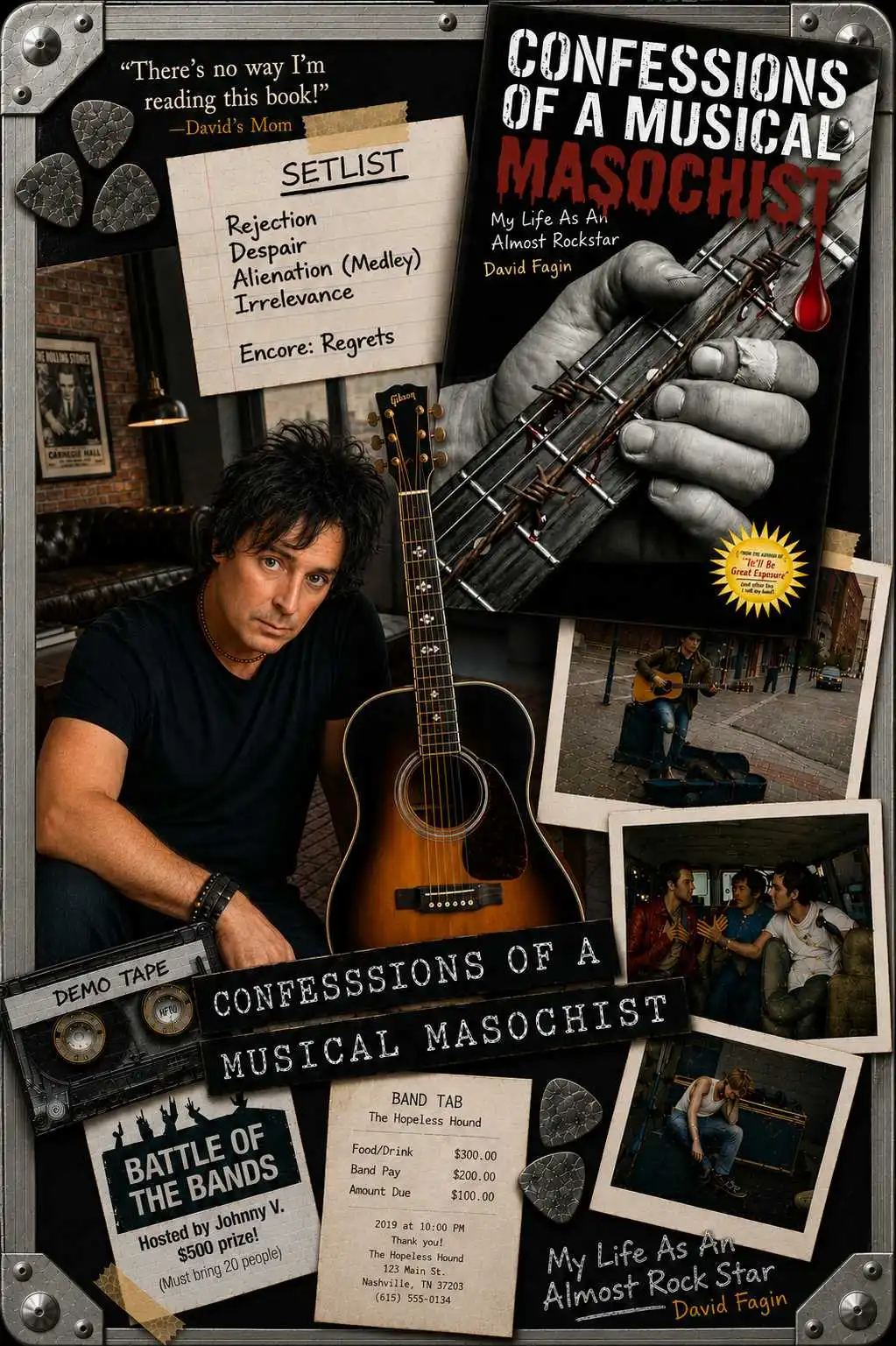
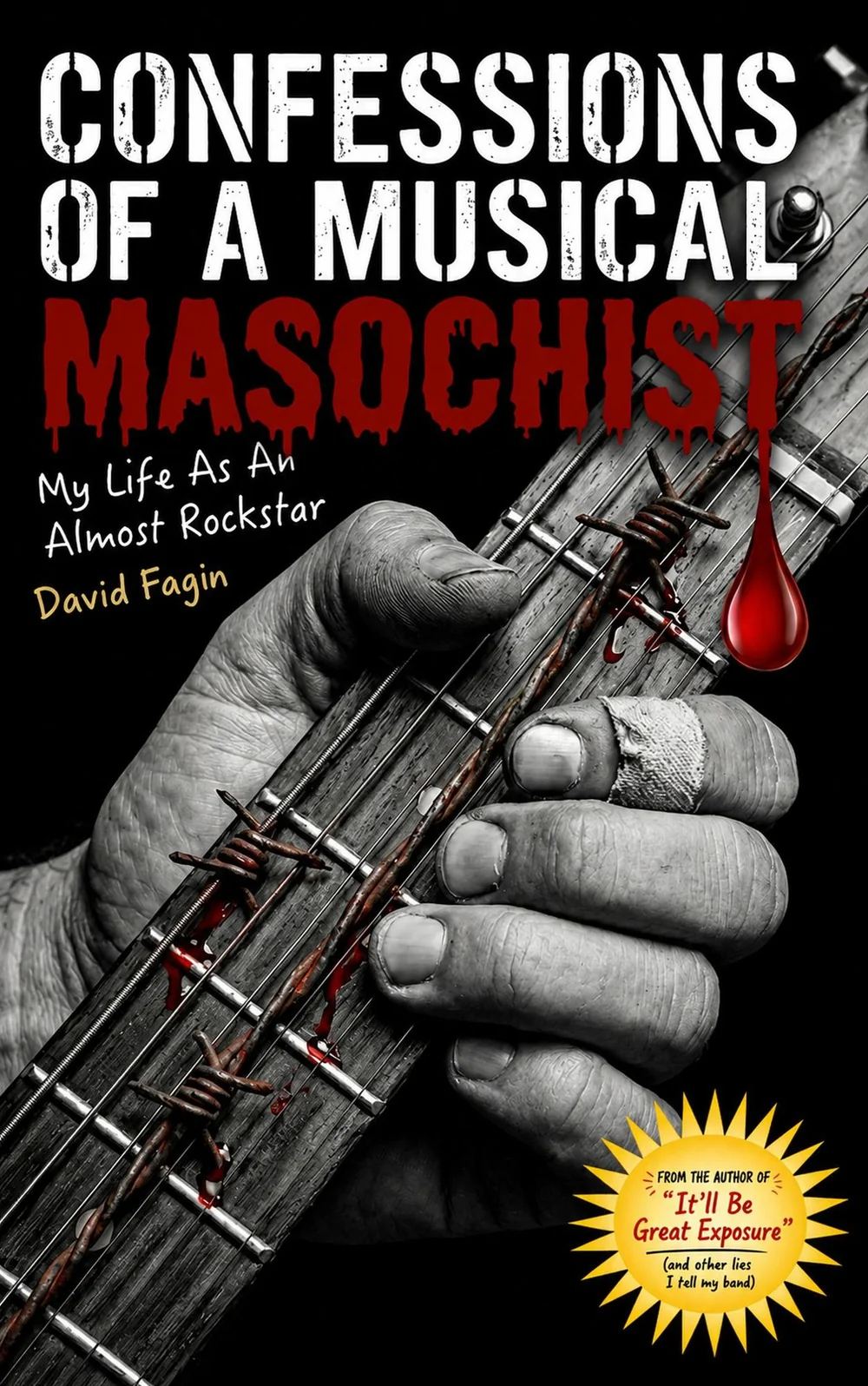
Now Fagin has put it all down on paper in Confessions of a Musical Masochist: My Life As An Almost Rockstar, a memoir that’s as much about the ridiculous business of rock ’n’ roll as it is about the stubborn determination to keep making music when fame and fortune refuse to cooperate.
Nearly four decades into his musical journey, Fagin is still at it. Still playing, still chasing gigs, still believing in the power of a great song. And perhaps that’s the real story here. Not why The Rosenbergs didn’t become huge, but why someone who came so close, so many times, never stopped trying.
I caught up with David to talk about The Rosenbergs, the records that deserved better, taking on the music industry, and what it really means to spend your life as an almost rock star.
Confessions of a Musical Masochist looks back on decades of chasing the elusive dream of rock stardom. When you started The Rosenbergs, what did you imagine success would look like? And looking back now, has your definition of success changed?
One thing that writing the book illustrated for me was that my dream of rock stardom was not that of your typical musician.
Looking back, I realized I never really was interested in performing for 75,000 people at Giants Stadium. Rather, my main goal with The Rosenbergs was simply to get a booking agent who could keep us working and who would do the legwork that I had to do myself 24/7. In that respect, we succeeded.
And today, as we speak, my goal for my Britpop tribute, The Wankers, is pretty much the same: to find an agent who’ll keep us working and take the pressure off of me having to do the heavy lifting 24/7.
Ultimately, my goal has always been the same: to be a working musician. To be able to survive doing what I love instead of being one of the “sheep,” taking the train or the bus every morning, an hour or two each way, to work for a company that views me as a number. The price you pay for this choice is zero stability and security. Easy to say when you’re young. Not so easy when you’re older.
I’m a big fan of The Rosenbergs, and listening to your records, it’s hard not to wonder how songs that strong didn’t take you further commercially. How do you look back on the band’s music today, and is there an album or song you feel deserved a much bigger audience?
Thanks. When we were doing it, the only game in town was commercial radio. There was no YouTube. There was no Spotify. There was no Apple Music. Radio – both terrestrial and satellite – still remains the best way to build an instant nationwide following. I am of the belief that it really doesn’t matter how good your music is. If your band gets on Z100, with 100k watts behind it, you will find an audience – it’s that simple.
Because we were based in New York, we were up against the worst, most unsupportive network of radio stations in the history of the music biz. The last thing they cared about was supporting the local scene. To the point, when The Rosenbergs won K-Rock NY’s Best Unsigned Band contest in ’96, the GM whose idea it was was fired within days of putting us on the radio.
As far as our songs go, I think “Birds of a Feather” could be a hit in any decade. It deserved more attention than it got. It has a very Beatle-esque hook and a pretty poppy vibe. But I’m sure there are a million songs out there that deserve more attention than they got. Off the top of my head, I could name a few dozen.
The Rosenbergs found themselves at the centre of some remarkable moments in music-industry history, from your confrontation with Universal over the Farmclub contract to your partnership with Napster. At the time, did you realise you were challenging the way the industry worked, or were you simply trying to find a better way for your band to reach its audience?
Looking back, we really had no idea we were at the center of the storm that was the “Big Bang,” i.e., the advent of the Internet, dot-coms, MP3s, file sharing, etc.
We were just trying to do what we felt was right. We knew the industry was going to try and continue to own everything the artist, no matter the decade, and we were just trying to say, “Hold on. There’s a better way that could benefit everyone.” Obviously, the powers that be had no interest in that.
In hindsight, I’m pretty proud of what we did. We weren’t Pearl Jam or Smashing Pumpkins or R.E.M., so for a baby band to speak out against the entire industry was considered lunacy. We had everything to lose, which we pretty much did.
Your memoir seems to embrace both the comedy and the pain of being perpetually close to making it. Was it difficult to revisit some of those disappointments and bad decisions while writing the book?
Not at all. It was cathartic. And nostalgic.
Did putting the stories on paper change the way you feel about that period of your life?
Yes. As previously mentioned, it really made me proud of what we did. The little band I started in my bedroom in New Jersey wound up playing a pivotal role at the dawn of the Internet and was at the center of the conversation, re: how labels should treat artists in the new millennium.
Despite all the setbacks, you never really walked away from music. What is it about making and performing music that keeps pulling you back?
I just love it. Everything about it. Except the booking part. That I could do without.
And when you look at The Rosenbergs’ songs today, do you feel they’ve found the audience they were always meant to find, even if it took longer than you imagined?
Not even close. Although my mom likes them.