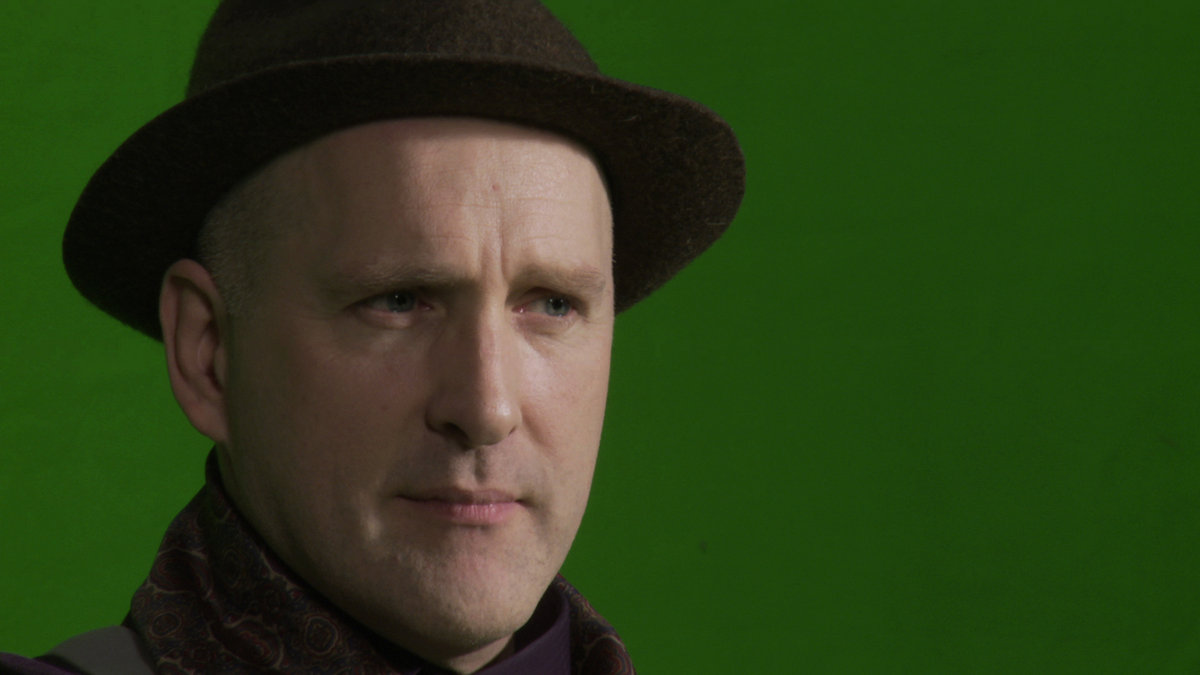
The Speed Of Sound – Museum Of Tomorrow (Q&A)

Something Else writes about The Speed of Sounds’ Museum of Tomorrow: Released by Big Stir Records, this 13-track collection centers on science-fiction concepts, where the past meets the future, the future meets the past, the present is questionable, and the line is blurred between fantasy and reality.

Sweet Sweet Music spoke to John Armstrong about a notebook for storing snatches of phrases, connected songs, an 8/10 review in Vive Le Rock, and misquoting JFK.
What was the moment you knew you were on to something?

There have been several with this album; among the biggest were:

After adding the keyboard linking parts between the tracks, the first listen through to the whole thing as a single piece and hearing the vinyl test pressing.

“Oh yes! That is EXACTLY what it is meant to sound like.” is a very good thought to have.

How did this record come together?

I write in batches; I have a notebook for storing snatches of phrases and titles while the ideas brew subconsciously and are ready to pour out when I get mental space and time. The lyrics are an essential part of The Speed Of Sound songs, so they are always the starting point. The music comes afterward to match the feel of the words. I think most people do it the other way around, but I’ve tried it, and that doesn’t work for me. 

I knew there were many connected songs brewing, and from the very beginning of the batch, I knew this would be a thematically connected album. I also knew it would be released on vinyl, so I was very conscious of the physical time constraints which forced each piece to be tight and compact, purely to get it to fit with so many songs. 

While the songs are taking shape internally, I was also thinking of the album as a whole; its dynamic feel and overall architectural shape, plus how we would link it all together – which in itself tied in the title. So rather than just a set of songs, Museum Of Tomorrow was conceived as a single piece, the only gap being to flip it over onto the other side. I like albums. 

The meaning of success has changed over the years. What would success look like for the new record?

In ‘normal’ recognized measurable terms, Museum Of Tomorrow already is a success; in that, we’ve been largely ignored or misunderstood for over thirty years and Museum Of Tomorrow went straight in with an 8/10 review in Vive Le Rock a full three weeks before release. 

In simpler, broader terms, as with the music itself, I take a longer view on it and still be making new music 32 years from the first release and enjoying doing it is success.

How great is the urge to stay creative?  To keep writing songs and lyrics?

It is big. I don’t think there is such a thing as writers’ block, but there is ‘not being in the right place.’ I find that to write new stuff, you’ve got to have no distractions and uncluttered headspace. When that lines up, they pour out. I know there’s plenty more in there, and the process of getting them out and knocking the right bits off the raw block to get at the shapes hidden in there is fascinating and a lot of pleasure, despite also being pretty damn hard work.

The process itself: experimenting with the sounds and textures of songs is very fulfilling. Most music never gets recorded at all, so the feeling of having piloted through the creative process and ‘landed’ a new album and preparing for release is addictively exciting.
As an artist, you chose to show your emotions to the world. Is it always comfortable to do so?

No. It is not comfortable, but to misquote JFK: “We don’t do these things because they are comfortable.” I find it way more interesting to write something that means something personally than go with Moon/June rhymes about nothing. It is all very serious subject matter and pretty dark thematically, but the music is uplifting and optimistic.

Gloomy, but we’re not a bunch of misery-guts about it. There is a natural playfulness there that hopefully is engaging. Not exactly a sugar coating and not exactly by way of protective body armor. Music should involve emotional experience, so that is what we do if/when other people connect; that is fabulous.

You can pick three co-writers to write new songs with. Who? … and Why?

Anna Calvi, Kate Bush, and Joni Mitchell. All three of them are explorers making their own rules and setting their standards. Each have their own Sound™, and each is very different. The idea of trying new stuff is exciting, and all three of those personal soundscapes are directions I would like to travel.

What’s the gig you will never forget? And why?

We’ve played many gigs, and they were all different and memorable, but probably the most unique was playing in the drawing-room of Victorian novelist Elizabeth Gaskell. It was a tiny intimate gig with so much history in the house and in that particular room. It felt like time travel and playing a gig in 1854. That was the first time we played Charlotte in public – which was only written about a week earlier, a song about fellow novelist Charlotte Bronte suffering an anxiety attack brought on by a doorbell ringing while she was visiting Mrs. Gaskell and hiding behind a curtain until the other guest had gone. It was Ms. Bronte’s 200th Birthday, and both hers and Mrs. Gaskell’s portraits were watching us from the wall next to the curtained window Charlotte had hidden in. It felt like she was there. Cool. But also very spooky.

Lyrics are too often taken for granted.  What is the line of text, or are the lines of text that you hope listeners will remember?  And why?

Yes, most people probably don’t listen to lyrics other than a chorus hook, or,  if they do listen, they probably mishear them anyway, which is a shame because there are an awful lot of good lyrics out there despite the general cultural dumbing-down we’ve had and the vocabulary contraction.

With Museum Of Tomorrow, the first line of ‘Tomorrow’s World’ is etched into the vinyl near the run-off groove: “We were offered Star Trek but they fed us Soylent Green.” It announces the whole album and sums up the way the 21st Century has been ‘a bit disappointing’* (*British Understatement) compared to what we were told we’d have 40-50 years ago.

There is meaning in all of the songs, plenty to dig for and carry away. We have been called a ‘thinking person’s band’ quite a few times. The vinyl issue has a printed 16-page booklet with the album lyrics in it, and that is also a PDF with the download (and the album streaming also includes the lyrics now), so there is more opportunity to hear them as they are. However, as soon as you release a song into the wild, even the people that listen to the lyrics will hear it in the context of their own experience, and it will mean something different to them.

Is recording a record easier than getting it heard nowadays?

It is possible to record an entire album and add an orchestral score all from a computer keyboard in your bedroom. Getting people to listen to it is hard. The internet is a blizzard of information blowing straight in your face, so naturally, people shut their eyes.

Countless people are shouting, “Hey, listen to my band.” It is challenging to be found amongst all that, even if people are actively looking for you. I also have a radio show (Tuning Up on Mad Wasp Radio), and the amount of submissions I get is enormous; it simply isn’t possible to listen to all of it. Time is a limited resource, and if people choose to spend it listening to you, that is an immense gift. Independent music physically IS that metaphorical/metaphysical tree falling when no one is there to hear it.

Cassettes are back. Which 5 five songs would make your first mixtape?

Only five? Whoa. That’s hard. Am I allowed to say listen to all the Tuning  Up shows on Mixcloud? There’s close to nine continuous days (and nights) worth of mixtape on there!

Recording music. What’s all the fun about?

Pushing buttons! AND sliding sliders! Recording is about exploring what you can do with the sound you’ve got and deciding when you have got enough of it. Thinking of new ways of doing things while trying to keep it as spontaneous as possible, planning things out in advance, and watching them all come together. It is sculpting shapes and structures from thin air. It is magical.

Playing music in front of a crowd. What’s all the fun about?

Live performance is where music comes alive. I’m an improviser, and in a live situation, that is pure excitement. The Speed Of Sound has never played the same set twice; there is always something different. We have a back catalog that is far too big to fit into a single gig, and although we are better at playing our own stuff than other people’s music, we do occasionally play a cover live too. Music has to evolve to stay alive. You can’t play something the same way for 30+ years; it has to stay fresh.

You can’t control the way people ‘hear’ your music. But if you could make them aware of certain aspects, you think, set your songs apart. What would they be?

We make pretty forceful crunchy music, but it floats at the same time. To get the most out of ANY music, you have to meet it halfway to start with. Our music is not background music; it is immersive. Dive in with an open mind and let it grab you. Relax into it.

They expect ‘the roaring 20s v2.0’. What kind of party are you looking for?

I like the long game, so it is a slow-burning fuse for me. I want to keep going, doing what the rest of the band and I are doing for as long as possible. Music is my drug of choice. So the so-called ‘glamorous’ matter/anti-matter type annihilation that people see as the Rock’n’Roll-Life-Style isn’t a choice I’d go for. However, for me, wherever there is a guitar, that IS a party.

STEPHEN CHOPEK – DWELLER (Q&A)

Multi-instrumentalist Stephen Chopek introduces his innovative EP, Dweller, a six-track collection of tasty power-pop music. Dweller’s genesis occurred when Chopek came home from touring with Mike Doughty, the former frontman of Soul Coughing.

Sweet Sweet Music spoke to Stephen about an unheard New Wave song from the 80s, the creative muscle and the making of Dweller.

What was the moment you knew you were on to something?

I felt good about the songs as I was recording them in Memphis during 2020, but it wasn’t until mixing earlier this year in Atlanta that the music really came alive. The first song that I started to mix was “Empty Hands”, which set the tone for the rest of the EP. I was experimenting with drum sounds, and after a few calculated guesses, I arrived at a vibe that grabbed me. Specifically, I liked how the synthesizers worked with the rhythm section. It felt like a New Wave song from the 80s that I hadn’t heard before. That groove informed the direction of the other instruments and how the vocals sit in the mix. This was my eureka moment that guided me through the other songs. 

How did this record come together?

Dweller started coming together in 2020, shortly after the pandemic forced everyone to isolate themselves from the outside world. I had just returned home to Memphis after a US tour in February, playing drums with Mike Doughty from Soul Coughing. I quickly realized that I was going to be inside for a while, so I shifted my focus from performing to recording. I had a lot of musical sketches and lyric ideas that were ready to be turned into songs. The fragments with the most promise were picked out and put through the paces. I spent a few weeks on each song, chipping away at them every day. Having the luxury of time on my side, I was able to approach the music with patience. Listening with fresh ears at the beginning of each session gave me the advantage of perspective. I allowed the songs to guide me along the writing process and see where they would take me. 

How great is the urge to stay creative?  To keep writing songs and lyrics?

The creative muscle needs to be exercised every day, so I always have a few projects going on at once. Practice routines are important, but so are designated times for uninhibited exploration. This can be applied to any number of creative endeavors. I’m always trying out new drum beats, guitar riffs, keyboard leads, chord progressions, vocal harmonies, etc., but there are other artistic avenues that I travel on. Photography is a big part of my life, as well as video art. I take lots of pictures and make my own music videos. Even though these are varied disciplines with different languages, they’re all part of the creative process, and they each inform the other’s development.

Lyrics are too often taken for granted.  What is the line of text, or are the lines of text that you hope listeners will remember?  And why?

The chorus of “Start Over” repeats the phrase “hold on, it’s not too late, we can start over”. Within the song’s context, the lyrics tell the story of a couple beginning again when things seem like they’re falling apart. On another level, those words are also about not giving up and starting new every day. Two important ingredients for a fulfilling life are persistence and patience. Balancing those two can be a challenge, but it definitely keeps things interesting. 

Is recording a record easier than getting it heard nowadays?

These days, recording songs is easier than getting them heard. You don’t need a lot of gear to record music, and technological advancements are always making more user-friendly, affordable, and compact tools. You can set up your laptop or phone anywhere and just go for it. Whatever limitations you experience can be used to your advantage by finding interesting ways to work around them. Getting the music heard is another story. There are indeed more outlets than ever to share your songs online, but there are also many things out there competing for people’s attention. You have to really love the whole process and not get discouraged when others don’t think your music is as amazing as you do. Keep going and improving and sharing. Your songs will get better, and people will start to notice. 

Recording music. What’s all the fun about?

My favorite aspect of recording music is making something out of nothing. That’s the part of the creative process that I find endlessly fascinating. You plant a seed and watch it grow. Of course, you need to take the initiative to get started and the motivation to continue, but there’s also a dance that goes on where you alternate taking the lead. Sometimes you guide the song, and sometimes the song guides you. This approach will take you in different directions than you originally planned and lead you to places better than you could have expected at the beginning of your journey. 

James Henry – Pluck (Q&A)

James Henry delivers punchy, guitar-driven songs with sweet melodies, succulent harmonies and sharp lyrics. Think Merseybeat meets Squeeze meets Weezer.

Sweet Sweet Music spoke to James about that “seize the day” mentality, Frank Zappa, dipshit rubbish beats, and the release of his great new record ‘Pluck’.

What was the moment you knew you were on to something?

Regarding my new album, Pluck, there was a gap between the final mixdown and initiating the process of release, where I had not listened to the songs at all. I suddenly had to do so to prepare for mastering, and I came to that listening experience almost as a separate person – someone detached from the writing and recording of these things. It was surprising – I really liked what I heard! I thought, “There should be a few others out there who will like this too.”

I think it’s the best thing I’ve done, by a long way. It’s the sort of music I would buy – I hope that doesn’t come across as arrogant at all. At the very least, it’s a competent album.

When did you decide to start asking for opinions on the new songs?

In late 2020/early 2021, I began to contact blogs and radio stations that I thought may be receptive to this work. I’ve had a pretty good reaction to the album from most of the people who responded. One review in particular from the site “PopRock Record” was incredible.

The guy who runs the enterprise, Dennis Pilon, had taken the trouble to carefully listen to the whole thing and made authentic links with the work of other artists that I was considerably proud of.

Getting comments such as these from people who’ve never heard of you before is a real confidence boost. 

The meaning of success has changed over the years. What would success look like for the new record?

Creating an album independently and having it available as a physical product constitutes success in my book. The online world gives musicians a route to release that just wasn’t generally available to them previously. The problem then arises of getting that release noticed – there is so much noise out there. I’m grateful for any recognition! Added success would be selling a reasonable amount of CDs and gaining fans who are genuinely interested in what I do and willing to support more of it. I’d like to achieve that someday.

How great is the urge to stay creative?  To keep writing songs and lyrics

The urge for me to carry on is strong as I have quite a backlog of material which, if it all turns out to be listenable, I would like to have released. In doing so, it might be good to have the support of a label, but if not, I’ll try and continue to do it myself.

I like writing and recording and have done so for many years. Even if I weren’t looking to put something out, I’d still write. It’s a fun activity. I’m also a huge fan of the guitar and will maintain my desire to thrash about on one until my calloused hands wither and my arthritic fingers crack and crumble.

As an artist, you chose to show your emotions to the world. Is it always comfortable to do so?

I suppose that can appear in certain songs, but I honestly don’t set out to “show my emotions” or bare my soul through songwriting. In terms of lyrics, I do see a freedom to say what’s on your mind. Still, I also enjoy highlighting the unorthodox attitudes and behaviors, which often provide a chance to introduce humor into a musical situation. I like lyrics that raise a laugh or an eyebrow.

You can pick three co-writers to write new songs with. Who? … and Why?

If you twisted my arm, I wouldn’t mind trying to come up with something sat opposite Paul McCartney. He’s a genius, a master of modern pop songwriting, and you’d be a complete fool not to learn from him.

Chrissie Hynde and Ray Davies spring to mind, too – their approaches to writing and performing are unique, and I’d like to witness how that all begins.

If I had a choice of working with an artist who’s passed on, then Frank Zappa or Prince would be my choices. Both were outlandishly talented – and I know Frank wouldn’t have been shy of sharing a forthright opinion.

Lyrics are too often taken for granted.  What is the line of text, or are the lines of text that you hope listeners will remember?  And why?

From my song “Tomorrow May Be Too Late”, the title alone is pretty much to the point. The first lines are “Tomorrow may be too late, so why do you sit and wait? Get out of your chair, start tempting fate – tomorrow may be too late”. I like that “seize the day” mentality if, as a listener, you feel you need to invoke it.

For more “self-help” style wordage, the song “Afterthought” may be appropriate: “Why do you treat me like an afterthought? I can’t compete if I’m your last resort. I won’t be Plan B – I want to rewrite your history, but…… I’m never going to be anybody’s afterthought”. I would say many of us have been in relationships where we’ve been taken for granted, so to speak. If so, this could be your battle cry.

When was the last time you thought, ‘I just wrote a hit!’?

I can’t ever tell! I write ultimately for my own amusement. I’ve heard many songs in the past by famous artists where I’ve thought, “That’s a number one,” only for it to disappear without trace or languish around the lower reaches of a chart while some dipshit rubbish beats everything else and sells millions.

Is recording a record easier than getting it heard nowadays?

Absolutely! The technology to make a convincing record at home is pretty staggering to me, compared to what I used to get out of an Atari ST1040 and a 4-track cassette recorder. Getting it heard in the right place, though, is nigh on impossible, especially with the amount of material that’s out there online. The mainstream media still seems resolutely impenetrable to me, without having a shed load of money to buy your way in. Getting a sync placement or a spot play on a major radio or TV outlet has proven beyond my capabilities over the years…….but you never know, eh? Gotta keep tryin’ ……..

Cassettes are back. Which 5 five songs would make your first mixtape?

OK.

“Saturday Morning” (from the album “Sweetener”), “The Sun Is Cracking The Flags”, “I’d Be All Over That” (both from the album “Overspill”), “Available For Selection” and “So Many Times Before” (both from the new album “Pluck”).

Recording music. What’s all the fun about?

You’re the director of the entire film that is your song. You can have anything happen at any time, in any order, with pretty much any instrument your computer can muster. You can mess with your guitar sounds; you can throw a Moog synth phrase in there; you can say rude words and everything. It’s hard work because there’s a basic level of technical stuff you HAVE to incorporate, which may be boring or impenetrable to many. But…..if the end product is close to what you first heard in your head, there is no bigger thrill than hearing it coming back at you. It keeps you out of mischief – or deeply in it, depending on your point of view.

You can’t control the way people ‘hear’ your music. But if you could make them aware of certain aspects, you think, set your songs apart. What would they be?

Many of my songs have a 60’s musical influence. What I think often sets them apart is the guitar work that’s bludgeoned into a lot of the material, which stops it from sounding too contrived. I like aggressive lead guitar sounds, and in that respect, I’m influenced a great deal by Adrian Belew. He makes noises on a guitar you can’t believe.

They expect ‘the roaring 20s v2.0’. What kind of party are you looking for?

Anywhere that offers tasty small sausages, the freedom to wear a baker boy cap, and plays “A Girl Like You” nice and loud.


The Sun Sawed in ½ – ‘Sirens’ and ‘Beaches in Bali’

The Sun Sawed in ½ released two EPs in the past few months. ‘Sirens’ and ‘Beaches in Bali’ are musically very rich. That sound did not arise in a swanky recording studio. The pandemic made songwriter, guitarist, and producer Tim Rose look for new ways to record his music. He found it and told Sweet Sweet Music about the creation of, in total,  eleven new songs.

How did the new music come together?

Owing to the pandemic, I had a lot of time at home. So I began playing with Logic Pro X on my Mac for the first time. I ended up building fully realized demos to more than 30 new songs during my learning curve. Then I found that I wasn’t the only musician sitting at home. I got in touch with our lead singer, Doug Bobenhouse, and he and I started culling and building the best of the material.

Thankfully, I was contacted by a start-up company in Portugal called Musiversal that helped pro-studio musicians during the pandemic by giving them easy 30 minute booked gigs during the day doing a remote recording. This was incredible as it allowed our band to work with some world-class players and use sounds and instruments we never thought to implement.

What’s the gig you will always remember? And why?

The Sun Sawed in ½ has had some really fun gigs. From opening for bands such as Echo & The Bunnymen, Semisonic, and Cracker to performing with Chuck Berry in the audience.

However, having the opportunity to play at the Cavern Club in Liverpool was a stand-out. Given the Beatles were my role models as a young songwriter, just the chance to be in their hometown was enough of a dream come true. But to perform at the International Pop Overthrow at the Cavern was the icing. 

When was the last time you thought, ‘I just wrote a hit!’?

For everything we produce that we foist upon the general public, we put through a rigorous cycle of doubt. We deconstruct the song, question the lyrics, poke at it, trash it, and if it still wakes us up at night bouncing through our heads, we know we have a hit.

To answer the question directly, the last song I wrote gave me that feeling right away. However, like all the others, it needs to go through the scientific peer-review process before I’ll swear to it.

Recording music. What’s all the fun about?

Everything. It’s like designing a palace. Building the structure and then adding the filigree and the frescoes. Today, it is really simple to build a fully realized song online. With Zoom, Audiomovers, and a Mac, we were able to record hundreds of sessions with talented musicians with ease.

In fact, we never set foot in a recording studio for these EPs. And, everything sounds as good as the work we did with Keith Olsen at Sound City/Goodnight L.A. studios in the ’90s. Technology has been really kind to composers and producers. I’ve had more fun making these EPs than anything else we’ve done with The Sun.

You can pick three co-writers to write new songs with. Who? … and Why?

Given that none of my picks are likely, I will pick those who are purely hypothetical. 

  1. Pyotr Ilyich Tchaikovsky would be a wonderful mentor to write with. His sense of melody is sublime, and his deep knowledge of music and composition would push our songs beyond anything anyone is doing today. I remember listening to The Nutcracker with headphones in the dark and thinking how this was the first epic rock opera.
  2. Nina Simone is an artist I admire, owing to her unique voice, piano skills, and her ability to take a song and turn it into an emotional journey. I would love to access that depth of my soul and have the skill to translate it to my music. Few artists have done this or can do this. Brittney Howard comes to mind for someone still with us. But, Nina is in a class by herself.
  3. Sam Cooke. I don’t believe I’ve ever heard a better voice on a human. And, that talent goes way deeper than his smooth voice and stellar performances. Sam was an impassioned songwriter who was first to bring the pain of the black existence to the masses and a decade ahead of Marvin Gaye and “What’s Going On.” On top of that, Sam Cooke was a brilliant writer who knew what a hit song sounded like and had the directions mapped out in his mind to drive there in style every time. One of my mentors, Andy Partridge of XTC, is an A-level Power Pop songsmith, and his “Earn Enough for Us” song has a Sam Cooke pastiche from “What a Wonderful World.” To be that sure of myself and to be that talented would be ideal. To co-write with someone at that level would be a life-changer.
  4. I wanted to mention the names of my songwriting influences: Brian Wilson, Lennon-McCartney, Dylan, Elvis Costello, etc. I don’t think it would be ideal to write with any of them because I’ve studied them in detail my whole life. However, it would be an honor.

The Foreign Films – Starlight Serenade (Q&A)

You would expect that after the release of The Record Collector”, The Foreign Films’ Magnus Opus, Bill Majoros’ musical inspiration tank would be empty. Nothing could be further from the truth. With Starlight Serenade, another highlight is added to the already so rich oeuvre.

Bill Majoros explains to Sweet Sweet Music how this is possible.

What was the moment you knew you were on to something?

When a lightning bolt of inspiration hits, it’s always a magical feeling. I love creating music from thin air! Songwriting is a daily ritual for me, but intuitively you feel the excitement and energy when you’re on to something special. It’s like tuning into an imaginary radio station and discovering a new song!

I’ve been working with a fantastic bass player and co-producer, Carl Jennings, for many years now. When we work together, it’s like musical telepathy. When I showed Carl the basic ideas for the songs, he immediately came up with fantastic bass lines. That was a eureka moment! The overall vision for the album materialized!

How did this record come together?

After a pretty epic project- A 3 LP, 31 song, vinyl box set “The Record Collector” I began to romanticize about the way bands recorded and released music in the 1960s, exciting singles and albums being released within a short period of time, capturing the energy and zeitgeist of the moment. I’ve been using this concept as my current blueprint for releasing music.

With that in mind, my two most recent albums came out back to back, with Ocean Moon in 2020, followed by my brand new release, Starlight Serenade. I’m a multi-instrumentalist; in the studio, I begin with a guitar or keyboard part and lead vocal.

Having said that, the chemistry of collaboration elevates and illuminates the songs! I’ve been working with Rob Preuss, legendary Canadian keyboard player, and the incredible orchestrator Jason Frederick from the UK for these records. Steve Eggers from the fantastic Canadian band The Nines also contributed some background vocals. I’ve been loving the collective sound; suddenly, a song will start to transcend a sketch and become a technicolor painting.

Both records were created around the idea of shining positive light in dark times. I think of it as retro-futurism or kaleidoscope pop, A musical alchemy of the past and present while dreaming of the positive future. A new “roaring 20s”!

The meaning of success has changed over the years. What would success look like for the new record?

If you put all your heart and soul into a record and love the people you’re working with, that’s success.

For me, success is doing what I love the very best I can. From the time I was a kid, all I’ve wanted to do is make cool records like my musical heroes. I’m thankful to be able to pursue that goal.

As a writer, I always hope the music reaches more listeners. I always hope my music brings musical joy the way my favorite artists brighten my life.

In a tangible way, I’m working with a great record company Sonic Envy/ Warner Music. It’s my first time being affiliated with a major label for quite a while. I’m optimistic the melodies will reach many more ears, lol!

How great is the urge to stay creative? To keep writing songs and lyrics?

It’s incredibly important to stay creative; I’m always passionate about writing new songs and recording! I love and live for sonic discoveries. It keeps my sense of wonder alive. Composing can turn a grey day into beautiful technicolor; it truly elevates my spirit! Music illuminates the heart and soul; it’s a beacon of light in the dark.

Staying creative is part of my life’s philosophy or mantra; I’m always striving to grow as a musician/artist. For me, the secret of songwriting is to immerse yourself in great music, film, and art, then combining influences you love to create something new, in a humble way, adding to the grand tapestry of music.

In other words, listen to tons of cool records, then put lots of love into making cool records of your own.

As an artist, you chose to show your emotions to the world. Is it always comfortable to do so?

I think of it from a cinematic point of view. I love to create characters and atmospheres, telling stories, and painting musical pictures. That’s why I go under the name “The Foreign Films” My own emotions are definitely in every note, but I feel it’s much more interesting to create creative, imaginary scenarios.

Songwriting is also an exploration of the subconscious, like a deep-sea dive into the dream world. Ultimately The Foreign Films’ new LP Starlight Serenade is my imagination’s jukebox. The songs became the soundtrack to my life.

You can pick three co-writers to write new songs with. Who? … and Why?

Wow, I may as well go big, lol, Paul McCartney, Bob Dylan, Paul Simon…hmmm maybe Elton John. Any of the greats would be a tremendous honor.

What’s the gig you will never forget? And why?

That’s a great question; I’ve been a touring musician for many years! A couple of years ago I played The legendary Cavern Club “birthplace of The Beatles” in Liverpool. It was a thrill! The Fabs made me want to become a musician! As a boy, my parents bought my first records, Revolver and The White Album. It opened my mind to a universe of creativity. It was full circle as an artist! I’ll never forget that fantastic experience!

I was also lucky enough to play the infamous CBGB’s in New York City, 1st Avenue in Minneapolis (Prince owned it and filmed Purple Rain there), and The Stone Pony in Asbury Park (made famous by Bruce Springsteen).

All of these are very memorable, beautiful experiences!

Recording music. What’s all the fun about?

We love to record in an old-school way, playing live drums, guitars, bass, and vocals in a traditional studio (Westmoreland Hamilton, Ontario, Canada). We try to capture the human spirit in every note, not relying too heavily on technology.

For me, it’s important to keep the music organic, like all the vintage albums I love. Having said that. Jason Frederick makes the string arrangements from the UK, and Rob Preuss (keys) is in NYC. Modern recording technology makes this possible! Carl Jennings and I lay down the basic tracks at his studio, capturing live energy, then mix in overdubs for extra sonic magic!

It’s incredibly fun to work with such fantastic musicians. At the conclusion of a recording project, it’s wonderful to press vinyl. It makes everything feel complete. Album art is incredibly important; it helps bring the recording to life visually. I’m fortunate to work with the artist named Kristie Ryder (Poppermost Prints). Every recording has a corresponding cover that captures the technicolor spirit of the songs.

You can’t control the way people ‘hear’ your music. But if you could make them aware of certain aspects, you think, set your songs apart. What would they be?

I always play every note with heart and soul, wanting my songs to radiate good feelings; musical sun through the clouds. I try to write creative, psychedelic pop songs that are fun to sing along with, but there’s often a story hidden within. I love to take the listener on a sonic journey. You could listen to the music and float downstream on a river or dive deep beneath the surface.

My songs often function on a few levels. For example; The mystical premise of “All The Love You Give” asks the question, “if you could go back in time, what would you change?”

The character magically wakes up in the 1960s with a chance to begin again. She decides to follow her bliss and take the path less traveled.

“All this love you give, live the life you want to live with all the love you give.”

Like a musical time machine, you’ll hear jangly guitars, vintage drums, bass, and synthesizers played with a very live feel. All of my songs tend to have a subplot.

Another example, inspired by a reoccurring dream, “A Photograph of You” is a ghost story, from the point of view of a spirit who haunts a dusty old attic in a ramshackle cottage that time forgot.

While playing crackling records on an antique gramophone, he spends his days gazing at faded photographs, reliving earthly delights from long ago. The apparition reflects on bittersweet moments of love and loss, then suddenly vanishes following a startling revelation!

Ultimately I want to take the listener on a musical adventure and illuminate the heart. Lyrics are too often taken for granted.

What is the line of text, or are the lines of text that you hope listeners will remember?  And why?

“Everything comes and goes, nobody really knows

Darling our love still grows flowers in the spring”

This is from my song “Rainbows” it’s an acoustic meditation on the ever-changing nature of life. As the seasons’ cycle around, everything is temporary and simultaneously eternal, like flowers dying in the autumn frost to be reborn in the spring.

This song is dedicated to my Mom’s beautiful memory and magical spirit.

“Rainbows in your eyes

Everyone laughs and everyone cries

All that shall live surely will die

Maybe we arise

Neath summer skies

And maybe I’ll see you again.”


Steve Rosenbaum – Have a Cool Summer! (Q&A)

‘During the 80s, I was playing in Ann Arbor, then in LA. During those years, I recorded many demos of my originals in my home “studio”, which consisted of, at first, two cassette decks, then a Tascam Portastudio 4-track cassette recorder. I never thought much about them being at all good enough to “release” so I sat on them from nearly 40 years.

About a year ago, I started posting a few of them on Facebook groups (Power Pop and Home Recording). The response was overwhelming, which was quite a surprise to me.’, says Steve Rosenbaum.

And now 23 of those demos have been bundled and released, on 8-track and reel!

Find out how that came about.

Have a Cool Summer! is a collection of 23 demos you recorded in the 80s. Have you always known the songs were too good to go unheard?

Quite frankly, I didn’t know. In a vacuum, I do think my stuff is excellent, but then, when I hear one of my favorite artists, I get a doubt in my mind: is it really that good? Many of the songs in this collection have not been heard by anyone else ever.

I joined a group on Facebook for fans of 4-track cassette machines (loosely referred to as Portastudios). These machines came out in the 80s as a cheap alternative to big studios. I posted a few of these recordings, and the members of that group were effusive in their praise – not only for the quality of the recordings but also for the songs themselves. It was then that I realized I might actually have a bit of a goldmine hidden in this collection of tunes.

A lot has changed in the music business since you recorded these demos. What change has had the most impact on your career?

If I had to pick one change in the business, it would have to be the ability to easily share music online, either by streaming, sharing, or posting. When I was recording these demos, the bar to distribution was incredibly high. If you really wanted to reach a large population, you needed a record deal, which I was not likely to get with these demos or this style of music.

Now, I can find blogs online (like yours), Facebook groups, or a hundred other avenues, and get these songs into the ears of exactly the people who will like them. Case in point – these songs are finally catching the ear of quite a few power pop and home recording fans.

In my experience, My Innocence could have been a hit for anyone who hit the charts in the ’80s. Have you often offered the song to others?

Thanks for saying that! I always thought the song was good, and others have told me the same. I’m open to anyone covering my songs but was never in a position to promote that happening. Nonetheless, funny you should mention it, this song actually *was* recorded by a singer named Niki something in the mid-80s in Los Angeles. My friend and bandmate, Mitch Goodman, knew her. She needed a song to showcase her vocals for a contest, so he suggested “My Innocence.” I still have a copy of it.

If anyone wants to cover it or any other song I’ve written, please let me know!

And then suddenly the question came up, ‘shall we release your demos from the ‘80s?

So, this guy I met on Facebook, Nathan Brown, heard some of my Portastudio and two-cassette demos, saw all the interest that they were generating, and proposed that he release them on his label, Dead Media Tapes. I was surprised that anyone would take these demos seriously, but he heard something in them. He has exclusive rights on them for 8-track and reel-to-reel release, with digital download, until sometime after the first of the year. After that, we will move to more typical media. I think it’s kind of cool that they are only available on tape since that’s how they were originally recorded.

A little more about the Portastudio: this machine, and others like it, was a big deal for songwriters in the 80s. For about a thousand dollars, you could actually do a multitrack recording at home. Famously, Bruce Springsteen did “Nebraska” on one. They didn’t sound great, but they got the job done. Before the Portastudio, I used an even cruder technique where I “bounced” tracks between two regular cassette recorders.

In the early days, I didn’t even have a drum machine and was doing my “drums” with buckets, Tupperware, coffee cans; you name it. I was running a mic through a guitar amp to add some reverberation. So, the sound of these recordings is a bit unusual, to say the least. But I figured out how to work within my limitations and still produce something that sounded good, even though it didn’t sound like an $800 an hour pro studio.

Hopefully, we are almost over a very crazy period. Do you already dare to look ahead and make musical plans?

Here in San Diego, the venues are re-opening, so there are starting to be opportunities to play live. I work with a couple of terrific musicians here in town that play my originals live with me in a band called “Mess Of Fun.” The last time we played was on the eve of the shutdown, March 12, 2020. We were supposed to open for Power Pop legend Paul Collins, but he cut short his tour right before our date. We went ahead and played what was probably the last live music show in San Diego that night. Now, with things opening up a bit, I’m back on the phone and email hustling for gigs.

Kerosene Stars – Where Have You Been?/Don’t Pass Me By

Chicago’s Kerosene Stars is composed of Scott Schaafsma (bass, vocals), Andy Seagram (guitar, backing vocals), Jim Adair (drums), and Tom Sorich (percussion).The band released its debut EP in 2011, a self-titled album in 2014, and a series of EPs, 2015-2017.

“Don’t Pass Me By” is the second single in a series of eleven that Kerosene Stars have released with more music in the pipeline for the next year and a half. It follows “Where Have You Been?,” which Big Stir Records released last week (“Don’t Pass Me By” is the digital “B-side”)

Sweet Sweet Music spoke with Scott Schaafsma about what’s good and what’s not, what’s overdone or too cliché, but especially about how the music of Kerosene Stars is created.

When did you decide to start asking for opinions on the new songs?

I’ve always wanted input from bandmates on what’s good and what’s not, what’s overdone or too cliché, etc. Even though I generally present the songs core structure as mostly completed to the group, I try to be mindful not to micromanage what parts someone plays and allow for each individual’s artistic contribution to come through in the song rather than forcing an unnatural reproduction of a part to be performed precisely as I envisioned it or like another band member may have done previously.

This way of working gives the overall feeling of ownership to each performer, creates a more positive experience, and allows us to play the same songs in varying ways, making our live sets less routine and machine-like and a bit more fun.

How great is the urge to stay creative, to keep writing songs and lyrics?

Since I was a child, I’ve been writing lyrics and creating songs, even if only in my head. The need to continue to create earworms to share with the world has only become more important to me as I get older.

As an artist, you chose to show your emotions to the world. Is it always comfortable to do so?

It’s always nerve-racking to reveal your creative soul to the world, no matter the size of the stage. If you aren’t feeling a bit of anxiety before each performance, then you’re probably doing it wrong. Sometimes the most anxiety-inducing shows are the ones where you know the audience is actually paying attention.


When was the last time you thought, ‘I just wrote a hit!’?

Sunday, August 25th, 2019. 2:45 pm. The result is the latest single, “Where Have You Been?” and it took me about 40 minutes to write, start to finish. Another single called “Stay Low” will be released in the coming months and was written the same day, sort of simultaneously with this one.


Cassettes are back. Which 5 five songs would make your first mixtape?

“Brecon Beacons”- Supergrass.

“Fools Gold” – Stone Roses.

“Watching the Detectives” – Elvis Costello.

“Stagger Lee” – Nick Cave & the Bad Seeds.

“Reptile” – The Church.

“Jonathon Fisk” – Spoon.

“Big Exit” – PJ Harvey… wait, did you say 5?

Recording music. What’s all the fun about?

Creating an eternal aural sculpture with your friends; there’s an awful amount of work that goes into the process, but once it’s completed and out there, it will live on and be heard somewhere, someday, by someone whether the band is still on earth or not. It gives me chills to think that 50 years from now, Kerosene Stars songs could still be heard and appreciated.

Playing music in front of a crowd. What’s all the fun about?

When there is a crowd, and the crowd is interested in what you are presenting to them.

You can’t control the way people ‘hear’ your music. But if you could make them aware of certain aspects, you think, set your songs apart. What would they be?

Kerosene Stars strives to create high-quality recordings both sonically and artistically. The vision we lean towards is best described as “if Elvis Costello were making ‘This Years Model’ in the modern era.” The writing isn’t from the 70s, but most of the instruments and gear are, so we naturally get that quality, but with technology, we can achieve the presence and aural colors in a way that puts our unique spin on things. I want to hear a particular sonic quality, a hard to describe energy and feeling from the vocals and band mix so that maybe in the future, it’d be hard to know precisely what time period these songs were recorded.

Enjoy Talk Talk, which was released in 2016. You can buy the Burn the Evidence ep here.

Hazy Weekends – Hurricane (Q&A)

Hazy Weekends is a Swedish based pop band consisting of musicians Marcus Bohm (Kyte/Marcus Bohm & the Bang) and Magnus Sorensen (Suburbia/Magnus Sorensen & The Captains Inc).

Hurricane, a four-track EP, was released in May.

Sweet Sweet Music spoke to Marcus and Magnus about the creation of Hurricane.

What was the moment you knew you were on to something?

The fact that we so quickly got a great bunch of songs together at our Cabin Sessions kind of hinted that we had that thing we had hoped to find together. The Cabin Sessions was a weekend out in the woods, in a cabin, without phones, internet, people, and other distractions. We wrote the EP in one night.

How did this record come together?

After writing the songs together, we recorded drums with a friend and then in our home studios—Marcus in Gothenburg and Magnus in Trollhattan. Tracks were then sent back and forth to each other, and finally, we had what would become the “Hurricane” EP.

When did you decide to start asking for opinions on the new songs?

We actually held the songs for a couple of years before releasing them this summer. We didn’t know what to do with them or how to release them.

No one heard them until the official release. Okay, maybe someone now and then, but mainly we wanted to keep the songs a secret until the unveiling.

The meaning of success has changed over the years. What would success look like for the new record?

The same could be said for the goal of making music for us. It has changed. Yeah, of course, we would still like to become famous and play everywhere. After making music for so long, it’s better just to go along and write, play and have fun instead of thinking of what might happen. With that said, we would be happy if people listened to the record if we could just stand out in the ocean of songs released worldwide every day; that’s a kind of success.

How great is the urge to stay creative?  To keep writing songs and lyrics?

Oh, it’s huge! We love writing songs, and we love changing them up, trying new things. We already have our second EP done, and it’s a bit different as it’s got synths and drum machines this time. EP #3 might have a new sound as well… who knows; we’ll let the creativity decide!

As an artist, you chose to show your emotions to the world. Is it always comfortable to do so?

When writing the songs, it’s okay.

When releasing them, not always.

It’s weird as songs can be so emotional and personal. But you get used to it.

You can pick three co-writers to write new songs with. Who? And Why?

Marcus:

1. The Roots, because I’d like to try working with a great hip-hop artist sometimes. It could be an exciting offspring. 

2. Max Martin, because I’d like to see how an artist who writes with that kind of purpose works. 

3. David Bowie, because he’s a genius.

Magnus: 

1. Butch Walker, that guy is amazing in so many ways.

2. Bleu (William James McAuley), I love his melodies and playfulness 

3. Adam Schlesinger of Fountains Of Wayne. RIP. One of the greatest pop writers ever.

What’s the gig you will never forget? And why?

Magnus: Butch Walker live in a cellar under a restaurant in Los Angeles. 

Marcus: Beach House at Trädgårn in Gothenburg-15 (I think)

When was the last time you thought, ‘I just wrote a hit!’?

Marcus: “I kind of always think that, if the song is produced the “right” way. But the last time, I guess, was a few weeks ago or so.”

Magnus: “Im currently mixing two tracks that I can’t get enough of. Songs I don’t seem to get tired of. They are hits to me!”

Is recording a record easier than getting it heard nowadays?

The technology makes it way easier. Many artists, therefore, only focused on the production; we think writing a good song is more important.

Cassettes are back. Which 5 five songs would make your first mixtape?

Magnus: Oh yeah, I love cassettes! Always have, always will! My solo work has always hinted at my love of cassettes in some way.

Making mixtapes was my favorite thing as a kid. The planning before even pressing the record button was a great process.

I’ve got boxes and boxes of old mixtapes. The order of the songs is so important! But this five-track mixtape will be a bit different. Highlighting some of my favorite tracks.

1. Nick Lowe – Cruel To Be Kind

2. Teenage Fanclub – Sparkys Dream

3. Big Star – The Ballad of El Goodo

4. Tom Petty – Refugee

5. Fountains of Wayne – Hackensack

Marcus:

1. Don’t you (forget about me) – Simple Minds

2. DARLING- Beach House 

3. The highwaymen- The highwaymen

4. Elite-Kent

5. Lily, Rosemary & the Jack of Hearts- Bob Dylan 

Recording music. What’s all the fun about?

The whole process is fun. From steering the song’s direction with the main idea, then adding and trying different jewelry on top of that. Following that song, you probably wrote on an acoustic guitar through the recording process until it becomes a full-blown pop song—Thats magic.

Playing music in front of a crowd. What’s all the fun about?

Here it’s so much about energy and vibe. When you connect with your audience, anything can happen. Seeing and hearing the reactions from them can fill you with so much energy.”

You can’t control the way people ‘hear’ your music. But if you could make them aware of certain aspects, you think, set your songs apart. What would they be?

To always pay attention to the lyrics. Sometimes to hear how a bass line or a background instrument goes/plays.

SUNBOURNE RD – MANNERS MAKETH MAN (Q&A)

Alex Siodmak is from Casale Monferrato in Northern Italy and with the assistance of friends, Davide Ghione, Sebastiano D’Alessandro and Riccardo Marchese, he is Sunbourne Rd.  Now available on CD, and previously only available as downloads, the 19 tracks present on “Manners maketh men” represent all of the 18 tracks included on Sunbourn Rd.’s three digital releases. Buy it at Kool Kat Musik.

Sweet Sweet Music spoke to Alex about experience, inspiration, and the experience of total freedom.

And, of course, about “Manners maketh men”. Power Pop Rock Perfection!

How did this record come together?

Alex Siodmak: Here’s how it started. Ray Gianchetti, the boss at Kool Kat Musik, contacted me because he was particularly interested in one of the three works I had recently made, “Teenage Lyrics,” a collection of singles. From there, it was easy to decide to merge a bit of my recent career and bring the last 2 EPs on the very same album.

I appreciate the variety of this cd. The songs are very different because the three discs we put together come from different experiences. My writing has changed a lot in the last period.

Ah, the disc price is also excellent. There are 19 songs. I keep you company for an hour.

How great is the urge to stay creative? To keep writing songs and lyrics?

Writing is such a cathartic experience. And even though I now know how to master the tricks of the trade (I mean that I am well aware that I can also write on request), certainly starting from my experience and inspiration is something else. Maybe I’m a little selfish. After all, the music I make must, first of all, meet my standards, and curiosity is one of them. I am always curious to know what I did a few months before: what I felt and how I explored this condition in musical form.

As an artist, you chose to show your emotions to the world. Is it always comfortable to do so?

Absolutely! As I said before. There is no better way to open up to the world than through your music. But when you want to do it in real life, just by talking, here come the filters. You begin to evaluate a bit of everything, including the consequences, more or less practical, of the things you will say. For me, writing is singing your emotionality, and it proves to be an experience of total freedom.

You can pick three co-writers to write new songs with. Who? And why?

Oh, God. Ok, this will be a “no Beatles answer” because it would be obvious.

I would say: John Prine; he had this refined eloquence; Ken Stringfellow, he’s probably the most underrated artist of recent years, and in the 60s, he would have given Brian Wilson a hard time. I love him so much, and sooner or later, I wish we could cross our paths; and – continuing the dream -.

Alex Chilton, I wish I could say “we wrote this together,” even if it was a little bit horrible. He is my point of reference: not musical because we are on very different steps, but in seeing the relationship between music and life. He didn’t pursue success (even if he had and deserved it). It is said he didn’t give much of a damn about the consent. He just wanted to keep himself creative and free. This pushes me to do my thing even today with the same enthusiasm of 20 years, and this time I am a little more mature!

When was the last time you thought, ‘I just wrote a hit!’?

I am always very focused on the song I am recording at that particular moment. Once the work is finished, my interest shifts to future projects. Therefore I am always chasing a new hit – as you call it – hoping that people will enjoy hearing my creations. I hope there is fun on both sides.

Lyrics are too often taken for granted. What is the line of text, or are the lines of text that you hope listeners will remember? And why?

“True to myself

That’s what I need to be,

 You searched for love

That’s what we’re made for”

Because it’s damn simple, but by the association of ideas, you could talk about it for an entire evening. And also because if you manage to put together in the same sentence “true” and “love,” you are either banal and short of ideas, or you wrote your next hit.

Cassettes are back. Which 5 five songs would make your first mixtape?

Help! – The Beatles

Thirteen – Big Star

Buddy Holly – Weezer

Be Mine – R.E.M.

The Man Comes Around – Johnny Cash

Recording music. What’s all the fun about?

My goal is to capture the essence of the song, that magnificent thing that I touch the moment I just wrote it (maybe just a sketch), and I decide to take it to the studio to refine it. It is important not to stray too far from that vision. The continuous rehearsals and the overdubs often take you somewhere else than at the beginning, and I can’t deny that at times it is fascinating if it works. Yet, I always prefer the spontaneity of the song just composed. Especially today, I am moving in this direction. I am looking for fidelity to the origins. So fun is not building on it but taking away from it until you reach something beautiful and pure essential. How many times can I do it? You will have to buy my album to find out.

Lannie Flowers – Home (Q&A)

BIG STIR RECORDS and SPYDERPOP RECORDS jointly announce the first major release of their new partnership: a full digital and physical relaunch of the acclaimed album HOME from LANNIE FLOWERS, out July 23, 2021. Hailed upon its original 2019 release as “a masterpiece” (Mike Lidskin, Woody Radio) and the best album of the year by Goldmine Magazine’s John Borack, Home – accompanied by a brand new single showcasing the title track and an exclusive b-side – stands to reach new ears and hearts with its dazzling demonstration of the Texas guitar-pop legend’s songwriting prowess.

When I heard ‘Home’ in 2019, I was convinced that Lannie Flowers had been influenced by the ‘great’ Texan storytellers such as Townes van Zandt, Guy Clark, and Blaze Foley. Nothing could be further from the truth, as he told Sweet Sweet Music.

Still, ‘Home’ is a record of brilliant stories told from an adult perspective. The type of stories the storytellers mentioned above mastered.

Lannie Flowers can do that too. He proves that on ‘Home’ fourteen times.

‘Home’ is different from your other records. When did you know you wanted to make something different? And why was it important to you?

Initially, I wanted it to come out after “Circles.” Because in my mind, it was part of a trilogy.
First was “Same Old Story.” Which is from a teenager, early 20’s point of view.
Then “Circles” was from an older person’s view.
And “Home” is more of a looking back perspective.


The last song on “Circles” is a song called “Rusty Circles.” It’s more of an acoustic song, unlike most of the rest of the album.


And the last line of the song is “I’m coming home.” So I thought that would be a great lead-in to the next record.


But it was important to me to make it sound different and more mature because it was about more mature situations.

You got great reviews when the record first came out. How easy is it to receive compliments?

It’s tough for me. When I read reviews, it’s kind of like they are talking about someone else. But it’s very humbling and rewarding. Nice to know that someone is listening.

There is a great storytelling tradition in Texas. Was this tradition, more than ever, an inspiration?

Not consciously. But I’m sure a lot of that unknowingly crept in. There are some great songwriters/storytellers from here. But they are way out of my league. I was a rock and roll kid. So when I was younger, I didn’t pay as much attention to that stuff as I probably should’ve.

I think ‘Anyway’ is such a beautiful song. How did it come about?

I had this little Paul McCartney-ish tune around for a while but couldn’t think of anything to write about. So, one evening, my wife talked about her friend’s son named Dylan, who moved to the city. That gave me a first line for the song. The rest was just storytelling.