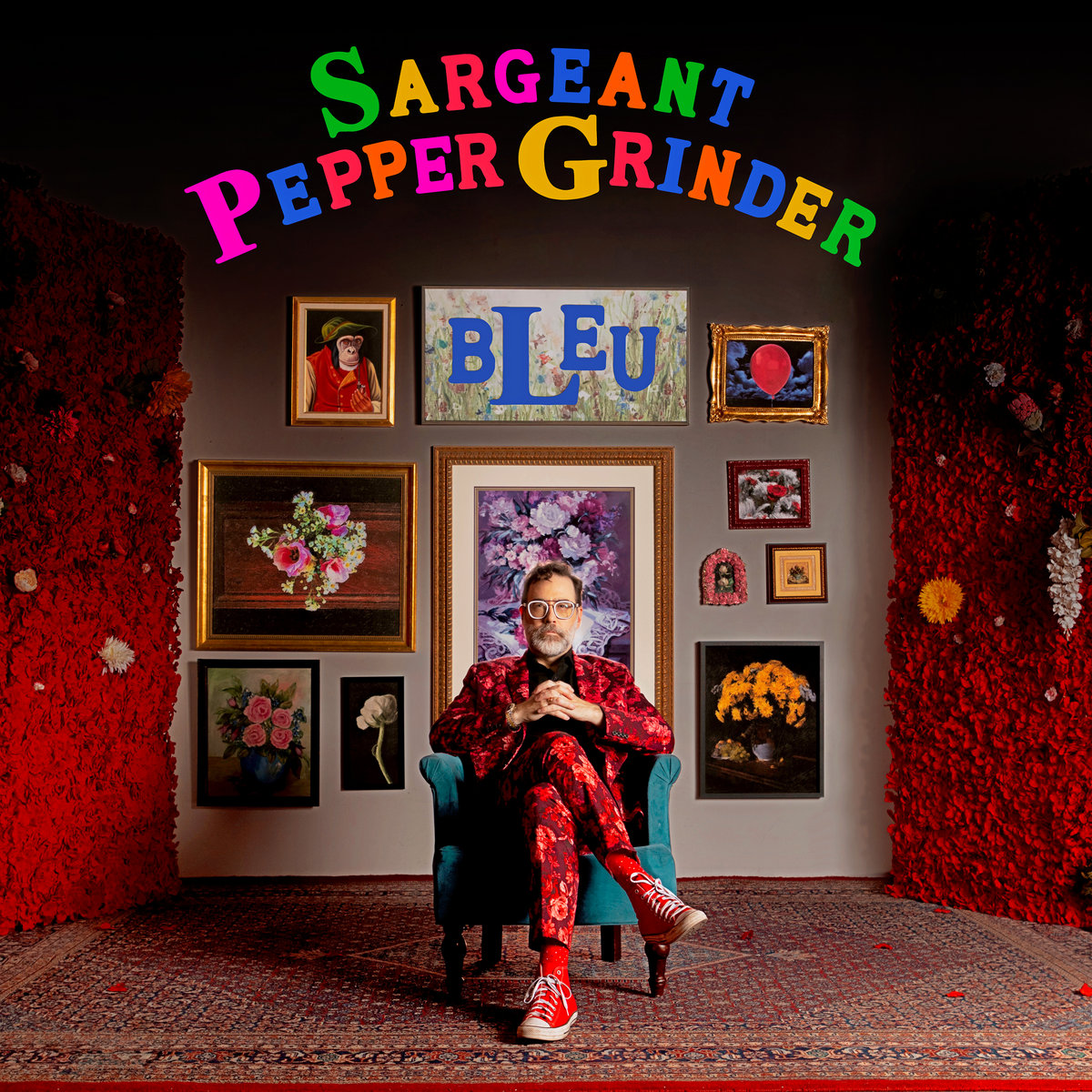
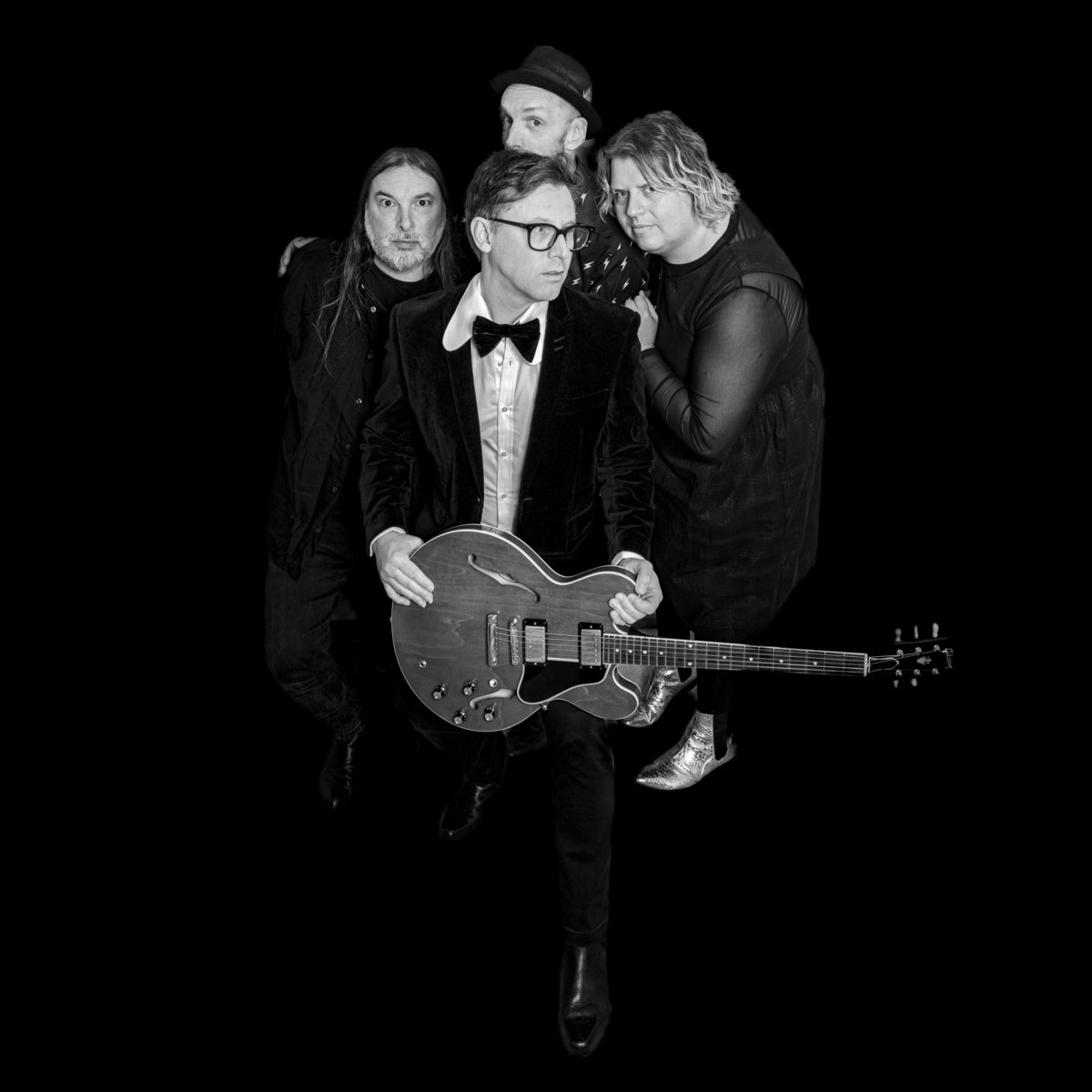
On Sargeant Pepper Grinder, Bleu turns grief into something bright, melodic and deeply human. The album is both a tribute to friends who are no longer here and a celebration of the people, memories and small moments that remain. Wrapped in the kind of irresistible melodies and harmonies that have long defined his songwriting, these are songs that don’t shy away from loss, but refuse to surrender to it either.
We spoke with Bleu about writing through grief, the strange kinship between sadness and power pop, obsessing over songcraft, and why Sargeant Pepper Grinder has ultimately become a memorial to friendship.
Sargeant Pepper Grinder feels like a very personal record. You describe it as an upbeat meditation on death and a celebration of friends who are no longer here. Was making the album a way of dealing with those losses, or did the songs simply become the place where those feelings naturally ended up?
Making this album was definitely a way of “dealing with” (processing, mourning, etc.) several very deep losses. Writing songs for my own artist project has always been a form of therapy for me, but many of these songs were a particularly palpable example of that. The recording process then became a way to commiserate, heal, and deepen connections with my friends who are still here, many of whom were also very close to Ducky and/or Alex “Scootch” Scutro.
Power Pop has always had this wonderful ability to hide sadness inside bright melodies and beautiful harmonies. On this album, though, the emotions feel particularly close to the surface. How do you find the balance between making something musically joyful and allowing the lyrics to be genuinely painful or vulnerable?
That seeming dichotomy is a hallmark of some power-pop that I’ve always loved. Just as humor helps many of us get through painful experiences, exuberant and tuneful music can help lift us from the valleys of crushing loss. I’ve also learned through therapy that two conflicting feelings can legitimately exist at the same time, and I think that juxtaposition brings a deeper meaning to life. But the main reason this album contains so much of that kind of thing is because I wanted to write music that Ducky and Scootch would’ve liked, and neither gravitated to sad-sack songs!
You’ve always been an incredibly melodic songwriter, but on this album the melodies sometimes seem almost deliberately at odds with what you’re singing about. Do you ever start with the emotional weight of a lyric and then look for a melody that gives it some lightness, or does the music usually come first?
When I write for “BLEU” (“me songs”) I almost always start with lyrics, usually a title with a concept, starting with the hook and moving on from there. In the case of this record though, that was obviously in service of conveying some pretty heavy emotions. I think “melodic songwriting” is just part of my DNA, but there’s certainly plenty thought (craft) that goes into melodic shape and in particular melodic-rhythm, and these songs were no exception. Even when I’m writing something heavy and the emotions are flowing, I can’t help but work the songcraft.
You produced and mixed the entire album yourself. Did keeping that process largely in your own hands matter to you, especially with material this personal?
Yes and no. I’m very open to collaboration, and worked with many talented songwriters, musicians, engineers, and Atmos mixers on this album, most of whom I think would agree that they weren’t particularly “over-produced.” But there was no way I wasn’t going to obsess over these songs, and producing and mixing it myself meant I wasn’t unnecessarily bothering other people (haAa!)
Looking across the songs on Sargeant Pepper Grinder, there’s a real sense of finding joy in people, memories and small moments. Did writing these songs change the way you look at those things, or perhaps make you appreciate them differently?
I look at this record now as a memorial. I truly wanted to create a tangible and (hopefully) long lasting tribute to Ducky and Scootch, as well as a heartfelt and healing expression of grief for myself and others. But yes, working on this record was very much a path to creating joy, memories, and small-moments – with my friends and family who are still around.
A Talk with Jeb Barry on the Release of The Typicals: The 1980s-90s Power Pop Band’s Final Recording, Released 32 Years After It Was Recorded, Lost, and Then Discovered.
Could you share the journey of bringing this record to life? How did all the pieces come together to create the final product?
The Typicals formed around 1986 as a four-piece band centered around Jeb Barry and Michael O’Neill’s songwriting. They wrote all their songs separately and then brought them to the band to arrange. “I never told anyone what to play when we learned a new song I wrote; we let them create their own parts. Mike did the same,” Barry explains.
Due to musicians moving on to other careers, by 1990, we were a three-piece with a new drummer. Our songs had gotten harder and less powerpop. We decided to record live at CBGBs on DAT tape for a future live album release of all new songs. Unfortunately, the sound engineer only recorded one channel, so it was a waste, although it was fun to play there (we had previously focused on the Boston area for shows).
Since I had a fairly expensive DAT tape, we booked an hour with a local studio where we recorded our first two self-releases (Popscreams and The Poverty Sessions). We recorded it live in one shot, except for one song we did four times but kept the first take.
We ended it all right in the middle of talking to DGC (David Geffen Company), who loved our stuff. But the band was entering their 30s, and the music business at the time was not a great place to be. People thought I was crazy to walk away. LOL
How did DGC get interested?
Before this, we had met and talked to a few major record companies and sent out dozens of copies of our album, but nothing came of it. In 1991, I saw that DGC was a new subsidiary that had signed a band I knew through college radio, Nirvana, for a million-dollar advance. I decided to stop sending out albums and tapes and created a small promo pack of articles and reviews of the band.
Cindy Peters from Gary Gersh’s A&R office at DGC called my house later. She told me to send her a tape of three songs and instructed me to put a special code on the bottom right of the envelope, or else it would be thrown away. I did that, and she called a week or so later, saying they loved it but thought we sounded like a band they had recently released, Nirvana. I had recently gotten the Nirvana CD and didn’t see the comparison, but she pointed out similarities like soft verses and hard choruses. She requested more songs, so I sent some new and some old, including rockers and acoustic ones.
She called again, saying the new songs reminded her of The Posies and requested more. This happened a few more times before I decided I didn’t want to travel around the country in a crappy van playing low-level shows for little money and walked away. I did not return the next few phone calls from Cindy.
Was there a particular moment or experience that struck you, signaling that you were onto something special with this project?
Probably the first time we played as a three-piece. I (Jeb) had to play bass on Mike’s song (except for “This Lonely One,” where I played bass on my own song) and vice versa. It made the songs simpler yet more intense compared to our older material.
The decision to seek opinions on your new songs is intriguing. When did you realize that external perspectives could contribute to your creative process?
I think that happens from the first time you play, especially performing original material. You seek input from others outside the band to gauge the impact of the material.
Success can take on different meanings as time goes on. When envisioning success for this new record, what does that picture look like now?
Our only goal when we recorded this was to give others an idea of how we sounded live as a three-piece and how the band was changing. This had nothing to do with the emerging grunge sound that was starting to become popular. As a three-piece, we needed to play the new songs more aggressively—and louder too.
Within this collection, do you feel that the best song you’ve ever written finds its home? If not, what distinguishes this record’s essence from your prior work?
As a songwriter (currently writing and performing under the name Pawn Shop Saints and doing Americana with some acoustic powerpop added in, e.g., the song “Diane”), I’m still trying to write that perfect song. That’s why I keep writing. But my favorite of this bunch is probably “This Lonely One.” It just stood out to me when I wrote it and when we recorded it.
As an artist, the act of baring your emotions to the world is profound. Does this vulnerability come naturally to you, or is it a constant journey of finding comfort?
Since all my songs are not written with any relation to me, I don’t really bare any emotions. All my songs are like films, where I create plots, scenarios, and characters to play out the song’s theme. Some people think I am writing about myself, or sometimes I’m writing about them, but I don’t do that. It’s all fantasy or fiction.
Imagine you could collaborate with three co-writers of your choice for new songs. Who would you select, and what qualities or dynamics draw you to them?
I have only co-written once, with Jason Isbell via Twitter (that’s another story). But in 1992, it would have been Tommy Keene, Marshall Crenshaw, U2, Elvis Costello, or Springsteen.
Today, it would still be Elvis, Springsteen, Isbell, and Steve Earle. I’d even include Taylor Swift since she writes very differently from me, and I love challenges.
Among the gigs you’ve performed, which one holds an indelible place in your memory and why does it stand out?
CBGB’s was cool, but probably our first show at The Rat in Boston or the frat party we played for hundreds of drunk college kids in the pouring rain. They had a big mud puddle they were jumping in right in front of the stage. It was cold and miserable, but fun.
Defining a song’s completion can be elusive. How do you determine when a composition has reached its final, ready-to-record form?
I guess it’s different for all songwriters, but like most, I just know when something isn’t working and needs to be changed. If it’s a song I think is good, I’ll work on it until it hits that comfort zone. Recording is a different beast. I may have a sound in my head I’m striving for in the studio, but sometimes it just doesn’t work. I’ve scrapped and rerecorded several songs in the studio. Luckily now, I can do that in my own home studio.
Striking a balance between experimental artistry and commercial appeal is a challenge. How do you navigate this dynamic within your music?
Since I don’t have any goals to be commercial and never have, I just do what I like. In 1992, that’s what we did. We didn’t try to sound like anyone, jump on the grunge train, or try to be hip or popular. We just had fun. It’s the same today.
Lyrics often carry profound meaning. Are there particular lines you hope listeners will always remember from your songs? If so, what’s the significance?
Every song could have a line that has meaning to somebody. I’m not sure any of them are profound, but listeners might catch a line or two that they feel speaks directly to them.
Can you recall the last instance when you felt the immediate certainty of having penned a hit song?
I feel I’ve written a lot of catchy songs that few people have heard. As for a hit, I’m not sure. I still think “This Lonely One” is a hit powerpop song. Since I don’t write in one genre and mix it up a lot, there could be hit country, pop, rock, Americana songs in my catalog. I’ve written thousands of songs—most are crap, but there are a handful I could perform every night. Usually, the simpler ones are the best for me, like “She Comes Along,” an unreleased Typicals song, which was always a crowd favorite and the first song of mine another band covered.
With the resurgence of cassettes, imagine curating your inaugural mixtape. Which five songs would be must-adds and why?
For The Typicals, they would be:
“She Comes Along”
“This Lonely One” (Mike’s guitar work/hook really makes the song)
“The Cold Shoulder” (another unreleased Typicals song, slower and groovier)
“I Could Be The One” (Mike’s song from the Popscreams album)
“The 4th Of July” (from The Poverty Sessions cassette)
I’d pick these all for the same reason: they are catchy. Mike, I’m sure, would pick different ones.
Performing music before an audience holds a unique allure. What aspects of this experience contribute to the excitement and enjoyment for you?
Just getting the interaction of the crowd, even if they are just listening. As a songwriter, it’s incredibly rewarding to have people actually listen to your songs, especially when doing a solo show. I did a solo show at the Bluebird in Nashville a few years ago, and there was no talking. Everyone just sat and actually listened.
While you can’t dictate how people interpret your music, are there specific elements you wish to highlight that set your songs apart?
For The Geffen Tapes, it was the hooks of the songs and the energy that we were trying to get across. Anything beyond that was a bonus. Today, it’s more about the lyrics and stories in the songs that I hope listeners pick up on.
If tasked with introducing your music through three songs, which ones would you choose and what story do they collectively convey to new listeners?
In 1992, it would have been “This Lonely One,” “Going Steady Still” (from Popscreams), and “This Lonely One” again since I think they are good, angst-tinged power rock songs.
In a hypothetical scenario where you could tour with two other bands, who would be your ideal companions and what synergies do you envision?
In 1992, it would have been Nirvana and U2 (my favorite band, and they’re Irish, so that’s a plus). I think The Typicals could have added a similar yet different sound to either band as a supporting group, which is actually what you want for a concert. Since we were all around the same age, that wouldn’t hurt either.
Studio moments often hold a touch of magic. Could you recount an instance that stands out as the most enchanting during your creative process?
For The Typicals, we never had much money, and there was no home recording then. If you wanted to record, you had to book time in a real studio, which wasn’t cheap. We recorded at Derek Studios in Dalton, Massachusetts, the only one around (another local, Arlo Guthrie, recorded there too). Since it was expensive, we learned to be well-rehearsed and record quickly. Our first album, Popscreams, was done live in the studio with vocal overdubs. We did it so fast that we had time to record four acoustic songs. The same was true for the second one, the EP The Poverty Sessions (named by Mike because the mixing took twice as long as the recording and was very costly). But the first time you listen to a final mix of your first recorded song and hold that album in your hands is unforgettable.
Where do you see yourself situated within the broader landscape of the music industry? How do you perceive your unique role and contribution?
We came close to something with DGC, but essentially we were a local original band that only did originals (all other local bands were cover bands) and put out our own music. One reason we did an album ourselves was because all the local ‘experts’ said it couldn’t be done and that you needed a record company. But since we had no management or money for promotions or tours, we were pretty restricted to being a Massachusetts band. But we showed a lot of bands that you could put out your own DIY records.
Envision recruiting three singers to provide harmony vocals on your next record. Who would you invite, and what qualities do they possess that resonate with you?
In 1992, it would have to be:
Susanna Hoffs—she has a one-in-a-million voice.
Robin Zander—he still has a powerful voice.
Scott Miller of Game Theory—he has a unique and standout voice.
With the record completed and the music released, do you believe the pinnacle of enjoyment has been reached, or is this just the beginning of an exciting phase?
Since it’s been 32 years after the recording, we don’t expect much at all. It’s hard to stand out in today’s mass-produced music world, but maybe someone will hear it, like it, and promote it to the right person to reach a larger audience. But if not, that’s okay. I really don’t expect to hear us on SiriusXM anytime soon or hear from a label looking to press the songs. We do have some more unreleased Typicals songs, mostly Tascam 4-track recordings, that will see the light of day in the next few months, and maybe some live show songs. It all depends on the quality of the cassette tapes. If they are lo-fi, that’s fine since we love that type of sound.
Looking ahead to the next couple of months, what exciting plans or projects are on the horizon for you?
The homemade album with the songs “She Comes Along,” “Cold Shoulder,” and “Oh Janine” from 1988 should see a digital release by Christmas. Plus, I may record another Pawn Shop Saints album or do a compilation of all the powerpopish songs the Saints have recorded—all for fun!
Can you take us through the creative journey of bringing this album to life? What were the key milestones, challenges, and breakthroughs you experienced along the way?
As described above, the show at CBGBs was a letdown on the recording side, but the live tape came out pretty well. The original DAT tape disappeared, and all I had was a cassette tape I recently found while cleaning out old Typicals cassettes. It’s not the best sound compared to the original tape, but after 32 years, it’s not bad. I tried remastering it, but it actually didn’t need anything, which is a kudos to the recording engineer, Greg Steele. I finally decided to put it out on the internet for free, especially since I don’t have the funds to press a record or CD. But maybe someday.
How would you describe the evolution of your sound in this new album compared to your previous works? Were there intentional shifts in style or themes?
Harder and rougher—not as pretty. Maybe our influence from The Clash or Dinosaur Jr. (who lived less than an hour from us in Massachusetts) was coming through, but who knows? I think we all just wanted a more powerful style, especially as a three-piece.
With this fresh collection of songs, how do you envision connecting with both your existing fanbase and new listeners? Are there specific emotions or messages you hope they’ll resonate with?
Since we’re releasing them 32 years later, most, if not all, of our fanbase is gone. So, we are starting from scratch three decades later. But these songs haven’t been heard outside of DGC, so maybe someone will randomly hear them, like them, and the sound. Or they might get lost in the modern music era.
Back then, if I hadn’t walked away from the business, I’m not sure what would have happened. Perhaps nothing. We might have stayed a regional act making no money and working crappy jobs.
Albums often involve collaboration with various musicians and producers. Could you shed light on how these collaborations contributed to shaping the album’s identity?
Greg Steele (who passed in 2023) usually just produced and left the engineering to others, as was done with our prior albums. This time, for the live recording, he did the engineering so we could get the best sound with no overdubs or fixes. It was all recorded directly to a DAT tape. The results didn’t need to be mastered or changed in any way. There were no other musicians—just myself, Mike, and Sean playing the same set we did at CBGBs a couple of weeks earlier.
In the digital age, visual elements are intertwined with music. How did you approach the album’s visual aesthetics, such as album art and accompanying visuals? How do they complement the sonic experience you’ve crafted?
I have an art degree but still appreciate the DIY look of many of the 1980s-1990s self-releases. Most of our posters and flyers were hand-drawn, and even our first album cover was hand-drawn since we couldn’t afford text paste-ups. For the cover, we went for a simple, time-period-appropriate look: a photo of us outside CBGBs and nothing else. If I had to design an entire album jacket, I’d keep with that theme.
“LET ‘ER RIP,” the new album by Mark Ward, will be released on June 14. This record is packed with incredibly catchy, classic Power Pop songs. It shines, sounds fantastic, and has even garnered praise from Paul Collins.
Sweet Sweet Music blog sits down with Mark Ward.
Could you share the journey of bringing this record to life? How did all the pieces come together to create the final product?
Having recently relocated from Alaska to Washington State, I left my long-term band, Last Train, behind, along with my valued creative outlet. We had a pretty good run with four albums of edgy Alt-Americana rock and some international airplay. However, arriving in Washington during a pandemic, I found I was really on my own musically. As a guitar player, my songs are admittedly guitar-centric. With that, I can cover most instrumentation and vocals, but I was without a drummer, and my drummer friends in Alaska were busy with their lives. A buddy of mine and fellow collaborator, Chad Reynvaan, suggested I contact Dylan Mandel to play drums. Though he’s in Pennsylvania, we immediately hit it off and started tracking drums remotely. He’s a total pro and, frankly, I could not have finished this project without him.
Was there a particular moment or experience that struck you, signaling that you were onto something special with this project?
Over the years, my songwriting has taken on a much more serious tone, especially with everything that’s going on in the world today. But serious songs can take a toll on both the performer and the listener. While I think it’s important to speak your mind and give voice to a sense of reason, it is equally important to just have some fun. While there are a few serious songs on the record, in this election year, I decided to take a hard departure from that and just write some fun pop songs that don’t necessarily have to mean anything, because that’s also okay. I set out to finish a song I had written a guitar line for some 40 years ago with that sound in mind, and the song “I’ve Been Around” just fell onto the page. It was so refreshing that I decided to write another, and another, and pretty soon I had a pile of power pop songs, because why not? The trick then became how to sequence the album so it didn’t feel disjointed. I think it works, and the album at least leaves you with a sense of hope.
Success can take on different meanings as time goes on. When envisioning success for this new record, what does that picture look like now?
Great question. I’m not a full-time musician and can’t easily play out as I don’t have a band where I live anymore. I’m not really interested in touring as I have a pretty busy, fulfilling life that music is only a part of. In this day and age, there is really no money to be made in the music business unless you’re a mega pop star. So I guess success for me is having my music appreciated, respected, and enjoyed by people who want to hear music that is not force-fed to them by an algorithm. As we used to say in my previous band, if we can sell enough CDs to cover the cost of making the album, it’s a no net loss and therefore a success.
As an artist, the act of baring your emotions to the world is profound. Does this vulnerability come naturally to you, or is it a constant journey of finding comfort?
It comes naturally to me, I suppose. I have always felt lyrics deeply in others’ music and my own. In fact, when you are working on a meaningful song and a line pops into your head that immediately brings you to tears, you know it’s the right line. This happens to me often. The trouble is, it can often be difficult to perform a song like that live. If the lyrics mean something to you and you are feeling the lyrics too much, you can quite literally choke up, which makes it impossible to sing. It’s a fine line, not going too far over the edge.
How would you describe the evolution of your sound in this new album compared to your previous works? Were there intentional shifts in style or themes?
My previous efforts have been tailored to the bands I was in, being mostly Americana, Alt-Country, Cow-Punk, or because there’s a pretty distinct sound of music coming from Alaska, a genre I called “Alaskana.” But my writing has always tended on the more pop side of things. Since my college years, playing in a New Wave band and loving bands like Paul Collins, The Nerves, The Beat, The Heats, 20/20, The Knack, etc., I’ve always had a power pop bent to my writing. With this album, I just decided to go all in for the majority of the songs.
Albums often involve collaboration with various musicians and producers. Could you shed light on how these collaborations contributed to shaping the album’s identity?
My philosophy on making a record is that you just can’t (or shouldn’t) do everything yourself. You need other expertise, ears, and sometimes ideas to make a song worthy of listening to. Dylan Mandel’s drumming gave a cohesive sound to the record. Even though he used three different kits and multiple snares, his drumming is spot on for the sound I was after. I’ve collaborated with my Alaskan buddy Chad Reynvaan, who runs Wattage Studios in Anchorage, on a number of things over the years. He’s been a great resource to bounce things off of as well as add the occasional synthesizer or backup vocal, which he did on this record. The well-respected Anchorage musician and producer, James Glaves, added some tasty keyboard and piano to a couple of songs. The finale of the record includes a list of friends who lent their voices quite literally to the choir on the song “Hope.” The last line still gives me chills. At the recommendation of Paul Collins, I used Justin Perkins at Mystery Room Mastering for the finishing touch. He’s amazing, and I think his efforts provided the final polish the record needed.
Now that More Kicks is a thing of the past, James Sullivan, with Vital Signs, has delivered an exceptional record. It’s sophisticated, melodic, narrative-driven, and utterly intriguing! Here is a restless writer at the top of the songwriting game.
You can discover ‘Day Late Dollar Short’ featured on the Best Power Pop of 2024 Spotify Playlist.
James, your record is truly beautiful and diverse. Did refining your sound after More Kicks disbanded come naturally?
Thanks! I actually finished this record before More Kicks ended. We’d finished the second record, Punch Drunk, and everything was at the pressing plant with Dirtnap and Stardumb. So we were sort of planning some touring around that release, but it was all 9-12 months in the future. I’d been writing so much for the two years leading up to that point and I didn’t want to stop. I also knew my lease was running out on the little studio space I rent, so I had about three months before I would have to move out of that.
So it was kind of a no-brainer to just keep on writing and recording. Honestly, I was a little worried about my state of mind without new music actively happening and I was quite burned out from writing so much for More Kicks, so making a new record on my own was an easy decision to make. I didn’t necessarily think it would be another album because there is always a chance that it turns out completely shit. Especially without the tasteful filter of Paolo and Kris (bass and drums from More Kicks) being applied to the songs. But as long as I was writing and recording something new, I knew I would feel okay.
Then I finished the ten songs and Punch Drunk was almost ready, so it was time to go and tour that thing. Vital Signs was done and even mastered, but it was just sitting on my computer. Six months later, I realized I didn’t want to do More Kicks anymore and I even had a completed record ready to go, so I finally got my arse in gear to get it released. I sent it to Stefan at Stardumb to see if he’d be interested – god bless him, he was – sorted out the artwork. Then that all takes a little while again, and here we are.
So the sound was just an amalgamation of physical limitations and the freedom of it not needing to be played by three people on a stage. There are so many limitations when making the record like that on my own. I record everything on an 8-track tape machine so I only have eight tracks to play with. Plus my own limited recording capabilities, I can’t play the drums and I suck at piano so that comes into play as well. Tiny cupboard-sized ‘studio’, loads of noise coming from everywhere in the building. In my head, I was going to make a huge orchestral piece, but that is simply not possible in those surroundings haha.
In terms of refining that sound, I just wanted it to have more space than my previous records. Less frenetic, more textures, a broader feel. I often wish I could embrace jam band aesthetics but that is essentially impossible if you’re playing things on your own and it’s all on tape so you can’t edit anything after recording. Plus, I’m quite a brutal editor of my own stuff, so what starts off in my head as ‘this will be a really long and tedious drone instrumental with almost no melody’ ends up becoming quite a concise pop song.
Your lyrics are captivating. Is writing them a smooth process for you?
Ah well thank you! I would say quite smooth, yes. I usually make a little demo of the song while I’m writing and the lyrics come last. I have nonsense placeholders in there while writing and then figure out what they should actually be once the music is at least mostly structured and worked out.
So I’m usually quite tired by the time it comes to writing the words. I like to write them very quickly and usually about 90% of those tired lyrics are there in the final version – just some tweaks here and there for better phrasing etc. Sometimes I think that might be why I often seem quite sad in the words – I’m just a bit tired by that point.
I usually write the chorus first and work backward to fill in the verses. That seems to help with the flow of setting the scene and the theme, and then getting a good payoff with the chorus. So the second verse can often be difficult because I’ve got a narrative that ‘ends’ with a chorus, but I have to continue the story for the second verse somehow. But yeah, I would say once the chorus words are in place, the rest of the words seem to come quite quickly.
I’m intrigued by ‘Guilty as Charged’. Can you share how that song came to be?
I had already started recording and while I was listening back to what I’d done, it all felt quite unambitious and nice. Exactly this idea of expanding the horizon is where I was going with Guilty As Charged, and also the song which precedes it, ‘Dronify’.
I was missing live drums on what I’d recorded. My friend Marco had played drums on Day Late Dollar Short and they sounded really nice. So I looped a few bars of him playing that song and just droned a bass riff over the top for four minutes. At this point, I realized I should essentially abandon structure and just go with the drone – so spoken word would be a good idea. I used that a bit on my first record ‘Light Years’ on the song ‘Lea Bridge’ so I liked the idea of returning to that.
I was reading ‘Nickel Boys’ by Colson Whitehead and he described someone as looking like they were ‘upholstered into their suit’. All disheveled and creased. I loved that. So I thought a character piece about whoever that person is would make for a great vignette. I wrote those words so fucking quickly, I’m not sure where it came from. The whole courtroom scene, the grotesque spectacle of a man getting sucked into thin air from within this horrible green linen suit. It really felt so freeing to write like that. A complete stream of consciousness that was absolutely not related to me or my life at all.
Many times I almost deleted that from the record because it felt thematically separate from everything else. If anyone had said to me ‘Erm, I’m not too sure about Guilty As Charged’, I would have definitely just thought, fuck it, and dropped it. But luckily, nobody heard the record except me until it was all finished. I’m glad it’s there.
Creating Vital Signs as a solo project must have been quite different from working with a band. What was that experience like?
Quick, instinctive, a little worrying because there is really no objective voice in the room at all. There is every chance that everything I’m recording is truly awful and I can’t tell because I’m far too close to the whole thing.
So it feels higher risk in one sense, but also lower risk in the sense that I have zero expectations for anything. Nobody is waiting for a James Sullivan solo record. I’m not even waiting for a James Sullivan solo record. I could quite easily finish a set of songs and then just do nothing with them and carry on with my life – as I almost did with these. But then, the ego in me can’t quite resist sharing them with the world in case other people also get a kick out of them.
Your new sound really showcases your vocal talents. Was this something you consciously aimed for?
Not at all, but I really appreciate that. With the self-recorded, straight to tape thing, I have to sing everything from start to finish in one take because I don’t have long enough arms to punch in the recording from where the microphone is in the room in relation to where the tape machine is. So it’s all in one take, or do the whole thing again. Which is mostly how I do it anyway – but this time it’s the only way I can physically do it.
I can definitely sing in tune; I don’t usually have problems with that. So having that one-take restriction probably adds a certain edge or sense of jeopardy to things. It definitely makes it feel more alive and, yep, more real.
What kind of compliment about Vital Signs would make you especially happy?
Christ, that’s quite difficult. I’m one of those dickheads who claims to not care about reviews but then when I get a nice one, I feel really good about it.
I think if people realize that I’m consciously trying new things, that I’m not scared of alienating listeners, that I am really really keen to not repeat myself, that makes me happy. I will scrap entire songs if they feel slightly too similar to something I’ve written before when it would be much easier to just tweak it slightly and record it. In fact, probably that would be an easier thing for listeners to get their heads around. I could have written More Kicks songs forever but I would have known I was cheating myself.
So I think if somebody told me I was a restless writer, that would make me very happy.
In 2024, Power Pop enthusiasts are in for a treat! Immerse yourself in the ever-expanding collection of now just over 100 top-notch tracks on The Best Power Pop of 2024 playlist.
Keep your ears tuned to and follow this Spotify playlist as we consistently add fresh soon-to-be classics every week.
From the plethora of amazing tunes, we’ve distilled the cream of the crop—the top 25 tracks of the year so far are now, at least for this week, reigning supreme at the top of the playlist.
Their position is likely to be challenged as we speak, so stay tuned for updates!
01 The Reflectors – All the Way Down
02 Rob Carroll – just about had it!!!
03 The Jellybricks – All About You
04 Wifey – Mary Ann Leaves The Band
05 Softjaw – Pleased With Me
06 Brent Seavers – Of Poetry
07 The Follies – Square Peg Round Hole
08 The Lemon Twigs – My Golden Years
09 The Prize – One Day at a Time
10 Spencer Segelov & Great Paintings – Don’t You Know?
Lava Fangs’ forthcoming album, “Sub Auroram,” is introduced by the irresistibly catchy single “Where Did She Go.” Jamie Coghill and Andrew Horne delve into their experiences crafting what they describe as the challenging process of creating their sophomore record.
You can discover ‘Where Did She Go’ featured on the Best Power Pop of 2024 Spotify Playlist.
Could you share the journey of bringing this record to life? How did all the pieces come together to create the final product?
Jamie – “Where Did She Go” is the lead single from our “difficult second album” … It’s an expression I’ve heard many times since becoming a fan of music as a kid. For the most part I pooh-poohed such a silly expression; How can a second album be difficult? As a fan of music I can think of many bands whose second album is an all time favourite. As a musician, being allowed the opportunity to make ANY album is a privilege and should be immune to such trivialities as being difficult!
As a middle aged musician at the dusty end of several careers in bands who *almost* got somewhere, I can now look on that expression with the road-worn experience of having been involved in a few “difficult second albums” myself. It’s remarkable and lucky really for any band to be around long enough to make it to the second album. The first album is full of excitement and the momentum of being a fresh new band and having a backlog of songs you’re eager to get out into the world and establish your sound with. The follow up album feels the pressure of having to live up to that effortless enthusiasm and momentum the first album had. The first album comes together instinctively, almost as if by accident. The second album has to be planned and meticulously thought out – yet it’s still supposed to somehow sound “fresh”.
The Lava Fangs “difficult second album”, Sub Auroram didn’t start out difficult. In fact we had almost all of the songs written and demoed within a year of releasing our debut. But then the world hit a speed bump that no bands have had to endure in the past – a bloody global pandemic! By the time we were finally able to get together and begin recording it had been a difficult couple of years and we’d all had COVID. I was still getting over it when we went into the studio with Paul Maybury (Rocket Science/The Pink Tiles) to track guitars, bass and drums to 24 track tape. We then spent the next year overdubbing and mixing it ourselves whenever our schedules allowed.
Listening to “Where Did She Go” now, I’m thankful that none of that “difficulty” comes through. It’s just as fresh and exciting as if it were from our debut record. Having four contributing songwriters gives Lava Fangs a fairly unique and diverse sound that only a handful of other bands share (readers of this blog are no doubt aware of Canada’s Sloan … can you think of any others?). For the most part Lava Fangs write songs individually then bring them to the band to add our combined flavour with arrangements, lyric and backing vocal suggestions, but “Where Did She Go” is one of our rare collaborations. Drew (guitar/vocals) brought us a song that we all loved but something was missing so I wrote some lyrics, a vocal melody and a pre chorus to tie all Drew’s bits up into a finished sounding song. I’m very proud of it as a group effort.
Was there a particular moment or experience that struck you, signaling that you were onto something special with this project?
Andrew – when I start to write a song, my process is stumbling across a few chords or melodies that I think sound cool. For “Where Did She Go” the initial verse chord progression sounded great to my ears. Then I tinkered with it till it was ready to present to the band.
From there, the band decides if the song has merit to continue. Jamie added a pre chorus and vocal melody so I guess it had legs!
Sometimes when you are deep in the process with a song it’s difficult to see outside of what you are doing. You have to shut out your inner critic and appreciate what you have created. For me, I find that once the band has given the song a thumbs up I can sit back and be proud of what we have done. The separation of time certainly helps too.
The decision to seek opinions on your new songs is intriguing. When did you realize that external perspectives could contribute to your creative process?
Jamie – Sweet sweet validation!! We all crave it don’t we? Especially on an artistic level. Is it really art if nobody appreciates it? Actually yes, but validation is also nice. As far as other people’s opinions contributing to my own creative process, I think it’s an intangible influence. I don’t write a song thinking about what people might say or think about it, I prefer the creative spark to come naturally and take shape instinctively and then decide whether or not I think it’s worth sharing with the world. Other people’s opinions only serve to encourage me and give me the confidence to keep making music – which is important and helpful, but not essential.
Andrew – I concur with Jamie on this one, validation spurns us (me) to continue on with creative pursuits. With any creative venture self-doubt rears its head constantly. Any positive words from respected peers/friends goes a long way. This affirms that what you are doing is worth pursuing and to trust in your instincts.
Success can take on different meanings as time goes on. When envisioning success for this new record, what does that picture look like now?
Jamie – This is so very true and a great observation! My measure of success when I was in my twenties is very different from how I feel today. For me, this album is already a big success even before it’s released! The fact that Wally and Jo from Cheersquad Records and Tapes were willing and enthusiastic to work with us to release it on their label is a success Lava Fangs haven’t achieved before. Having the opportunity to release 2 digital singles leading up to our second full length album on vinyl is a huge achievement for us. If people like it once it comes out in May (and maybe buy a few copies of the LP), it will just be icing on the cake. A big delicious success cake!
Andrew – At this stage in my/our musical journey, respect from my peers is how I’d like measure success. Having Cheersquad Records and Tapes deeming Lava Fangs worthy of release feels pretty successful to me.
Within this collection, do you feel that the best song you’ve ever written finds its home? If not, what distinguishes this record’s essence from your prior work?
Jamie – Our coming Album, Sub Auroram, feels like a more mature and thoughtful collection of songs to me. It’s definitely our best album as a whole. Personally it’s going to be hard to top “Line Up For A Broken Heart” and “I’m No Good For You” from our debut LP. Those songs came to me unexpectedly from out of nowhere and I’m very proud of them and may never write anything better than those two. Sub Auroram and its songs may not feel like it has the one-two punch of our exciting and energetic debut LP but it definitely has way more musical depth and is arguably a much stronger collection of songs. [See my solo project The Jimmy C and the movie soundtrack for Brides Of Satan for the best song I think I’ve ever written: “Learning To Live To Death”!]
Speaking for the rest of the band though, I’d say probably YES! Wesley’s “Lost For Words” is an excellent song for our newest/youngest songwriter (they haven’t been writing songs as long as the rest of us) and I expect even better songs are in their future. Drew’s “Photograph” is a stunningly mature song and I wish I’d written it. Stu’s songs on this album are also very very strong but my favourite of his songs is “Spitting Nails” from Sons Of Lee Marvin’s Minimum Underdrag LP from a few years ago. Look it up, you won’t be disappointed.
As an artist, the act of baring your emotions to the world is profound. Does this vulnerability come naturally to you, or is it a constant journey of finding comfort?
Andrew – Feeling inadequate is a rich vein to mine for lyrical themes. Hiding your true meaning behind metaphor, double speak and just plain lyrical nonsense says I’m not all that comfortable wearing my heart on my sleeve…just yet.
Imagine you could collaborate with three co-writers of your choice for new songs. Who would you select, and what qualities or dynamics draw you to them?
Jamie – I’m pretty lucky to already have three top shelf collaborators in Lava Fangs, but my three fantasy favourites would be:
1) Andy Partridge. He’s easily THE BEST songwriter in music history. XTC are a sorely underrated band and Andy’s humour mixed with emotional depth and massive talent are just incredible. His angular approach to guitar is amazing too.
2) Jeff Lynne. The immensity of Jeff Lynne’s genius will never be appreciated because ELO got too popular. People dismiss ELO as mainstream disco fodder (less so in recent years) but it’s clear why he got to work with the remaining Beatles in the 90s and all those legends in the 80s. If I could be transported to 1970 and replace Bev Bevan in the late era Move/fledgling ELO with him and Roy Wood, I’d be in creative heaven! Such a creative time and Jeff’s vocal harmonies and arranging are pop perfection!
3) There’s so many others but I think I’ll pick Roland Orzabal. Pop genius and Tears For Fears’ “Everybody Loves A Happy Ending” album is a proper masterpiece. He’s often very sincere in his music and not afraid to risk it all artistically.
And I’ll kick myself for not choosing Gruff Rhys, Lee Hazlewood, Andy Sturmer (Jellyfish), Jay and Chris from Sloan (and Pat and Andrew), and Max Comaskey from Dirty Fences – how much fun that would be!!!!
Andrew – Again I find myself concurring with Jamie about being spoilt with 3 excellent collaborators. Each time one of the ‘Fangs’ presents a new song or idea I’m excited to see what they’ve come up with. That’s a pretty cool place to be! And, knowing that my band mates will interpret my ideas in a particular way influences the way I write. Absolutely!
However, in no particular order these folks would be cool to pen a tune with –
• Kim Salmon & Spencer P Jones I’m cheating and making them a package deal. At the top of their game both could write songs with interesting & unique musical content and lyrics. Their songs have great depth & humour all in one go. Both absolute treasures in the Australian music alumni.
• Harry Vander & George Young. I could add them to this list for the Easybeats alone however they went on to churn out great songs in any style you liked (as long it was rock, pop or disco) for decades.
• Lee Hazlewood. Do I need to elaborate? [Jamie – HELL YEAH LEE HAZLEWOOD!!!!]
Honourable mentions of Gene Clark, Alex Chilton, Beck, Dolly Parton, T Swift (I think you’d get a bang-up working lunch with T Swiz is all)
Among the gigs you’ve performed, which one holds an indelible place in your memory and why does it stand out?
Andrew – The one we are about to perform in a drainage ditch at a rouge ‘generator’ skateboard party I think will be pretty memorable.
Or, that time I played support to Arthur Lee. What made that special? Arthur Lee!!
Jamie – In bands other than Lava Fangs, I got to drum in front of thousands of people at Melbourne’s Arts Centre forecourt playing AC/DC songs for an exhibition opening … that was pretty cool … but not as cool as the time I was playing at a tiny pub in Adelaide and threw my drum sticks above my head and walked off stage when a guy grabbed my arm and pointed to the dart board behind the drum kit with my sticks balancing perfectly on the ledge above! One in a million chance.
Defining a song’s completion can be elusive. How do you determine when a composition has reached its final, ready-to-record form?
Jamie – I feel like I’m pretty good at this, but it’s not necessarily a skill. It’s pure instinct for me. It’s finished when I can’t hear anything wrong or missing. It helps also to be time poor, both with Lava Fangs and my solo music as The Jimmy C, it’s about getting the most out of limited time. It’s actually an advantage to have kids and work stopping you from spending days and days on one song and never feeling fully satisfied because it won’t meet your expectations. If you have a set amount of time to get it done, it’s done when the time runs out!
Striking a balance between experimental artistry and commercial appeal is a challenge. How do you navigate this dynamic within your music?
Jamie – Commercial appeal? Never heard of it! Be true to your art – but pick a lane. Write the best kind of song you can within the parameters of your chosen style or genre. I’ve never had commercial appeal but I do try to write accessible songs. I respect the craft of songwriting and so don’t get too experimental within a song itself, but I really enjoy experimenting with genres and the structure of an album as a whole.
Andrew – Never tried. Making stupid noises with a memory man is more fun than being appealing commercially.
Lyrics often carry profound meaning. Are there particular lines you hope listeners will always remember from your songs? If so, what’s the significance?
Jamie – See “She’s So Cool” from our Unclarity EP from last December. Some of my most profoundly silly lyrics. I’m very proud to have the word “precipitation” feature in the chorus backing vocals.
I think Stu probably has the greatest gift for turn of phrase and cleverness in his lyrics within the Lava Fangs band. Go check out some Stu songs in our back catalogue.
Can you recall the last instance when you felt the immediate certainty of having penned a hit song?
Jamie – I have never, and will never write a “hit”, but I have written a few songs that I think can stand up along side the music I love as a music fan – and it’s an incredible feeling when you’re rising to that level. It’s always a surprise to me when I finish writing or recording a song that doesn’t sound shit! If I can write a song as good as the worst song by my favourite bands then I know I’m achieving something very rare.
Andrew – I write shit songs all the time…oh right you said hit song. I’ll let you know.
With the resurgence of cassettes, imagine curating your inaugural mixtape. Which five songs would be must-adds and why?
Jamie – I sure do love curating a good mixtape/CD/playlist! I’m surrounded by cassettes all day every day so they’re still a very familiar medium for me.:
• The Last Plimsoll by Stackridge – a pop opera masterpiece! Complex, richly musical and a tune you can whistle!
• Cybele’s Reverie by Stereolab – It’s vintage Yéyé pop with 90s indie cred … cracking track!
• Harold Faltermeyer’s theme from Fletch – just to catch the listener off guard! It’s so 80s and synthy and arguably way better than Axel F.
• Fade Away by Sloan – Jay Ferguson’s Action Pact album closer. It’s a real hidden gem in the Sloan catalogue and it hits me right in the feels.
• And lastly; More Than He’ll Have To Give by John D. Loudermilk – Just a beautiful gentle simple song about never being better than others but being the right person for someone. Could be swapped with Waiting For Someone by The Tokens from their incredible concept album Intercourse.
And all the songs I haven’t mentioned are causing me great pain … Homefront Cameo by Cotton Mather, Change For The World by Charles Bradley, King Kong by The Jimmy Castor Bunch, Ladybird by Tears For Fears … ouch! Let me dub you a 10 tape collection on C-90s!
Andrew – Ahhhh the mixed tape. The romantic calling card of yesteryear!
I’d have to include songs by The Stooges (Ashetons only please!) ok ok I’d pick Dirt from Funhouse. Nancy Sinatra would deffo feature! But what song? Sugar Town for a subtle drug reference, ‘Boots’ is way too obvious; Summer Wine I think would be a great choice but then again Bang Bang is bloody ace! Can we get a cheer from the back for Billy Strange and his arrangement of that song??
Big Star has always a place on such tapes, and I’d wager lots of people first heard Big Star in this format. Thirteen would be a great addition if your intent was to woo.
What’s that three? Two more to go.
Always a big fan of Australian 80’s indie music I’d have to include the Beasts of Bourbon or Scientists (don’t ask me to pick a song) and before you flip that tape over lets hear from Redd Kross – I saw them steal the show (over the Hoodoo Gurus) with a rendition of ‘Jimmy’s Fantasy’ so that one!
While you can’t dictate how people interpret your music, are there specific elements you wish to highlight that set your songs apart?
Jamie – Definitely the fact that we four Fangs all contribute songs and arrangements and ideas to each other’s songs. Many bands have a dominant songwriter and other members who are just happy to play their part. With us you get four different flavours and sets of influences which I think diversifies us thematically and stylistically from most other bands.
If tasked with introducing your music through three songs, which ones would you choose and what story do they collectively convey to new listeners?
Jamie – Ouch, yet another “Sophie’s Choice” … I have to mention “Line Up For A Broken Heart” because I wrote it and I’m very proud of it. It’s the main track that makes people consider us a power pop band. The other side of Lava Fangs is our “garage surf rock” side. A good example of this is a song you’ll have to wait until May to hear when our new album comes out; “Dancing For Satan” – a song that shows our silly side co-written by Wesley (bass/vocals) and Stu Manchu (guitar/vocals). My third and difficult final choice is “Where Did She Go”, our current single. Those three should be enough to convince anyone that we’re worth listening to and then people can look deeper into some of Stu’s garage punk tracks or Drew’s melodic 70s rock, Wesley’s indie pop … and our more moody and contemplative moments … and there’s so much more coming in May with our Sub Auroram LP!
In a hypothetical scenario where you could tour with two other bands, who would be your ideal companions and what synergies do you envision?
Jamie – I’d love to share a stage with Dirty Fences from New York. Their energy and antics would make for such a fun night. I’d also love to play with Canada’s Sloan even though they’d make me feel completely inadequate because they’re so amazing musically … If this were a time travelling fantasy I’d play with Jellyfish in 1993 and look even more inadequate. But what a story I’d have to tell!!
Andrew – Mudhoney & Mudhoney. Call it a life ambition.
Studio moments often hold a touch of magic. Could you recount an instance that stands out as the most enchanting during your creative process?
Andrew – I could not tell you of one instance of a creative stand out, we have many.
Creative epiphanies keep you coming back to the practice room when your regular life leaves you beat. It’s those times working on a great song or someone comes up with a cool part that is immediately apparent; that’s the magic that keeps you coming back time and time again.
Jamie – We giggle a lot in the studio. It’s lucky we handle most of our production and recording ourselves or we’d thoroughly piss people off.
How would you describe the evolution of your sound in this new album compared to your previous works? Were there intentional shifts in style or themes?
Jamie – Our first EP, 2017’s Black Rain, was a very noisy DIY garage affair, but still has a few hints of melodic evolution to come. Our Debut LP added the power pop flavours to the garage and punk and also introduced more thought to the production and arrangements with more vocal harmonies and musical textures. Our new album sounds more mature still in production and song writing. We still capture some frantic garage energy in places but we’ve evolved to give the concept of melody a little more respect. Our next project will probably rebel from this thoughtfulness and devolve into noise rock chaos … onwards and sideways!!