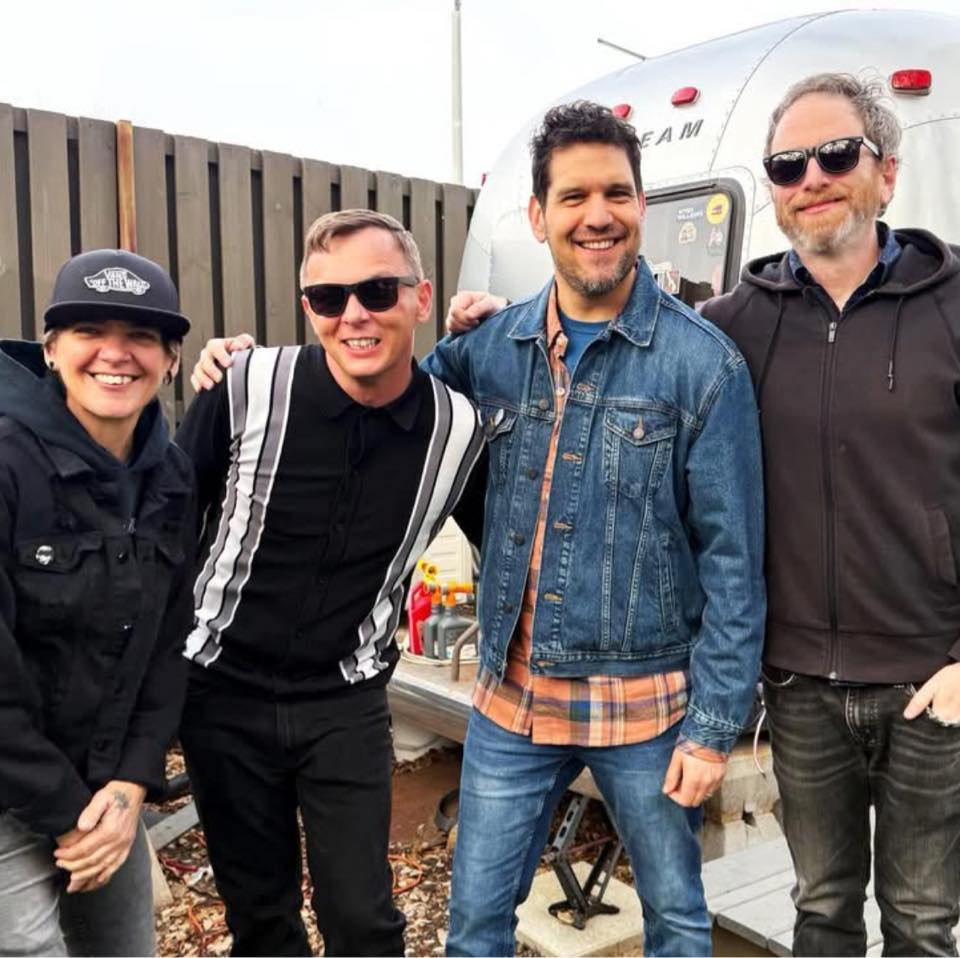
Baseball Bat, a power pop band from Nashville, has recently released two strong, catchy songs, building anticipation for their upcoming EP set to drop in mid-June.
In an interview with Sweet Sweet Music blog, Brian Fuzzell explains that these songs have a long history.
Could you share the journey of bringing this record to life?How did all the pieces come together to create the final product?
The four of us worked together and became friends at a Nashville technology company. One day, Jerry came in with the idea that he wanted to form a band called Baseball Bat. He had the name before he had a band. So, the four of us got together to try to play some Weezer songs, but we never did. Instead, we wrote some of our own songs—the first was our own type of theme song, called “Baseball Bat.” Years later, we finally played one or two of those old Weezer songs.
But it took a lot to make these songs come to life as recordings. Over the last 12 years, we’ve recorded most of them twice in separate sessions, and both times, we ended up trashing the recordings. We also kind of, sort of, passively broke up for about six years. But like Voltron, we re-formed two years ago with the goal to give this another shot and truly make some recordings we’re proud of. Fortunately, Jeremy Ferguson agreed to produce, mix, and engineer the sessions. He really captured the sound and energy we’d always hoped for. Another amazing thing that happened is our old friend and former coworker, Brian Murphree, got involved and mastered the recordings. He’s become an incredible mastering engineer with his business, Soundporter Audio Mastering, so it felt great to keep things in the family to finish the project.
With the resurgence of cassettes, imagine curating your inaugural mixtape. Which five songs would be must-adds and why?
Harry Nilsson “Gotta Get Up,” The Posies “Daily Mutilation,” The Replacements “Bastards of Young,” Weezer “El Scorcho,” Tom Petty “Honey Bee.” We love these songs, and they get to the heart of what the four of us collectively love about rock music.
If tasked with introducing your music through three songs, which ones would you choose and what story do they collectively convey to new listeners?
“Let Down,” “Brain Dead,” and “Baseball Bat” (the song) are probably the best introduction to what this Baseball Bat thing is all about. Those three represent our blend of slacker garage-y quirkiness very well.
Where do you see yourself situated within the broader landscape of the music industry? How do you perceive your unique role and contribution?
We have absolutely no role in the music industry at all. Ha! Baseball Bat is more like an art project, existing only for the purpose of friends having some laughs and creating together. Our unique contribution to listeners is to provide the soundtrack to make memories, make babies, have some laughs, and repeat.
In the digital age, visual elements are intertwined with music. How did you approach the album’s visual aesthetics, such as album art and accompanying visuals? How do they complement the sonic experience you’ve crafted?
We keep it pretty simple. Baseball Bat is a garage band at the end of the day, and we like taking a straight-ahead approach to our music and visuals. We try not to overthink, much like the punk and garage rock we grew up on, but that doesn’t mean we want to be boring. Our “logo” came from duct tape letters, and most of our imagery is playful, simple, and fun.
We are inspired by the ones that blew our minds with simple, relatable, not-trying-too-hard releases from bands like Superchunk, Pavement, Tom Petty, The Toadies, and Green Day. Our EP cover for “It’s A Let Down” is an actual photograph from our bass player’s house in East Nashville when his basement flooded and all his vintage toys went everywhere. The natural chaos of that image felt just right for the cover and namesake.
These songs are 10-12 years old, and no matter how good we record them, it’s still just us behind them—a bunch of middle-aged dudes from Nashville, TN playing with heart. It kind of is a letdown, so we lean into it and hope that not taking ourselves too seriously is the key ingredient to make an unassuming set of songs that just wanted to get out into the world sound just right, despite the world not asking for them.
What’s coming up?
THURSDAY, JUNE 6: Cassette release show at The 5 Spot, Nashville, TN
6-8 pm early happy hour rock show with The Robe (Soccer Mommy & Features drummer Rollum Haas side project). We’ll sell the limited edition cassette exclusively at this release show – only 50 copies pressed on assorted colors!
FRIDAY, JUNE 7: Worldwide digital release
Digital and streaming release to all major outlets, including Bandcamp.
Cyndi Dawson and Henry Seiz, fronting The Cynz, collaborate with Jem Records to unveil their latest album, “Little Miss Lost,” produced by Kurt Reil, hitting shelves on March 29th. This release emerges as a potent and deeply personal narrative, chronicling Dawson’s journey to maturity through her poignant lyrics and Seiz’s infectious melodies.
In an interview with Sweet Sweet Music blog, Cyndi Dawson delves into the genesis of “Little Miss Lost.”
You can discover ‘Crow-Haired Boys’ featured on the Best Power Pop of 2024 Spotify Playlist.
Could you share the journey of bringing this record to life? How did all the pieces come together to create the final product?
Like all our albums, it was a journey of exploring where Henry and I were at in time as individuals and as writing partners. We don’t have a game plan- we allow things to come together organically. As a long-time friend, he is aware of where I want to go and explore, and as a musician, I also follow his own exploration and weave my words accordingly.
Was there a particular moment or experience that struck you, signaling that you were onto something special with this project?
For myself, once I wrote ‘When We Were in Love,’ I knew we were going to have something special with where our new record would go. The music evolved from an acoustic demo into a song that had a more rocking longing that fit our style.
The decision to seek opinions on your new songs is intriguing. When did you realize that external perspectives could contribute to your creative process?
They don’t. I don’t create music for others. I write because I feel a sense of urgency to do so. Henry and I write songs we would like to listen to. Of course, we want others to like them too, but it isn’t our motivation. Art is a compulsion. We create art because we have to. Success can take on different meanings as time goes on.
When envisioning success for this new record, what does that picture look like now?
We are successful now. Because we created work we respect ourselves. That’s fulfilling. In terms of financial success? If you expect that in music, you will be immensely disappointed. I see a value artists should get financially but until we respect ourselves and demand that from clubs and music sources we aren’t going to get that.
Within this collection, do you feel that the best song you’ve ever written finds its home? If not, what distinguishes this record’s essence from your prior work?
The best song we have ever written will never be written. If we have written it already, what motivation would we have to continue on?!
That elusive best song is always one song away.
As an artist, the act of baring your emotions to the world is profound. Does this vulnerability come naturally to you, or is it a constant journey of finding comfort?
I think that when you have experienced severe trauma in childhood, you either deconstruct as an adult or you find an outlet that helps heal you. I chose the arts in many forms- as a poet, a dancer, a model for artists and photographers, and as a front woman. It was no longer okay to stay silent. And I’ve learned that I don’t have to always focus on my own story. I can create characters that are me but can combine elements of others I’ve observed.
Imagine you could collaborate with three co-writers of your choice for new songs. Who would you select, and what qualities or dynamics draw you to them?
I honestly only want to write with Henry. Of course, I am asked to write with others time to time, but I always go back to thinking, if I’m going to write a great song then I want it for The Cynz.
Among the gigs you’ve performed, which one holds an indelible place in your memory and why does it stand out?
90% stand out. N/A lol
Lyrics often carry profound meaning. Are there particular lines you hope listeners will always remember from your songs? If so, what’s the significance?
I write parts of my life and parts of others. Sometimes I just write a sassy song. People will take what they need from my words. This is also why I don’t include lyrics. How many times have you thought a line in a song was one thing only to find out it was something very different? I think that can change the song’s significance to you and what you needed and got from it.
Can you recall the last instance when you felt the immediate certainty of having penned a hit song?
‘Crow Haired Boys.’
If I am singing it in the shower, then I know others will!
With the resurgence of cassettes, imagine curating your inaugural mixtape. Which five songs would be must-adds and why?
1- Patti Smith Gloria
2-MC5-Kick Out the Jams
3-The Struts-Pretty Viscous
4-(The Greg Provost version) Chesterfield Kings- Up And Down
5-Rolling Stones- Stray Cat Blues
Performing music before an audience holds a unique allure. What aspects of this experience contribute to the excitement and enjoyment for you?
The energy exchange between the audience and us. When they are bouncing and singing along it’s magic.
If tasked with introducing your music through three songs, which ones would you choose and what story do they collectively convey to new listeners?
We have five albums out now. I would find that very difficult to do- pick just three songs. Every album was a particular time and vibe our collective minds were in.
In a hypothetical scenario where you could tour with two other bands, who would be your ideal companions and what synergies do you envision?
Toughest question ever. There are so many! Currently, we vibe completely with Slamdinista. I think a tour with them and Palmyra Delran and/or Cocktail Slippets would have the right energy balance. But see? I could name ten others.
Among the compliments you’ve received, is there one that remains etched in your memory? If so, what made it particularly unforgettable?
Women especially come up to me and tell me they feel I’ve spoken to them with my words. They say they wish they had my strength but my strength is on stage. Not everyone gets that space or platform.
Studio moments often hold a touch of magic. Could you recount an instance that stands out as the most enchanting during your creative process?
Hah- the next secret project that Jem is putting out- I was completely into the moment recording it. But I cannot say at this time what the track is. With my own songs, I would say one that stands out is Little Miss Lost.
Where do you see yourself situated within the broader landscape of the music industry? How do you perceive your unique role and contribution?
I’m not sure what music industry there is currently- particularly for an original rock and roll band. Europe is way ahead of us in that regard. But like anyone pursuing a career doing what they love, I just want the songs to get out. I want these babies to leave the proverbial nest and start making friends with others.
With the record completed and the music released, do you believe the pinnacle of enjoyment has been reached, or is this just the beginning of an exciting phase?
I’ll be honest, speaking for myself. I am very uncomfortable in the ‘after’ phase. The recording process is full-on commitment to the idea that you are exposing your guts and soul. I know I do. If the record should flop it’s not that I’m worried about approval- it’s that I failed at communicating well. What if no one gets it? I’m giving you all my heart. Do you want that? I’m giving everything I have. Do I deserve to be in this position? My insecurities can often cripple me that way. But there’s a strong part of me that realizes I did the best record I could … WE could. Put it out there and let it live its own life.
Looking ahead to the next couple of months, what exciting plans or projects are on the horizon for you?
We are traveling a lot this year so the next couple of months are shows and travel. Shorter road trips are very much my favorite way of touring. I really love my home life and garden and don’t like being away too long.
How would you describe the evolution of your sound in this new album compared to your previous works? Were there intentional shifts in style or themes?
We don’t have intentional shifts in style, but I did want to continue the exploration of my past from age 17-present. I used my own experience (with artistic license) to come to terms with who I am today as opposed to Little Miss Lost from the past. But that also meant revisiting love and heartbreak not only I experienced but what I caused others as well.
Albums often involve collaboration with various musicians and producers. Could you shed light on how these collaborations contributed to shaping the album’s identity?
This album had a few producers and outside contributors, but ultimately the majority of the work was done at House of Vibes with Kurt Reil from The Gripweeds. I very much have a say in how songs end up, as does Henry, but for this album, I was open to let go of some of my control I have in the past.
In the digital age, visual elements are intertwined with music. How did you approach the album’s visual aesthetics, such as album art and accompanying visuals? How do they complement the sonic experience you’ve crafted?
The cover art was created by the artist Rene Moncada and his wife Joann. It is a photograph of myself at 17 modeling a string dress sculpture on Wooster St. in Soho, in front of his loft and gallery. They create most of our covers and my poetry book covers. I was his model at 17, and I always have him involved in creative and artistic parts of our finished products.
The back cover is a current photograph of me by the terrific photographer Sherry Rubel.
It’s past to present. The inside are photographs by Sherry and Johan Vipper.
All of it represents the sonic experience of the album and its themes.
“(…) stuff with hooky memorable riffs, big vocal melodies, jangly guitars, busy rhythm sections, and a lot of energy,” is how Steve Bailey describes the sound of Sorry Darling. In this interview, he and Liz Wagner introduce the band from Brooklyn, NY, and take us through the making of ‘See This Through‘, the beautiful EP recently released.
You can discover ‘Sorry Darling’ featured on the Best Power Pop of 2024 Spotify Playlist.
Could you share the journey of bringing this record to life? How did all the pieces come together to create the final product?
Steve – The majority of the songs on the EP had been gestating for about 5 years across a few different iterations of the band. Initially Liz and I had started Sorry Darling as sort of a stylistic diversion from our respective bands at times (shoutout to The Sharp Shadows, Wild Yawp, the Significant Looks, and Blaze Pascal!) It was meant to be primarily acoustic but as it became clear that we really liked writing together and that we simply wanted to rock more, the lineups got bigger and the songs got louder. The definitive lineup of Sorry Darling came together a year or so ago and by then we were itching to get into the studio, so once the songs had been learned we wasted no time getting in there.
Stylistically I feel like ‘See This Through’ is sort of a greatest hits of what we love in pop and rock music – stuff with hooky memorable riffs, big vocal melodies, jangly guitars, busy rhythm sections, and a lot of energy. I think the artists we individually like are all over the map but together make a really compelling mix sonically.
Was there a particular moment or experience that struck you, signaling that you were onto something special with this project?
Steve – I think it was early in the recording process at Studio G when we first heard ‘In Theory’ on the big studio monitors and realized that we rocked harder than we had initially thought we did! It’s one thing to learn the songs and play them together in a small room, but another entirely to work with a great engineer like Jeff Berner and hear yourself sounding as big and awesome as your favorite records do. If you can have that out of body experience of listening to yourself and forget it’s you, then you’re going places.
The decision to seek opinions on your new songs is intriguing. When did you realize that external perspectives could contribute to your creative process?
Steve – I think it’s useful when you are working on them in the studio. Personally I like to keep those processes internal save for a few trusted musical compatriots because I don’t want to second-guess my own artistic intent. I think too much committee can take away what’s unique about your music.
Liz – I think it mattered most to me to see which song of the 6 hit who and why. It was validating and exciting to share with our closest musical allies and friends and hear that all 6 got a chance to be somebody’s favorite.
As an artist, the act of baring your emotions to the world is profound. Does this vulnerability come naturally to you, or is it a constant journey of finding comfort?
Steve – An interesting question. For me personally I think part of writing pop music is less about my own personal vulnerability and more about reflecting situations that evoke that for people writ large. All of the songs originate from real experiences, but I am less interested in what people think Steve Bailey Himself™ gets up to and more interested in how they can relate these feelings to people and situations from their own lives. I think when that happens you get a real conversation going.
Liz – Agreed, a very interesting question. I hope that my Liz Wagner Biro Herself™ stories resonate and evoke memories and feelings for listeners as Steve said but I’d be lying if I didn’t say these two songs especially weren’t deeply personal! Writing vulnerably, playing vulnerably, singing vulnerably, etc. absolutely come naturally because I am a heart-on-my-sleeve kinda gal but woof, the post-show/post-release vulnerability/visibility hangover is real… That part is less natural. I have a complicated relationship to being perceived.
Imagine you could collaborate with three co-writers of your choice for new songs. Who would you select, and what qualities or dynamics draw you to them?
Steve – Chrissie Hynde for her way with words and attitude. Stuart Adamson (RIP) for his gorgeous melancholy and otherworldly guitar wizardry. Jessica Dobson of Deep Sea Diver for someone newer and closer to home for both of the above. She’s incredible and has such a personal musical language that still feels familiar and inviting.
Liz – Wow what a question… I am deeply moved and see myself in the lyrics of Katie Gavin of MUNA, Fiona Apple, and Jenny Lewis and right now the poetry of it all is what has me most captured.
Striking a balance between experimental artistry and commercial appeal is a challenge. How do you navigate this dynamic within your music?
Steve – I’ll be the first to say that I’m not a terribly experimental person when it comes to music. Weirdly I think the internet now is divided between people aggressively dedicated to niche artistry and people who want the most bone-headed hooks ever. I seek to exist between those two worlds in the way I feel the best bands always were – using interesting ideas in service of really memorable material.
Liz – I am similarly unsure of where to strike that balance in a particularly conscious way. I think, or at least I hope, we toe the line of the expected and the unexpected. I love throwing something just a little weird behind the more “bone-headed hooks”, as Steve defined them. I think because our personal influences are so diverse the art ends up being harder to put your finger on than any of us knew when we first brought in a song or a riff or whatever.
Lyrics often carry profound meaning. Are there particular lines you hope listeners will always remember from your songs? If so, what’s the significance?
Liz – Honestly, I want them to remember all the words always and sing along at shows cause that’s just so fun when it happens!
With the resurgence of cassettes, imagine curating your inaugural mixtape. Which five songs would be must-adds and why?
Steve – “In a Big Country” by Big Country, “Baba O’Riley” by the Who, “Brass in Pocket” by the Pretenders, “Material Girl” by Madonna, and “Shadow of a Doubt” by Sonic Youth. All of them live in my brain eternally, so might as well try and trap them on this cassette tape.
Liz – Ohhhh shit what a question… since Steve went retro I’ll stay (mostly) current – “The Wire” by Haim, “Best Left” by The Beths, “Honey” by Maggie Rogers, “Loudspeaker” by MUNA, and “When You’re Gone” by the Cranberries.
While you can’t dictate how people interpret your music, are there specific elements you wish to highlight that set your songs apart?
Steve – I think the level of craft we bring to the table makes us special. Bands these days either tend to be one-note fuzzy riff lords or navel-gazing indie/emo and we’re neither. I don’t think you should have to veer that far to either extreme to be heavy or to share a feeling. The best bands did it all and did it with style. I think we’re formed in that tradition.
Liz – I’d agree we’re trying to do it all, and I think again that’s a place where our diverse tastes and backgrounds converge really beautifully. I want our music to be equally enjoyed by you, your toddler, and your boomer mom and feedback thus far is that we’ve done that!
In a hypothetical scenario where you could tour with two other bands, who would be your ideal companions and what synergies do you envision?
Steve – The Beths and Charly Bliss would be super fun. I think all three of us value big hooks and on songcraft, so I think it’d be a match made in heaven.
Liz – I second The Beths, no question. It’s the one band all four of us passionately agree on! And I’d love to tour with Jenny Lewis, I think our songwriting is compatible and we’ve always said we’re for fans of Rilo Kiley.
Among the compliments you’ve received, is there one that remains etched in your memory? If so, what made it particularly unforgettable?
Steve – A friend of mine told me that my guitar style was instantly recognizable and that felt like a real accomplishment. Guitars may be back on the rise but I don’t know that song-focused guitar playing totally is just yet. I think we have a lot of enthusiastic strummers out there, but I don’t know that Millenials/Zoomers have too many guitar heroes that aren’t TikTok or YouTube people. I’m not an insane shredder but I do think I have certain musical tics that combined give me a sound that isn’t really in step with what most people seem to do lately.
Liz – One of my moments is actually something Steve said to me once after I expressed some self-conciousness about a particular vocal performance – he said something along the lines of “lots of people have voices that are nice to listen to but not everyone has a voice that makes them feel the way that you can.” I’ve really dined out on that feedback for a while now, so thanks buddy.
Where do you see yourself situated within the broader landscape of the music industry? How do you perceive your unique role and contribution?
Steve – Our generation has spent its entire adult life being talked down to. I think a lot of our generation’s music shows the hallmarks of being browbeaten, or suffering from arrested development (i.e. emo). With Sorry Darling I think we deal with a lot of the same feelings and situations but we’re not writing downer music that sounds like surrender. There’s some attitude there, there’s some ‘fuck you’ in the joyful energy, and there’s some maturity to how we handle the subject matter. I think that’s really important and I hope that inspires others to do the same.
Liz – Well said. I hope our songs help people feel less alone, that’s my biggest hope within art in general.
Envision recruiting three singers to provide harmony vocals on your next record. Who would you invite, and what qualities do they possess that resonate with you?
Steve – HAIM. Because they are HAIM.
Liz – Haha I am cool with that.
With the record completed and the music released, do you believe the pinnacle of enjoyment has been reached, or is this just the beginning of an exciting phase?
The Maureens, hailing from the Netherlands, have introduced a new gem to their discography with ‘Everyone Smiles.’ This album features thirteen bright and lively pop tunes that Dutch critics aptly liken to the finest works of The Posies, Teenage Fanclub, and The Jayhawks. These comparisons are fitting, as, akin to these influences, ‘Everyone Smiles’ not only boasts beautiful melodies but also elevates its offerings to an exceptionally high level through harmonious vocals.
Hendrik-Jan de Wolff provides insights into the creation of ‘Everyone Smiles.’
The initial responses on social media and the initial reviews for “Everyone Smiles” are positive. Did you sense that you were working on something special during the making of the album?
At the time, our focus was primarily on delivering the songs at their best. The journey to recording was extensive, spanning 2.5 years, including the challenging period of the pandemic. We crafted numerous songs and tested them in the rehearsal room before recording began. We were perhaps too close to the material to view it objectively, as the press and listeners do now.
The connection with Frans, our producer, was strong, as was our belief in the songs. However, judging our own “child” is always a challenge. It’s gratifying to receive positive reactions, especially when they capture the essence of what we love to create: songs with substance and clear influences from the Beatles and the 60s.
Frans Hagenaars, your producer, is credited with shaping the sound of Dutch Indie Pop. Did you ever inquire about his influence on the genre?
Absolutely. His work on albums with Johan and Daryll-Ann, among others, consistently features an edge and a vintage feel that aligns well with our music. Frans brings a unique perspective to recordings, emphasizing live performance and avoiding excessive perfection. In our pre-production discussions, his vision aligned seamlessly with our desires.
There is a substantial number of years between the release of ‘Something in the Air’ and ‘Everyone Smiles.’ What are the key moments in the history of the creation of this album?
Due to the Corona period, we could no longer rehearse weekly, leading to a different approach to creating songs. I worked extensively on songs on my own, often in collaboration with Stefan (drummer). However, this made it less of a band process and more fragmented.
During the recording week, several drastic choices were made, giving songs a completely different vibe, as if they had been through the car wash. Frans played a significant role in these decisions, whereas before, we were mainly at the helm ourselves.
This truly was a co-production, resulting in an album that sounds different from our previous records and has more of a live feel.
The harmony vocals stand out more on ‘Everyone Smiles’ than on previous albums. Is singing together a particularly enjoyable aspect for the band?
Absolutely! Harmonizing is a significant element for us, often introduced towards the end of the creative process. I pay careful attention to harmonies, recording vocal parts early on to emphasize their prominence in the song development. When we rehearse the vocals together, it feels like adding the perfect finishing touch. Singing together as a band gives the songs an extra lift, creating a beautiful synergy.
Being a Dutch band on a Spanish label is intriguing. Can you elaborate on that?
In 2018, the Spanish label Meritorio approached us with enthusiasm, showcasing a preference for guitar bands, especially jangle pop. We reached favorable agreements regarding vinyl pressing and promotional activities. Communication is straightforward through Whats App, and the connection with Spain provides additional attention (press) and opportunities for performances, which might not be as apparent otherwise.
What are your plans for the upcoming months?
“Everyone Smiles” is set to release on vinyl on January 26, followed by the album presentation at Tivoli on February 3. We aim to play in as many places as possible to promote the album. Additionally, we hope to schedule shows in Spain and England in May, details of which we’ll share soon. Stay tuned to social media and our website for updates. Meanwhile, we’re already immersed in creating new songs, as we don’t want to wait another five years for the next album.
You can discover ‘I’m The Only One For You’ featured on the Best Power Pop of 2024 Spotify Playlist.
Scheduled for release on February 16th through JEM Records, Paul Collins’ newest album, “Stand Back and Take a Good Look,” wasn’t a solo endeavor. Opting for collaboration, Collins assembled a remarkable lineup that included the late Dwight Twilley, Richard X Heyman, Prairie Prince, Ronnie Barnett, and members of 20/20 and Shoes. The outcome? Twelve delightful, crystal-clear, predominantly upbeat Power Pop anthems. Over at Sweet Sweet Music headquarters, we’ve cleared the space, pushing aside chairs and tables, ready to jump and dance while enjoying the tunes.
Paul, it seemed like you stepped away from the music scene for a bit. Was that the case, or did it just appear that way?
When the pandemic hit, I just stopped, like everybody did. Then, once things had really settled in, I just wasn’t able to find a re-entry point until now. I had spent ten-plus years touring all over, and quite frankly, I was tired and getting older. It seemed like a good time to step back and take a good look!
When you introduced your new album on social media, you highlighted collaborations with prominent Power Pop figures. Were these iconic partnerships part of your initial vision for the album, or did they naturally evolve during the creative process?
It was really a spontaneous thing. I didn’t really have a band, and I wanted to get that band sound, but I didn’t know a lot of musicians here in New York who were experts at this kind of music. So, I said to myself, “Why don’t I call some of my friends around the country to see what they would say?” Without exception, they all immediately said, “Yes!” So, in short order, I had an absolutely stellar lineup of musicians to contribute to the record.
Creating the perfect song—how much of a creative high does that bring?
For me, it’s everything! Writing the perfect pop song is my lifelong pursuit.
What significance does this new album hold for you, and what can listeners anticipate from it?
First off, it’s a rock ‘n’ roll record, so hopefully, people will jump around and enjoy it! Then, I guess it would be nice if some of the songs really resonate with people. I know for me, having songs that you hold close to you is a big part of why we are drawn to music in the first place.
When you perform in the Netherlands, it’s clear your music resonates with more than just my kids. How does it feel to witness your music embraced by successive generations time and again?
This is the power of music; it can transcend everything and connect people from different cultures, backgrounds, and generations. In the end, it’s about making you feel something, and good music becomes the soundtrack to our lives! Keep on Rocking!