Scott Gagner is set to unveil his latest creation, the album “Reverse,” which is slated for release on August 22nd. From the very first listen, a distinct and captivating shift in vibe becomes immediately apparent. While its precursor, “BloodMoon,” may not have explicitly embraced a dark theme, it carried an undeniable air of darkness, at least in my perception.
In stark contrast, “Reverse” boasts a more relaxed, approachable, and liberated feel. Its melodies flow with greater ease, weaving a tapestry of captivating pop songs that truly come into their own. The luminosity of these compositions shines more brilliantly, while the shadows take on a deeper hue of black.
The impact of that initial listen left me utterly astonished, yet intriguingly, “Reverse” continues to grow more enchanting with each subsequent play. It’s a testament to the album’s allure that I’m confident I’ll be immersing myself in these new tracks on a frequent basis.
Scott Gagner candidly shares the fascinating journey behind the creation of “Reverse” in an exclusive interview with the Sweet Sweet Music blog.
How did you approach the uplifting and melodic tone in your latest album ‘Reverse’? Was it a deliberate decision from the beginning or did it naturally evolve during the creative process?
My songs tend to be fairly accurate reflections of my state of mind during the time of writing. With that in mind, it should come as no surprise that my family and I are in a much more centered, balanced, and happy place since settling into our new home in Minnesota.
My last album “BloodMoon” was also a little darker, and it’s often natural for the pendulum to swing the other way a bit. That said, the album does have a darker side, as all of my favorite records do.
As for melody, it’s rare for a song I’m writing to make it onto an album if it’s not highly melodic. I would have to say that melody is at the top of the “song pyramid” for me, in terms of importance. Next on the list: cowbell. Obviously.
Can you share your experience of recording in iconic studios like Abbey Road, Studio 2, and others?
Just visiting Studio 2 was near the top of my bucket list. To be able to actually record there was a brain-melter. But that was just the beginning. It turns out that several of the original Beatle pianos are still very much in service, including the legendary “Mrs. Mills” tack piano (Penny Lane) and the Challen (Fool on the Hill). Those pianos — plus a gorgeous Yamaha grand piano — became the backbone of my session.
Even more remarkable, prior to the session, I emailed an old black and white photo of John Lennon singing into a slightly dented Neumann U47 to the folks at Abbey Road (likely on the day he introduced “A Day in the Life” to the other Beatles — still my favorite song). I asked whether the studio team could track down that exact microphone due to the dent. About three hours later, I had an email in my inbox saying that they had found it, and it would be available for my session. Best. Email. Ever. The day itself was completely surreal and slightly overwhelming, especially at first. It took awhile to settle in.
Luckily, I had my old friend Kevin Garrett along for the ride. The whole experience was a dream come true, and easily one of the best days of my life.
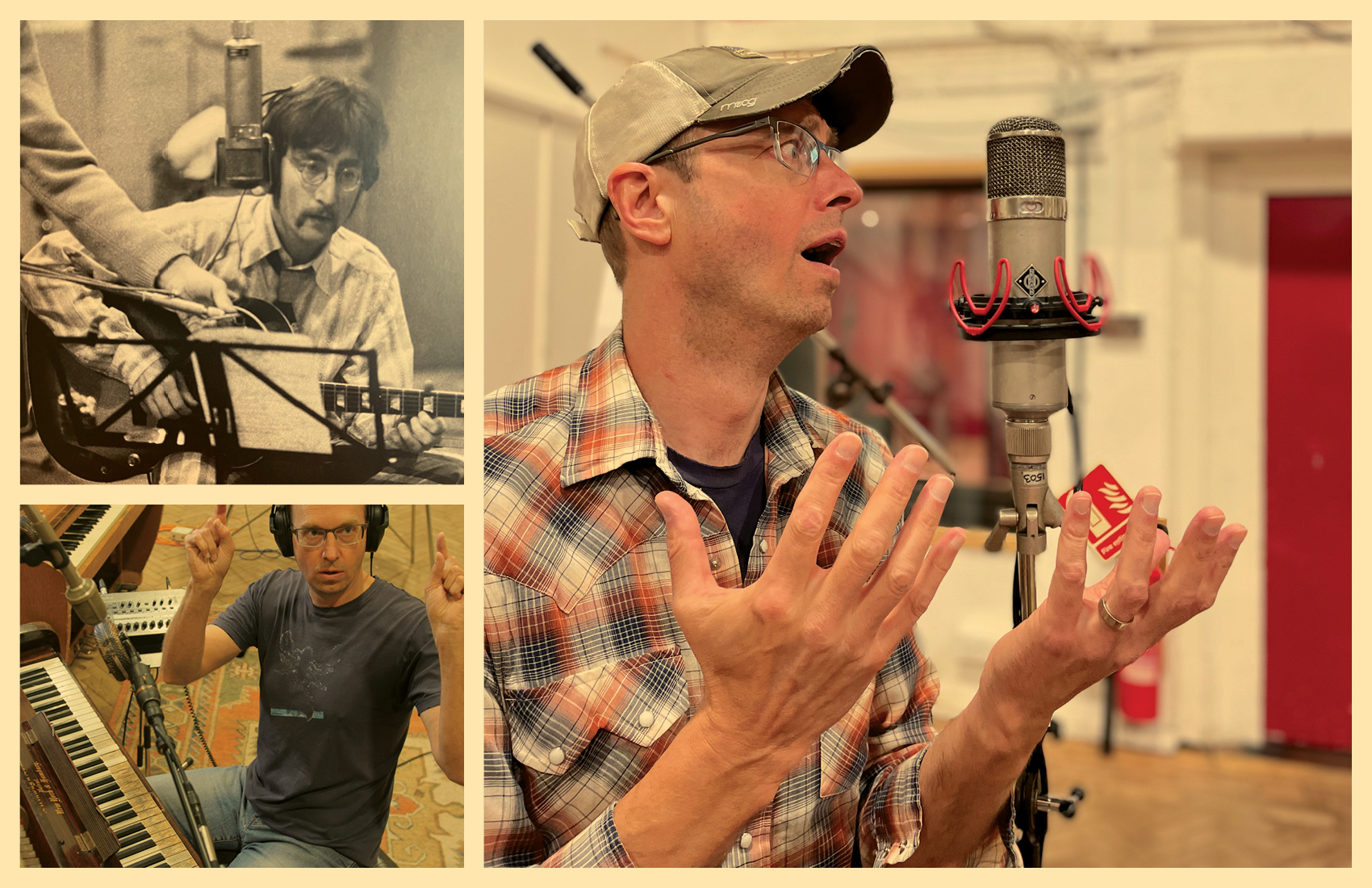
Your songs have a remarkable blend of looseness, spontaneity, and accessibility. Accepting compliments can be challenging, but how do you feel about such a heartfelt compliment?
I’m so glad that some looseness comes across. I sometimes worry that modern recording techniques enable me to polish things too much. Being a longtime fan of bands like Guided By Voices and Pavement, I have a huge appreciation for keeping things raw and loose, without sacrificing melody. In the end, you want to serve the song above all else, while maintaining your distinct human spirit / touch / tone / feel. I guess I try to do that by playing many of the instruments myself, even when I know that there are plenty of musicians who might be able to play it better. Better isn’t always better. Unless you’re Steely Dan circa 1976.
The song “Never Could See Any Other Way” has a very “Beatle-y” flavor to it. Was that on purpose?
Absolutely. While in London for the Abbey Road session, I met fellow songwriter Nick Frater, who I’d invited to play keyboards at the session. A few days before the session, I mentioned an idea I’d had kicking around for awhile: wouldn’t it be fun to turn the run-out groove gibberish at the end of Sgt. Pepper’s Lonely Hearts Club Band into a full-fledged song? Knowing that Nick was a fellow Beatles freak, I figured he’d appreciate the audacity of “completing” an unfinished song by The Beatles. What I did not expect was for Nick to text me an iPhone recording that night of a possible chord sequence!
The next morning, over traditional English breakfast, I scribbled down a few lyrics. A few nights later, I met Nick at his home studio, and we blended our ideas together into a suitably 1967-era Beatles homage, with Nick playing Mellotron and Rickenbacker bass, and myself singing. It happened very quickly and easily.
From there, I took the recording back to my home studio in America, played some Ringo-esque drums, 12-string guitars, and enough psychedelic effects to fill the Albert Hall. Nick then mixed the song beautifully, while I put together the video. It was a fantastic collaboration, and a great excuse to have a little fun.
That said, we’re reeeeeally hoping that Paul and Ringo don’t sue us.
‘Christine McVie’ is not only a tribute to a brilliant songwriter and singer but also captures the essence of a Fleetwood Mac song. Could you tell us the story behind its creation?
I’ve wanted to pay tribute to Christine for years now, mostly because she’s a badass, but also because I grew tired of hearing the story of Fleetwood Mac often reduced to the drama between Lindsay and Stevie. Not to discount their contributions, but Christine’s songs are the ones I always return to.
The homage I wrote was almost a cross between “Hold Me” and Christine’s solo hit “Got a Hold on Me.” I knew that the production would offer the perfect excuse to pull out every Fleetwood Mac trick in the book, including Christine’s blend of electric and acoustic pianos (a combination of Nick Frater and myself); Lindsay’s innovative double-speed guitars and blazing solos (the latter of which was performed by my college friend James Nash); John McVie’s signature bass line (“dum, da-dum, dum, da-dum”); and Mick Fleetwood’s groove and trademark drum fills. It’s eerie and tragic that she passed away immediately after the song was completed. RIP, Songbird.
There’s a striking contrast between ‘There Was A House Here’ with its dark and eerie vibe and the following track ‘Goodbye,’ a sensitive ballad. Was this intentional to create such a collision of emotions on the album?
Indeed it was. Sequencing records is often an exercise in creating a good flow between similar songs. But another tool at a songwriter’s disposal is surprise and contrast. It’s important to keep people on their toes from time to time. Otherwise listeners can become bored and tune out. For the songs you mentioned, I felt it was especially important to give the listeners a soothing place to land after a fairly jarring rocker. Ahhhhhh.
The album’s artwork is captivating and would make a great t-shirt design. Do you think that the artwork for ‘Reverse’ is especially important to the overall experience?
As a graphic designer by day, and a musician by night, the marriage between music and visuals is extremely important to me. I’m proud of how the album cover turned out, as I’ve been wanting to return to the simplicity of hand-drawing for years now. I also wanted to embed as many references to the song lyrics as possible within the illustration. You’re not the first person to mention that it would make a good t-shirt design. I might have to print a few up if I get a few more requests!

Your final song ‘Footprints’ carries a strong emotional impact. As a listener, I resonate with it despite having adult children. Thank you for conveying those feelings so accurately in your music.
Much like my favorite living songwriter Ron Sexsmith, I feel like my first decent songs started arriving after I had kids. Since then, some of the favorite songs I’ve written have been inspired by them, including “Footprints.” I feel that life is too short to try to sidestep or otherwise “mask” vulnerable emotions, and there’s almost no better medium for conveying them than in song.

