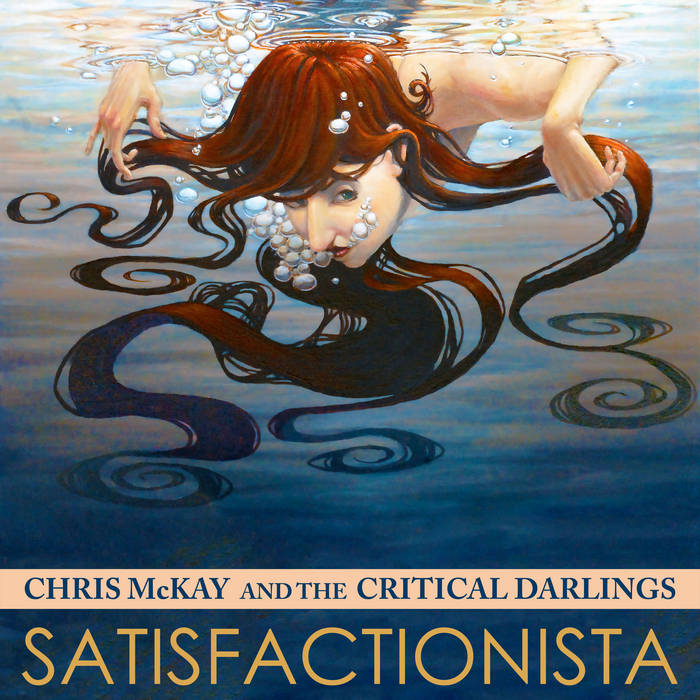
In recent years, I’ve delved into numerous Power Pop albums, keeping a vigilant eye on all the releases out there. Amidst this musical exploration, somehow Satisfactionista, a true piece de resistance by Chris McKay, slipped under my radar. It’s peculiar that this masterpiece isn’t a frequent topic among genre enthusiasts. I compare Satisfactionista to Marc Jonson’s “12 in a Room” because they both exude a classic, lost-in-time vibe with their exceptionally crafted songs deserving more recognition.
“12 in a Room” found its audience within the Power Pop community, appreciating its undeniable brilliance. Now, as I uncover Satisfactionista, I believe the time is ripe for this album to find a broader audience as well. Both albums are absolute gems and should be celebrated; it’s worth noting that Satisfactionista has recently been re-released on vinyl, making it a must-have for any music aficionado. I’m genuinely thrilled to have stumbled upon this hidden gem and to have the opportunity to experience its brilliance.
Could you share the journey of bringing this record to life? How did all the pieces come together to create the final product?
Hi, Patrick. Thank you for taking the time to talk to me and spread the word about Satisfactionista! I hope you’re enjoying the music.
After The Critical Darlings’ first album, C’mon, Accept Your Joy, and the shows that followed, it felt like The Critical Darlings were done. I began looking for a new project and met guitarist and vocalist, Joe Orr. He is the one who actually suggested that, instead of a new project, he would be interested in joining The Critical Darlings. With an extra guitar player and vocalist, it really expanded our options before the original pretty strict power-pop, and interest was rekindled all the way around. It took us a while to find the right drummer for the reinvigorated band, but when we did, it suddenly felt like it always should have. I thank Joe for keeping Frank and me in The Critical Darlings. Without him, there would be no Satisfactionista as we now know it.
Was there a particular moment or experience that struck you, signaling that you were onto something special with this project?
I’m a huge David Bowie fan. When I first heard the song “Aladdin Sane,” my entire sense of the possibilities within music was altered dramatically. The first time I heard it as a teen, I looked over to Amanda (my future wife) and said, “I don’t know who that piano player is or even if he’s still alive, but if he is, we will work together.”
It’s truly surreal to me that it actually happened, but getting Mike Garson to play piano on “Something Unseen” definitely blew the doors wide open. Originally, “Something Unseen,” “An Uncertain Flight,” and “Tonight Never Happened” were going to be on a solo EP since they didn’t really fit the original power-pop style and were a bit more epic. Once we got Joe in the band, though, we let the rules go, and when Joe and Frank heard how the songs were progressing, they suggested we fold them into the album, and I’m so glad they did.
Getting Mike Garson on piano also then led me to get David Barbe (respected producer) on board. He pulled in Drive-By Truckers’ drummer Brad Morgan for “An Uncertain Flight” and “Something Unseen,” which were the first two songs recorded for the album (the first and last songs on the official record, too).
Seriously, I say it often, but where else are you going to hear David Bowie’s most recognizable musician playing with a member of Drive-By Truckers?
When Mike sent me the intro to “Something Unseen” via email and I heard it for the first time, I nearly cried. I’d simply said something like, “I need a piano instrumental about a minute long that starts in B major and ends in D minor to segue between two songs.” I encouraged him to feel free to go all the way back into the feel of songs like “Lady Grinning Soul,” and he came back immediately with that gorgeous intro. I still can’t believe that came from a collaboration in which I was involved. With that, I knew we’d have something special even if no one else ever heard it.

The decision to seek opinions on your new songs is intriguing. When did you realize that external perspectives could contribute to your creative process?
Honestly, some of it was laziness and a way for the band members to not argue amongst ourselves. We had scores of songs and needed to cut them down to 12 or so. We each had our favorites, so we posted demos for everything on the album except “Something Unseen” (which couldn’t be demoed first), along with quite a few songs that may or may not ever be heard. We did voting averages by numbers, and darned if people didn’t come up with an interesting album that would have been significantly different from what we chose. For example, I really didn’t want “Give Up Town” on the record. I was also not very keen on “Scared Of Myself” or “Worms On The Pavement.” I thought some of the other songs were better. I really wanted a song of Joe’s called “Things Got Weird” to make the cut. I think we would’ve done a great job on it, but we all agreed, so we all bit the proverbial bullet and just went with it as is. I still say I was right about “Give Up Town,” though I don’t mind it now. I will readily admit that I was wrong about “Scared Of Myself” and “Worms On The Pavement.” Both of them wound up being live favorites. I don’t know if I would do another completely non-band-members-by-vote thing again, but I know it made Satisfactionista better, and it did keep us more determined and focused without having to worry about those internal disagreements about song choices.
What do you think of “Worms On The Pavement,” “Give Up Town,” and “Scared Of Myself”?
Success can take on different meanings as time goes on. When envisioning success for this new record, what does that picture look like now?
To me, success is about having people hear the music, enjoy it, and for that music to, somehow, make a moment better for the listener. That’s truly about it. If I were more pragmatic, I’m sure I would’ve been more successful on a monetary level, but, for me, it really does come down to the beholder. If the beholder loves it, it’s a success.
I wish it were easier to get the word out there so more people would hear it, but I’m grateful for every person who has tuned into the record and enjoyed it, and I’m glad it’s getting looked over and heard again now.
Within this collection, do you feel that the best song you’ve ever written finds its home? If not, what distinguishes this record’s essence from your prior work?
No, I can unequivocally say that the best song(s) I’ve ever written are not on Satisfactionista. I can, however, say that, so far, Satisfactionista is the best collection of songs I’ve released to date. At the time of its original release, the album certainly would’ve had the best, but I’m honestly not quite sure which “best” that would be. The song I’m most satisfied with at capturing what was in my head versus what came out of the studio is “Sadder Day.” There was a song on the first album called “Phony” that was the band’s most popular live song, but, after Satisfactionista came out, it switched to “Sadder Day” pretty quickly.
As far as my best songs, I just hope my health allows me to release those songs that are waiting to be heard. I have my next album about halfway recorded, and, to me, it’s by far my best collection of songs. If each next record isn’t “the best,” I don’t know if I would bother to make the effort to finish it. Of course, getting a new album done these days is a bit tricky, but I’m really hoping that, sooner than later, those songs will be out there, and I hope you’ll hear ‘em and love them.
As an artist, the act of baring your emotions to the world is profound. Does this vulnerability come naturally to you, or is it a constant journey of finding comfort?
I wouldn’t call it “finding comfort.” “Sadder Day” is sad for me every time I sing it. It was inspired by the death of my father and came to encompass my Grandmother (who died just before Satisfactionista was released and was the reason I play music), an aunt who was struck by lightning and killed during the making of the record, my father-in-law who died right after the album came out, and, even further on, my best friend who died because he couldn’t get the medical care he needed because of the cruelty of the United States health care system. They’re all in “Sadder Day” for me. So it’s not “comfort” at a personal level. It does help if I know that a song reflects what someone else is suffering through and it helps them feel not so alone, but I always feel what went into the song.
That being said, I am pretty wide open emotionally so things are usually easy enough for me to express, even when those expressions may be uncomfortable for myself or others.
Defining a song’s completion can be elusive. How do you determine when a composition has reached its final, ready-to-record form?
I don’t know that a song is ever really done. It just gets frozen in audio amber in a recording studio at some time during the process and, generally, the songs keep evolving beyond that. Even meanings and motivations change for songs as time goes on, and I believe that’s something that happens with both the performer and the audience.
Striking a balance between experimental artistry and commercial appeal is a challenge. How do you navigate this dynamic within your music?
I do my best to ignore those rules. I tend to write songs with hooks, but I’m glad to veer off into something more experimental anytime the mood strikes. I believe some of that is evident on Satisfactionista. The first song even is, really, a mid-tempo ballad, but there are elements of dissonance, and while I hope “An Uncertain Flight” is easy on the ears, I also hope it makes the ears bend on occasion.
Can you recall the last instance when you felt the immediate certainty of having penned a hit song?
Nope, because I’ve never had the luxury of writing a hit song. There are songs that I believe would’ve likely been successful had they been released and promoted by The Music Industry Machine, but “hit” is a strong word for a kid who was raised musically by listening to Casey Kasem’s American Top 40.
On the other hand, I’ve certainly seen moments where a new song is being performed live and the lyric or the music will suddenly hit the crowd and there’s a jolt of a visceral emotion. That’s an incredible feeling of connection with the crowd.
Performing music before an audience holds a unique allure. What aspects of this experience contribute to the excitement and enjoyment for you?
Live performance has always been my communion. Whether I’m on stage or in the audience, for me, it’s about a unique environment where the artist and the audience become this single sprawling symbiotic creature where each influences the other. It’s been a while since I’ve been able to perform live, but it’s been about the only place where I’ve truly felt free and that I’m fully myself.
Among the compliments you’ve received, is there one that remains etched in your memory? If so, what made it particularly unforgettable?
Without getting into specific examples, any time someone tells me that my music changed the course of their lives for the better, that is the best possible compliment. What more could one ask from anything that one does in life?
Where do you see yourself situated within the broader landscape of the music industry? How do you perceive your unique role and contribution?
I see myself as completely irrelevant to the music industry. The industry doesn’t care about me and, so far, I’ve had no reason to care about the industry when it comes to my music. I could’ve gone with a small label to release Satisfactionista, but I didn’t want to cut back on the vision for a few extra dollars.
Looking ahead to the next couple of months, what exciting plans or projects are on the horizon for you?
I just want to be able to be healthy with my wife, my family, and my friends and be able to continue making music. I hope to finish the next couple of albums that I have already written and get them released in a way that I feel will do them justice. That’s the best possible future for me and doubly so if I find myself back on the stage and feeling that wonderful communion.
In the digital age, visual elements are intertwined with music. How did you approach the album’s visual aesthetics, such as album art and accompanying visuals? How do they complement the sonic experience you’ve crafted?
Well, I don’t really worry about the digital age for music releases. It just doesn’t speak to me. When I can, I do full production vinyl releases with art, photos, information, lyrics, credits, notes, and whatever else fits the project’s aesthetic.
Those who buy CDs or do digital downloads don’t really seem to be interested in the tangible qualities of it anyway, so I do it for the true vinyl fetishist that needs something beyond audio wallpaper to ignore. I try to put together a full experience with which one can interact. Of course, I do make digital downloads available, but, for current releases, those downloads come with the purchase of the vinyl with full art.
I’m actually surprised to see how many people feel the same. What I’m providing is expensive to make, it takes a long time, it’s hard to put together, and it’s a lot to ask for that attention from an audience, but if someone wants to really experience it? Well, that’s the only way they really can, in my opinion. I make it for the hardcore music lovers, and anyone else that wants to join in more passively is more welcome, but I can’t say I’m targeting them, if that makes sense.
I do try to make music videos for every song whenever I can. I don’t think they should be necessary, but, honestly, people listen more when there’s a visual. I’m trying to finish up videos for Satisfactionista so there will be one for all 18 songs. The goal is, at some point, to have an official album release party where people can watch The Film Of The Album and actually watch the record!

