The landscape of an innovative movement within Modern Power Pop is taking shape with more clarity. Bands are increasingly citing figures like Mo Troper or Tony Molina as their primary inspirations. It’s intriguing to note that their influences lean more towards Chris Bell than The Knack, showcasing the distinctive essence of this movement. This isn’t about straightforward accessibility; these records often take listeners on an exploratory journey rather than providing a comforting familiarity, akin to a plunge into the unknown rather than a cozy bath. Craig Heed from Miracle Sweepstakes also draws inspiration from Todd Rundgren and Brian Wilson, adding further depth to this evolving scene.
Be sure to catch ‘Ooh Ahh’ featured on the ‘The Best Power Pop of 2023‘ Spotify playlist.
Could you share the journey of bringing this record to life? How did all the pieces come together to create the final product?
Ian had a bunch of recording gear his dad left him, and the process of making Last Licks was essentially learning how to use all of it. The irony of our band is that Doug and Justin have both worked professionally as audio engineers, but Ian and I have never really graduated past four-track demos, yet it was Ian and I who recorded the bulk of the basic live tracks. Doug came out a couple times to Ian’s basement in Long Island and showed us how to set things up, and from there, Ian and I would meet up on weekends and try to record his drum tracks.
There were times early on where we’d think we got a really good performance, but when we’d email it to the rest of the band, it’d turn out the mic placement was off, and it’d be back to the drawing board. Justin’s suggestion to use two mics on the snare drum smoothed out most of those issues, though. Once we had the tracks for drums and my guitar, we’d send it to Doug and Justin, who’d add their bass and guitar parts, respectively. Justin got really into adding “bells and whistles,” too – lots of guitar textures, synths, and auxiliary percussion – and when he offered to mix the album, it was kind of a turning point. We were just able to spend so much more time making mix revisions than we would’ve, had we worked with an outside engineer. I think the mixing was really what made the album sound the way it does. On the raw tracks, you could tell we were playing in a basement, or that I recorded my vocals in my bedroom. But the final product sounds like a record.
Was there a particular moment or experience that struck you, signaling that you were onto something special with this project?
My thinking going in was that we probably didn’t have the technical know-how, recording space, or gear to get really good raw sounds, so for this to work, the sound of the record would really have to come together in mixing. So my idea was to finish a pair of songs first, get someone to mix them, and if they came out well, then I’d be confident that we could make a whole album this way.
I chose “Ooh Ahh” because it felt like a single, and “Let Something Happen” because I had a clear plan for how to track it, having Ian play his acoustic kit for the choruses, and this drum loop we sampled from his electronic kit for the verses. Once we finished tracking them both, they were mixed by Michael DiSanto, who came highly rec’d from our friends in the band Gorgeous. I was pretty happy with how they came out, and that’s when it felt pretty attainable to home record the whole album. We put out “Ooh Ahh”/”Let Something Happen” in summer 2022, and spent the next year or so hammering out the rest of the songs in Ian’s basement.
The decision to seek opinions on your new songs is intriguing. When did you realize that external perspectives could contribute to your creative process?
In recent years I haven’t really been sharing my songs with many people mid-process. I’ll show rough ideas to my girlfriend, and her opinion is pretty important to me, but I think I usually just hear what I wanna hear. If a song I didn’t think much of elicits a really positive reaction, I see it in a new light, but if a song I’m excited about gets a tepid response, my attitude is, you just don’t see the full picture yet, and I stubbornly keep working on it. I can think of at least a couple times where the latter has happened and I was vindicated in the end.
I’m a pretty thorough demo-er, I have a maxed out SoundCloud page full of them, and I used to send them around to friends whenever I had a new one I was excited about. But when we were making Turn Heel I noticed everyone was getting “demoitis,” where they were thrown off by the studio versions of songs because they’d grown so used to the demos. So partly because of that, I’ve played things a little closer to the vest.
Success can take on different meanings as time goes on. When envisioning success for this new record, what does that picture look like now?
I think the infrastructure to be a true left field success, like a Clap Your Hands Say Yeah or a Broken Social Scene back in the day, just doesn’t exist anymore. The Pitchforks of the world aren’t looking to pluck The Next Big Thing out of total obscurity, they’re chasing clicks by focusing on established acts. There’s viral fame, but I think most of the artists The Algorithm chooses generally still have more initial momentum than we do. You’ll see someone referred to as being obscure, and they’ve still got magnitudes more streams or followers or whatever than we do. We’re really obscure.
So short of someone with a lot of clout stumbling upon our music, liking it, and setting off some magical chain of events, I think it’s probably pretty difficult to jump from where we’re at now to any level of legitimate success. But I think the process of recording this album ourselves, and not being sure how it’d all turn out, lowered our sights to where it’s just gratifying to have even made something we think is good. So success takes the form of being proud of the music, grateful for whatever positive response our friends have to it, and being able to make another one.
Within this collection, do you feel that the best song you’ve ever written finds its home? If not, what distinguishes this record’s essence from your prior work?
I’d like to think the best song I’ve ever written is still ahead of me, but while it may be more grower than shower, I think “Nor’easter” is a strong candidate for best Miracle Sweepstakes song. I was really into “Before Meaning Comes” by Ian William Craig, and listening to a lot of Les Rallizes Dénudés, and wanted to write something that kind of combined the two, basically an ambient rock song. It’s the longest Miracle Sweepstakes song, and arguably the simplest– the chord progression is probably the most basic and ubiquitous one we’ve ever used. But I think it just works.
To my ears, it’s the one song of ours where if you put it on, it just colors the room. It’s got some of my best guitar tones, and really the first thing resembling a proper solo that I’ve played since “Private Disguise” off our first album. I’m pretty happy with the lyrics as well, they conjure pretty vivid, solitary memories – driving along Shore Parkway in Brooklyn, taking the LIRR – that encapsulate where I was at when I was writing all these songs.

Among the gigs you’ve performed, which one holds an indelible place in your memory and why does it stand out?
I used to work for a company that helped architects and engineers get their licenses, and one of our clients hosted an industry conference in Brooklyn that they wanted live music for. My boss threw our hat in the ring, and so we wound up playing the “cocktail hour” of the event in this big fabrication studio, where we were set up on the mezzanine level playing to the guests below. It felt like what I could imagine playing an Andy Warhol Factory party was like or something, except instead of it being some druggy bohemian loft, it was this corporate party.
We prepared a few covers to play, one of which was “The Killing Moon,” which we wound up recording for Halloween shortly after the gig. Towards the end of the set, we played our song “Bad Bee,” which has an extended noise breakdown that I feared had alienated the attendees. This was compounded by our next and final song, a cover of Radiohead’s “Creep,” during which I think I sang “fucking special” instead of “very special.” I worried we had offended the whole room, but when we came down from the mezzanine, everyone we talked to said they loved it. It was a great one-off experience, and we’ll probably never make that much money from a show ever again.
Striking a balance between experimental artistry and commercial appeal is a challenge. How do you navigate this dynamic within your music?
I wrote a piece for Talkhouse about what I called “the Goldilocks Zone” between accessibility and experimentation, and how I think the most compelling music toes the line between the two. Last Licks is our most experimental album in a literal sense– so many of the songs came out of experimenting with new methods and ideas. But every song has a pretty strong melodic sensibility, and as a songwriter I always try to give some payoff to justify the weirdness. The flipside is that whenever I offer up a killer hook or big chorus, I use it as carte blanche to do some weird self-indulgent stuff right after. One for thee, one for me…
If tasked with introducing your music through three songs, which ones would you choose and what story do they collectively convey to new listeners?
The guy who we were initially recording Turn Heel with wound up ghosting us, but while we were recording “Maker’s Script,” he was like, “you know, I really don’t know who this song sounds like.” He eventually landed on Queen, which was awesome, because it definitely doesn’t sound like Queen. But he was this hotshot Brooklyn producer guy, so he definitely knew a lot of music, and it was cool that we’d made something he thought was truly original. I’ll go with that one, but since it’s a little jarring and abrasive, I’d probably first lead with “Shoot the Blue,” which has been a staple in our sets since I wrote it, and is the one song that randos in the crowd respond to. It’s got one of my best choruses, a cool chord progression and structure, and I really like the production and arrangement.
For track three, I’ll pick “How True” off the new album. It came together so effortlessly despite being such a departure from what we’ve done previously, and I’m really happy with it. I think if someone showed me a band with these three songs, I’d be really excited that a band like this exists. And feeling that way is really all you can ever hope to get out of making music.
Among the compliments you’ve received, is there one that remains etched in your memory? If so, what made it particularly unforgettable?
Around the time Rorschached came out, I met this dude at a party at Justin’s old apartment who asked what band I played in, then busted out his phone and followed us on Instagram right there on the spot. I’d keep seeing him around, and he’d be really friendly but keep saying, “remind me your name again? Right– Miracle Sweepstakes! I follow you guys, been meaning to give it a listen!” It was this funny and illuminating microcosm of how many impressions it takes for someone to actually check something out.
Eventually, I’d see him and he’d be like, “love your guys’ stuff, man!” It all culminated with running into him and his girlfriend at a show at Baby’s All Right in Brooklyn, maybe a couple months before COVID. He introduced me by saying, “you gotta check this guy’s band out– Miracle Sweepstakes. They’re like, the Beatles of New York City! No one is doing what they’re doing!” But before I could blush, he continued, “And the craziest part is, NO ONE knows about them! They have NO fans!” It’s still my favorite thing anyone’s ever said about me and my music.
Studio moments often hold a touch of magic. Could you recount an instance that stands out as the most enchanting during your creative process?
Probably the opposite of enchanting, and this is more Ian’s story to tell than mine, but during the recording process a raccoon broke into Ian’s basement and had babies. She basically just squatter’s rights’d the place, and we couldn’t record for several weeks while her and her kits were down there. Eventually the authorities apprehended them, and took them all to some raccoon sanctuary or something. I just know they had to be taken at least 18 miles away from the house, otherwise they’d find their way back. Luckily, none of our equipment was destroyed.
Where do you see yourself situated within the broader landscape of the music industry? How do you perceive your unique role and contribution?
I wouldn’t consider us a part of the music industry since we don’t make money doing this, but whenever I send our stuff out I feel like we’re in kind of a sonic no man’s land. There are bands that sound like a perfect fit for a certain label, or bill, or that fit cleanly in a certain genre or scene, and we don’t. I’m proud of that on an artistic level, but I do think it makes it harder to connect with people.
Most music listeners are casual listeners– they don’t care how unique or innovative something is, they just want something they can put on and enjoy. So if something sounds familiar or is easy to get into, that resonates with people. The bands I’ve known who’ve gotten some level of success almost always involved people who used to be doing something more interesting, and when those projects didn’t go anywhere, they started new ones that were more on the nose, and those were the ones that connected. In fairness, they’re almost always done very well, so I do think execution matters. But listeners haven’t had to work for music in a long time. There’s no modern equivalent to buying a CD and having to learn to like it, and so I think acquired tastes are less of a thing now. If you can make someone say “this sounds just like Big Star!” that’s good enough for them. There are a million shoegaze or emo or post-punk bands who all sound interchangeable, and they’ve all got more going for them than we do. But there’s only one Miracle Sweepstakes.
With the record completed and the music released, do you believe the pinnacle of enjoyment has been reached, or is this just the beginning of an exciting phase?
I think the dopamine rush you get from an album is probably at its highest right when the music is released, because social media has poisoned our brains and that’s when you’re getting the most likes and whatnot. That stuff fades quicker than ever now, as music is increasingly worthless and disposable to people.
In terms of personal enjoyment of my own music, I think that’s at its highest once there’s some distance. Revisiting past albums with a fresher set of ears, once I’m no longer living and dying on how well I think they came out, I find I can enjoy them for what they are a bit better. The little imperfections or things I could’ve done differently still sting, but that’s life when you’re crazy.
Looking ahead to the next couple of months, what exciting plans or projects are on the horizon for you?
Not sure when this will run, but we’re playing a release show for the album on November 4th at Unruly Collective in Brooklyn, with Street Missile, Pleaser and Jeremy Good Job. Beyond that, we’re working on a video for “Bad Bee” that we’re pretty excited about. We’ll hopefully have more shows in New York, and we were trying to set up a little weekender in Boston.
Justin and I also have a band called Hit with our friends Charles and Cameron, and we’ve got an album in the works for 2024. It’s kind of like noise rock meets the Byrds. I just started working on a new, sort of conceptual Miracle Sweepstakes song project that I haven’t even told the rest of the band about yet.
How would you describe the evolution of your sound in this new album compared to your previous works? Were there intentional shifts in style or themes?
The biggest new element is Justin– he joined just after we finished tracking Rorschached, so while he’s been in the band for years now, this is the first album to feature him. He has so many great parts that I either wouldn’t have thought of or couldn’t have played– the sweep picking at the end of “O-Pine,” the almost neo-classical-meets-country leads on the choruses of “Bad Bee.” Even parts he lifted from my original solo demos are reinterpreted in such a next level way. My demo of “Last Licks” had this spooky, atmospheric overdub on the choruses that Justin took and turned into this mammoth riff that sounds like a dinosaur or something. It’s so huge it spills into the second verse, and it totally makes the choruses pop.
The other big thing was our approach to the drums. For “I Try” on Rorschached, Ian played his sampling pad instead of a traditional kit. We expanded on that for this record, using the pad as well as Ian’s electronic kit, and worked on arrangements where maybe one section of a song would be a sampled loop, and the next would be real drums, or the two would even overlap. “Rectangular Eclipse,” “Let Something Happen,” and “Nor’easter” all feature that approach.
We took things even further on “How True,” where the whole song is built on samples and MIDI tracks– we barely even play on it ourselves. It’s an approach I’d like to explore more on the next thing we do.
With this fresh collection of songs, how do you envision connecting with both your existing fanbase and new listeners? Are there specific emotions or messages you hope they’ll resonate with?
As we were working on the album, I realized there was kind of a linear narrative in the track sequence. It starts with “Last Licks,” which is this urgently pessimistic song, and ends with “All This Way to Come Back Now,” which is triumphant and almost anthemic, and kind of saying, “who cares about now or never?” Musical attention spans are nonexistent at this point, but I hope the album as a whole resonates with listeners because 1) I think it’s a pretty immersive listen taken in full and 2) “All This Way” is probably the catchiest song on the record, and I don’t want it to be completely buried.
In the digital age, visual elements are intertwined with music. How did you approach the album’s visual aesthetics, such as album art and accompanying visuals? How do they complement the sonic experience you’ve crafted?
The visual component to our music is almost as important as the music itself to me, and I spend a lot of time thinking about what the music looks like and how I can capture that. I do all the artwork for the band, and before this record, the through line for most of it was this loose sports team aesthetic, where we had a big MS logo and this tequila sunrise color scheme. My friend Alex Gowing, who’s done the layouts for the physical runs of all three albums, made it based on a sketch I did, and I created all these drawings that were kind of like the Warhol-Basquiat collaborations, where I was basically defacing Alex’s clean graphic design work with all these wild gestures. Turn Heel and all our early singles featured some iteration of that, and while we moved away from it a bit on Rorschached, there’s still the big yellow “M” in the foreground.
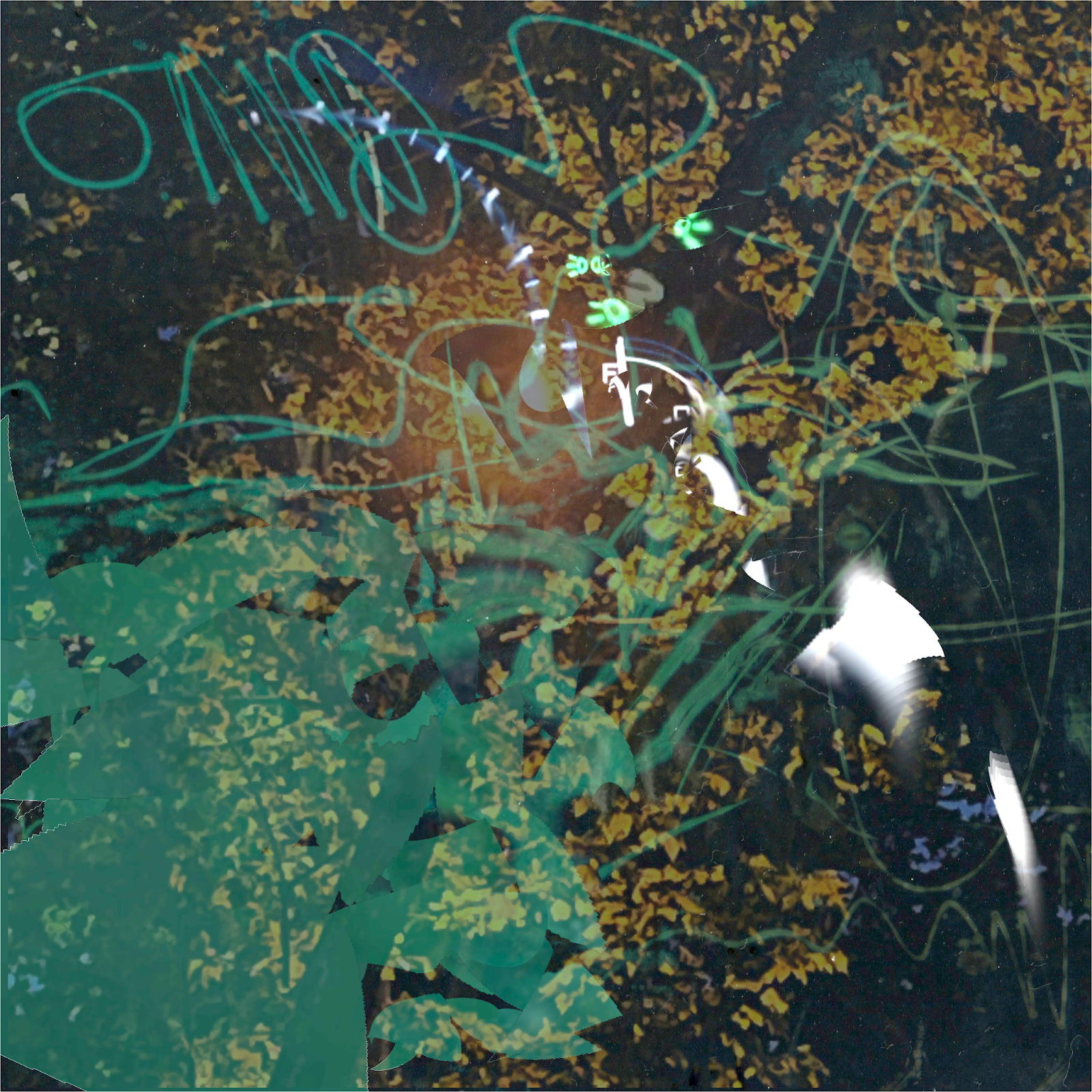
For Last Licks, I wanted to break from all that while still preserving the kind of abstract expressionist aesthetic. I had this weird little neon drawing tablet that had these random scribblings on them, and part of it looked vaguely like the handwritten Miracle Sweepstakes “M.” The colors also matched the darker sounding material we were working on– no yellow. I knew I wanted to overlay that with a screenshot I took from this dumb video I posted on Instagram, which was just of the lit up dashboard of my mom’s minivan while I sheepishly asked people to come to whatever show we were playing. I just thought it was a cool, stark image, and kind of reminded me of Ghost in the Machine by the Police.
I put those together and felt like it was still missing something, so I took some pictures of the street lights illuminating the trees across the street from my apartment, and layered those in as well. I just felt like the record had this dark, autumnal vibe, and even though it was June at the time, the pictures just had the right foreboding, nocturnal quality. I messed with it in Gimp until I felt like I had the definitive version.
I took a similar approach to the visualizer I did for “Rectangular Eclipse,” which was all just footage I got on my phone at Coney Island after a Brooklyn Cyclones game. It’s all double exposures and extreme zooms to get a lot out of a little, but the idea is the same– trying to convey the visual textures and palettes that are intrinsic to the songs.

