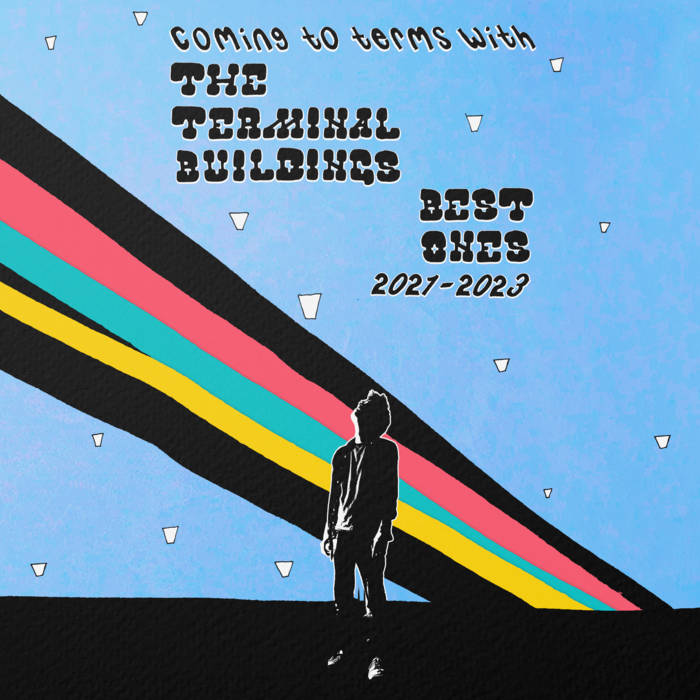
Presenting ‘Coming to Terms With the Terminal Buildings: Best Ones 2021-2023,’ a new ‘best of’ compilation capturing the favorite tracks from the past couple of years. Crafted in a Glasgow flat, these songs draw inspiration from the likes of Mo Troper, Tony Molina, Big Star, Teenage Fanclub, Guided by Voices, and Martin Newell.
Finlay explains to Sweet Sweet Music blog what this compilation is about.
Could you share the journey of bringing this record to life? How did all the pieces come together to create the final product?
Some of these songs were originally written 2 years ago, and some as recently as July, so in that sense, it took a long time to come together, but it wasn’t planned like that. The last time I put a compilation out it covered the period 2018-2020 and felt like it wrapped up the first chapter of the Terminal Buildings. This year, I again came to a point where I’d stopped writing songs for a while, so I thought it would be nice to take a retrospective look at the music I’d made from 2021 until now. Once I’d decided to do it, choosing the songs was quite easy, and it came together quickly. As a kid, I had a lot of ‘greatest hits’ collections on CD, and I still have a soft spot for the compilation format, so it was fun to revisit that.
The decision to seek opinions on your new songs is intriguing. When did you realize that external perspectives could contribute to your creative process?
It’s kind of a cliché at this point, but for the last 5 years or so, I’ve been writing and recording as the Terminal Buildings just for me, and I’ve pretty much kept it to myself. I hit a big birthday recently and thought, why not put some songs out there a bit more? This is what I’ve spent a lot of my free time working on, so it seems weird not to share it.
Success can take on different meanings as time goes on. When envisioning success for this new record, what does that picture look like now?
I just think it is nice for someone to listen and ‘get it’, like “I can tell what you’re trying to do here”. Even if they don’t like it! It’s good to take part and try your best and for other people to recognize that.
Within this collection, do you feel that the best song you’ve ever written finds its home? If not, what distinguishes this record’s essence from your prior work?
There have been a few times when I’ve written something and thought, “This is easily the best thing I’ve ever done”, but I usually change my mind when the next one comes along. I have tried to be quite brutal with the tracklist – normally, I have a pretty lax quality filter because I find it hard to discard a song if I’ve spent any time on it, and I feel like I never know how it’s going to turn out until it’s finished. With a ‘best of’, I have forced myself to be picky!
Defining a song’s completion can be elusive. How do you determine when a composition has reached its final, ready-to-record form?
That’s still a mystery to me, but I like to write short songs, so they tend to reach a natural stopping point quite quickly. I haven’t played any of these live to an audience, but in other bands, I’ve felt parts evolve the more they’re performed and the recording being a snapshot of that, so with the Terminal Buildings, they are often recorded in a relatively juvenile state. Sometimes, it’s a challenge to know when to stop tinkering with a song – although eventually, I’ll start to get bored, and then I just have to make peace with it and let it go.
In putting this collection together, I’ve found my favorites are often the ones that were quickest to write, which is kind of annoying when you’ve sunk more time into a tune, and it doesn’t turn out that good.
Striking a balance between experimental artistry and commercial appeal is a challenge. How do you navigate this dynamic within your music?
I’m usually trying to write very poppy songs, and I don’t think there’s much about them that is particularly original, so anything that sounds experimental is probably a side effect of my recording methods. It’s music that aspires to fit a certain model for a “hit” but has absolutely no commercial appeal whatsoever – this reminds me of Michael Chabon’s “Tragic Magic” article on power pop, which I think suggests that commercial failure is one of the key features of the genre. This is also touched upon in Mo Troper’s article “Power Pop Is Camp“.
Lyrics often carry profound meaning. Are there particular lines you hope listeners will always remember from your songs? If so, what’s the significance?
This is a bit of a cop-out, but no! I’m a big fan of lyrics that are simplistic and silly or that are so earnest as to be a bit corny. A lot of the songs do have personal meaning or genuine sentiment behind them, but most start with a line that I just think is funny or catchy. I’m mostly interested in the lyrics flowing or sounding good, so they don’t always stand up to close interrogation. ‘Struck Me Down’, in particular, has some pretty dodgy grammar.
Studio moments often hold a touch of magic. Could you recount an instance that stands out as the most enchanting during your creative process?
I record almost everything in my flat, so in terms of “studio magic,” it’s slim pickings. Some of my favorite creative decisions have been borne out of laziness. To take ‘Cruel World’ as an example, I recorded two versions of the guitar solo, intending to choose the better one, but in the end, I just left them both in to fight over the top of each other. And now I think that’s an important aspect of the song because it makes up for other songs that don’t even have any guitar solos.
How would you describe the evolution of your sound in this new album compared to your previous works? Were there intentional shifts in style or themes?
Something I like about this collection is that there is a big disparity in fidelity between the songs. You have some of the cleanest recordings that I spent a lot of time on in 2021, recorded with a full drumkit and loads of takes, and then there are some I recorded on my phone or on my old cassette recorder. So it roughly charts when I’ve had more and less time to spend on production, and I guess you can track that through the lyrical themes too. I hope that it gives the whole thing kind of a collage feel.
In the digital age, visual elements are intertwined with music. How did you approach the album’s visual aesthetics, such as album art and accompanying visuals? How do they complement the sonic experience you’ve crafted?
In the last year, for reasons of efficiency and pragmatism, I have cut down my whole music-making process to the point where I’ve recorded songs entirely on my phone, and I’ve been doing the same with the artwork. As with the music, I do all the cover art myself, and I like combining hand-drawn elements with digital collages. That approach has stayed fairly consistent, but for this one, I spent a lot more time on it, and I’m pretty pleased with how it turned out. I took specific inspiration from other album covers (especially ‘Now’ by Kim Jung Mi and the Cribs’ debut album), and I even hand-drew my own fonts, which I really enjoyed doing. I might quit music and just do fonts from now on.

