2026 keeps looking more and more like the year of the Power Pop resurrection, Bandcamp is writing about it, Shindig! Magazine is writing about it, and I can’t help myself, I need to list the Power Pop albums I have been listening to the first nine months of the year.
A few of these reviews started life over on Chiming Back, back when that was still where I kept my notes on this stuff. That blog is done, but the records aren’t, so those write-ups found a new home here instead.
So no, this isn’t a ranking, and it’s not trying to be definitive or comprehensive. It’s a batch of albums I genuinely can’t stop playing, offered up for no better reason than that I love this genre and these are the records currently proving why. More than twenty of them now, as it turns out, once I actually sat down and counted.
Make of that what you will. Here they are.
Lex Bauman: The Dangerous Game
The punch line of Sweet Sweet Music Blog is “Let’s Put the Power Back in Pop.”
And if you don’t know what that means, please listen to Lex Bauman’s new album, The Dangerous Game.
Better yet: put on the classic debut albums of The Beat and The Romantics, and then The Dangerous Game.
It will take you as high as a Power Pop kite can go.
It took me to a height where, as a 56-year-old, I honestly thought “While We’re Still Young” was about me.
Music City: Welcome to Music City
After one listen, “Pretty Feelings” already feels like a song that’s always existed. Not just because the melody slips into place so effortlessly, or because its themes are timeless, but because it carries itself like a hit, in the same way Adam Schmitt, Matthew Sweet, Fountains of Wayne, or Teenage Fanclub made hits in the ’90s. Instantly familiar. Effortlessly melodic. Impossible to resist.
Music City’s immaculate pop sound, strong enough to invite comparisons to The Lemon Twigs or Mod Lang, yet clearly its own, has therefore, perhaps conveniently, been described as part of what Shindig! Magazine calls the revival of the Third Wave of Power Pop. It’s a helpful tag, but Conor Lumsden’s songwriting reaches beyond neat categorization. The Irish-London songwriter draws as much from the shimmering brilliance of ’90s power pop as from its ’70s architects, The Raspberries, Big Star, and the rest of that sacred lineage.
And then something quietly remarkable happens: “Pretty Feelings,” which at first feels like the song, becomes just one great track among eleven others. Welcome to Music City doesn’t lean on one obvious single. It thrills because of its consistency, because of its depth of craft.
If we don’t collectively catch on, this record has all the ingredients of a future cult classic, the kind whispered about in the same breath as Phonograph or 12 in a Room.
Mod Lang: Borrowed Time
Mod Lang are a four-piece out of Detroit who channel the melodic rush of The Raspberries, the aching jangle of Big Star, and the John Lennon side of The Beatles, and somehow make it feel like it belongs firmly in the here and now. There’s nothing self-consciously innovative about what they do. Instead, they chase something far more elusive: the perfect pop song. Not as an exercise in nostalgia, not as museum rock, but as a living, breathing pursuit.
This is retro without kitsch. No wink, no quotation marks, just heart, hooks, and a belief that chiming guitars and skybound choruses still matter.
“What I Can’t Have” and “In Advance,” the opening one-two punch of Borrowed Time, take things to another level entirely. The confidence. The momentum. The sheer exhilaration. These songs don’t just sparkle, they surge. Long live Mod Lang.
The Goods: Goodbye Summertime
Goodbye Summertime is the follow-up to Don’t Spoil The Fun, one of my favorite records of last year, and it builds on everything that made that album so good: instantly gratifying guitar pop with melodies that grab you right away, but an emotional depth that only opens up the closer you listen.
Rob Good’s lyrics are the heart of it, direct, honest, unafraid to sit in vulnerability. The title captures a very specific kind of bittersweetness: change that hurts a little even when it’s leading somewhere better. “Wing” is the rawest moment on the record, written fast and recorded just as fast, in the middle of feeling it. “Ginger Rose” pushes Good into an unexpected falsetto that adds a whole other emotional layer, and “Waiting,” just voice and guitar, proves that a song doesn’t need length to leave a mark. Sometimes the small moments carry as much weight as the big ones.
Bleu: Sargeant Pepper Grinder
On Sargeant Pepper Grinder, Bleu turns grief into something bright, melodic and deeply human. It’s both a tribute to friends who are no longer here and a celebration of the people, memories and small moments that remain, wrapped in the kind of irresistible melodies and harmonies that have always defined his songwriting.
What makes the record so striking is how openly it sits with two conflicting feelings at once, genuine sorrow and real joy, side by side, refusing to cancel each other out. Bleu produced and mixed it himself, obsessing over every detail, and it shows: this is a record built as a lasting, tangible tribute, and it never once slides into sad-sack territory.
Rob Bonfiglio: The Over Under
The Over Under is the kind of album that keeps revealing itself the longer you sit with it. I liked it immediately, but months in, it’s become one of those records I return to when I need to reset. Bonfiglio wrote, recorded and mixed nearly all of it himself, whittling down a batch of some twenty songs to the ones that carried real weight, and the closeness of that process is audible everywhere. “Need You Know” is the emotional core, quietly vulnerable and built around a riff with a Fleetwood Mac-ish pull; “More Pure Than Gold” is its sharper, angrier counterpart, more political and more urgent. Both come from the same instinct: write what actually needs saying, and trust the songs to find their own shape.
A View of Earth From the Moon: Rolled Over Like A Wave
A View of Earth From the Moon is Jonathan Fickes’ band, and ever since 2017 I’ve been endlessly returning to Closer to a Ghost. “One Thousand Miles Apart” and “Distance Runner” still find their way onto nearly every playlist I make. Despite the long gap between releases, Rolled Over Like A Wave delivers exactly what you hope for from a follow-up: razor-sharp yet instantly accessible Power Pop songs filled with vivid reflections on the past, on why those memories can still matter in the present, and sometimes the other way around.
But this is far from a purely melancholic or nostalgic record. “Every For Free” and “Looking Straight Ahead” sound like the voice of someone fighting for change, or simply trying to scrape together fifty bucks. The urgency that drives opener “Emerson and Henry David Thoreau” never fades. These are not songs casually tossed together. They are stories that clearly needed to be told.
Albums like this are what keep Power Pop alive, fresh, and relevant. And if I end up being the only person who prefers Rolled Over Like A Wave over the latest records by The Lemon Twigs or Uni Boys, I’ll gladly stand by that. Power Pop doesn’t need more ’70s soft-rock nostalgia to stay relevant. It needs conviction, edge, and a sense of purpose. Rolled Over Like A Wave has all three.
Mopar Stars: Official Researchers Of The NJ Devil
Mopar Stars are built to hit. The songs hit hard and the hooks stick fast, but underneath all that noise sits a genuinely sharp eye for the small contradictions of everyday life, good days next to bad ones, a little optimism curdling into bitterness, just getting by next to wanting more. Where the band’s earliest demos were buried in cassette murk, Official Researchers Of The NJ Devil opens the sound up: bigger, clearer, unpretentious, but still every bit as physical.
Songwriter N-A-O built these tracks to be immediately memorable and let the rest of the band find their own parts around them, and you can hear that trust paying off. This sounds like a band that came up through Hüsker Dü punk and carries that same Replacements-style restlessness, never forgetting how satisfying it is to hit hard. No surprise the first pressing sold out fast.
Stephen Egerton: I Think You’re Overthinking This
The title alone is good advice, and the record follows through on it. Ten songs from the Descendents/ALL guitarist that never once strain for effect. This is craftsmanship with personality, not craftsmanship for its own sake. The flow from one track to the next feels effortless, melodies stick without announcing themselves, and every so often a chorus lands with exactly the punch you didn’t know you were waiting for. Sometimes that’s all you actually need.
The Legal Matters: Lost at Sea
Lost at Sea is The Legal Matters’ fourth album. Keith Klingensmith, Andy Reed, and Chris Richards had already refined their signature sound on 2016’s Conrad. That was the record where I fell for their harmonies, and I haven’t fallen out of love since. Those voices intertwine so naturally, serving songs that carry a distinctly ’70s sensibility, where everything revolves around melody, craft, and the quiet grandeur of the composition itself. No excess. Just the song.
That devotion to the beauty of the song isn’t lost on Lost at Sea. But when you hear the bite, almost the venom, in the guitar on “Everybody Knows,” you immediately sense that something has shifted. There’s an urgency here that wasn’t as pronounced before. The world is boiling, after all, and perhaps a pure L’art pour l’art, a song for the sake of the song, approach no longer feels sufficient.
At least, that’s how it sounds to me.
And strangely, that evolution feels beautiful. Without abandoning their core values, those luminous harmonies, that reverence for melody, The Legal Matters push themselves into different territory. Maybe even more relevant territory. For days like these.
Jesus Christ Taxi Driver: Taxi the Rich
When I first heard “Have It,” the opening track from Taxi the Rich, I couldn’t share it with the Power Pop community on Facebook fast enough. It sounded like a song that could just as easily have come from The Knack as from XTC. Others picked up on echoes of Sloan’s infectious energy and the quirky brilliance of Panorama-era The Cars.
That same creative tension runs through the album’s remaining ten tracks. Along the way, Jesus Christ Taxi Driver also taps into the sharp-edged indie funk sensibilities of bands like Yard Act and Hot Chip, creating a sound that feels both familiar and refreshingly contemporary. It’s a remarkable balancing act, a band that seems to hold the future of Power Pop in their hands, even as they insist on calling themselves a blues band. Or a violent rock band. Don’t let them fool you.
Local Drags: Cool If We Split?
“Hell is in the doorway, blocking light,” sings Lanny Durbin on the highly punchy, melodic “Highbeams,” one of the standout tracks on Cool If We Split?, the new release by Local Drags on the excellent Rotterdam label Stardumb Records. Durbin masters the classic mix of dark lyrics with catchy melodies and sparkling guitars, delivering a power pop masterclass that not only stands out today for its quality, but would have triumphed just as proudly in the 90s, one of the genre’s heyday periods, thanks to its shared sense of urgency and vibe with the most beloved bands of that era.
If you’re a fan of bands like The Shazam and Splitsville, to name just two examples, you’ll recognize that same level of quality when listening to Cool If We Split?. I get the sense that Local Drags is flying under the radar, which is remarkable, because the catalog Durbin is building is outstanding, and Cool If We Split? is a new high point.
Daniel Romano’s Outfit: Preservers Of The Pearl
Like Sloan, Daniel Romano’s Outfit might just be the best band in the world right now, and Preservers Of The Pearl makes that case without breaking a sweat. This is a band completely in tune with itself, forged through countless live performances into something tight, instinctive, and utterly alive. Power Pop songs the way Power Pop songs should sound: to the point, energetic, dangerous, and catchy as hell.
Hurry: Zoned Out
Hurry’s Zoned Out carries that scruffy, hooky warmth that made Nada Surf so easy to love, but the Teenage Fanclub blood runs even closer to the surface, and not just because Gerard Love himself shows up on “Moving After You.” Ten songs in, nothing here is rushed or overworked, just guitars that jangle exactly as much as they need to and melodies that land without straining for it. It’s the kind of record that sounds effortless because the effort went into knowing what to leave out. A quietly excellent addition to the year’s Power Pop pile.
The Greenberry Woods: It’s All Good, Sugar…
Just under a year after Mobtown by Splitsville, the Huseman brothers return with It’s All Good, Sugar…, the latest album from their other band, The Greenberry Woods. It’s an equally pleasant surprise, because twelve good songs in a row is something worth stopping to appreciate, in a world where thirty-second snippets are apparently enough to make a hit.
Not here.
What you get instead is craftsmanship, melody, and a healthy dose of mischief. Pop music has thrived on that combination for as long as it has existed, and The Greenberry Woods make it sound as fresh as ever. It’s All Good, Sugar… could just as easily have been released in the 1990s, and within the world of Power Pop, that happens to be one of the highest compliments imaginable.
Timeless is another. It applies here too.
The Greenberry Woods sound like masters of melodic songwriting, effortless hooks, and the kind of album that reminds you why you fell in love with Power Pop in the first place.
Salieri & The Turnspit Dogs: The Katzenklavier
Corey Landis has built something genuinely singular here. Experiment and melody in a long-distance relationship that works. Wayne Coyne and Mark Oliver Everett are fair reference points, as much as the young Elton John is, but this is its own world, one where the jester holds up a mirror and makes you question what you thought you understood. A tour de force, an artistic and intelligent statement, overwhelming in its beauty and urgency.
Cut Worms: Transmitter
Transmitter is Max Clarke’s fourth full-length album as Cut Worms, produced by Jeff Tweedy of Wilco. I’ve been a fan for a while now, and the reason is simple: Clarke sounds like Paul McCartney paying tribute to Buddy Holly. In my world, that’s about as high as the bar goes. Vulnerability and bravado intertwined so naturally it feels inevitable, like they were never meant to be separated in the first place.
The Well Wishers: Expected Outcomes
“I like a lot of different kinds of music, but the songs I love most are usually torn apart by a guitar after about two and a half minutes.” That used to be my answer whenever someone asked what I was into. I’m not sure it’s still entirely true, and I’m not sure it happens on every track of Expected Outcomes.
What I do know is that the guitars take center stage throughout all eleven songs. The tone, the playing, the power chords, the seemingly endless stream of punchy melodies. It’s absolutely fantastic.
So if someone asks me today what I listen to, my answer would probably be: “I like a lot of different kinds of music, but the songs I love most are usually torn apart by a guitar after about two and a half minutes. And right now, I’m listening to Expected Outcomes by The Well Wishers a lot.”
The Jimmy C: Pretending To Be A Person
Fifteen songs, and Jamie Coghill goes absolutely all over the place with them, country-tinged one minute, seventies rock swagger the next, a stretch of quirky sixties pop, a detour into something almost proto-metal, and none of it apologizes for the whiplash. Diversity wins out over stylistic consistency at every turn, and it should be a mess, but it isn’t, because the one rule that never bends is that the song is king. Whatever genre Coghill is trying on, the hook always comes first. Criminally under-known, and a genuinely fun record to get lost in.
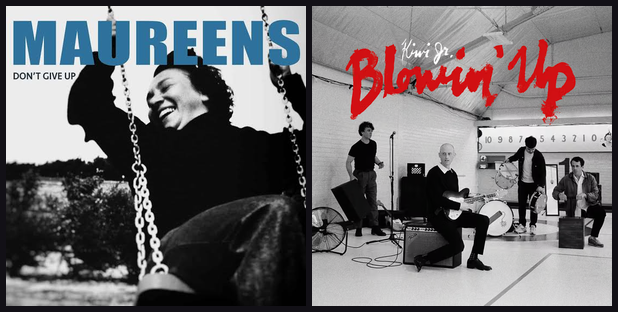
The Maureens: Don’t Give Up
The Dutch live music scene overflows with cover bands, while the airwaves are dominated by party pop sung by fresh-faced young artists celebrating little more than a night at the local pub. The Maureens are the antithesis of all of that. No trend-chasing, no pub anthems, no calculated appeal to radio formats, just classic songcraft, chiming guitars, and melodies rooted in the golden age of guitar pop.
Don’t Give Up contains thirteen tracks, one meticulously crafted gem after another. Handmade, thoughtful, deeply human. No grand statements, just sincere and personal stories told with warmth and precision, melodies that linger long after the album ends. It’s earned them a home on Spain’s Meritorio Records, which makes perfect sense: few places in Europe have championed Power Pop as consistently or as passionately as Spain.
There’s something bittersweet about that for Dutch music fans. The Netherlands has produced brilliant guitar-pop bands, Johan, Daryll-Ann, Moss, and now The Maureens, yet so much of it remains hidden in plain sight. Thankfully, I found them. I hope more listeners will too.
The Creepy Jingles: Against All Opps
Six tracks, no wasted motion, and a title that doubles as a mission statement. Against All Opps comes from a band that clearly couldn’t care less about trending. “You Don’t Trend” says as much right out of the gate, and instead the record spends its short runtime chasing hooks that stick on the first pass. Titles like “Throw Me in Some Rice” and “Funhouse Mirror” hint at a band with a sense of humor that never gets in the way of the songcraft. It’s a small, slightly odd, thoroughly likeable record, hidden in the sweet sweet melodic jangle jungle where it belongs.
Kiwi Jr.: Blowin’ Up
Four years after Chopper, Kiwi Jr. return with Blowin’ Up, and the Toronto band’s restless jangle-and-garage charm hasn’t gone anywhere. It’s just more open, more confident, more lived-in than before. That didn’t happen by accident. After years of moving from record to record without much of a break, the band finally let themselves stop, write, throw things away, and figure out what still excited them about playing together. Ten years in, they know each other’s strengths well enough to steer with more confidence and take a few real risks with arrangements and time signatures, without ever overthinking the process. Putting themselves on the cover for the first time feels like the right, old-school way to mark that shift.